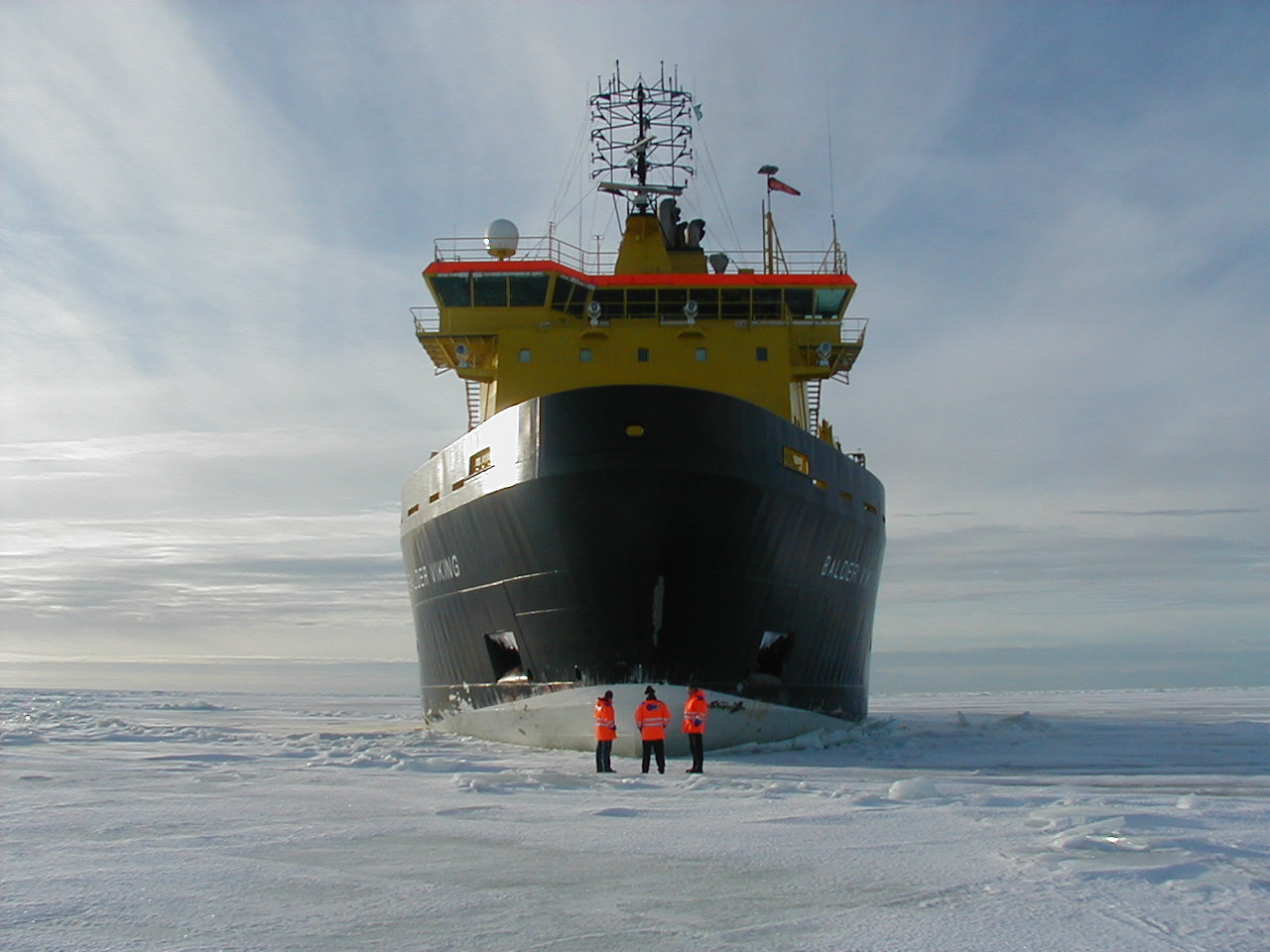
Back in the 1970s a Norwegian company known more for its colour scheme than anything else was Viking Supply Ships, whose craft were painted in black and yellow diagonal stripes. One, the Edith Viking featured on the first rig shift I ever went on in about 1977 and I was struck by its paint job. Later another of the company ships, the Ben Viking, was hired by a film company to take part in the movie “North Sea Hijack” which featured, in addition to the delightfully painted ship, the British actor Roger Moore (who died last Tuesday). If this was a film blog I would say more. Like many OSV companies Viking have had their ups and downs and in their lifetime have had other names, and for a while we thought that the striped ships were toast, so we were cheered when the Tor Viking II and the Balder Viking (Photographed in the ice by Bart Trondsen in 2004) arrived in Aberdeen in 2000. They were KMAR 808s, and only recently I reviewed the KMAR 404 probably as different from the 808 as chalk from cheese. They were designed in the marine architects house owned by Kvaerner, which had been Maritime Engineering and actually was to become Moss Maritime…but more of that company later. The first two 808s were followed in 2001 by the Vidar Viking. They were all constructed at Kvearner Leirvik and were intended to double as commercial anchor-handlers during the summer, and if requested, as Baltic ice-breakers during the winter, and in their icebreaker role they would be fitted with a V shaped extension at the stern, and a helideck in the middle of the main deck. The V shape would enable them to pull commercial vessels close up to their sterns, and then they would steam ahead breaking the ice and dragging the cargo ship behind them. As anchor-handlers they were provided with four MAK engines providing them with 18,300 bhp and 200 tons bollard pull and for the purposes of keeping them free of ice they were provided with pumping systems and wing tanks which could create a 10 degree list in 20 seconds. From the start they proved popular with operators and for all three to be together at any time proved to be a rare occurance (although captured on film by the author in Aberdeen in 2001). As well as working in the North Sea and the Baltic they have been out to Sakhalin and also to Alaska in support of potentially icebound exploration drilling. Today, in what might be described as an extremely competitive offshore environment they are still proving popular, the Tor Viking II and the Balder Viking currently being engaged in a North Sea rig shift, although the Vidar Viking is laid up, and may only be reactivated at the end of the year, one assumes in time to engage in icebreaking activities.
