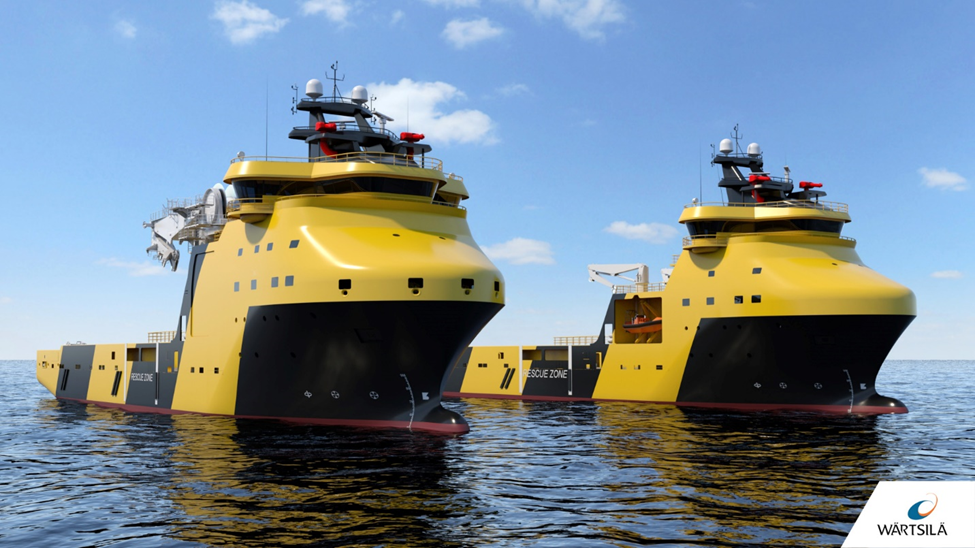
The future: VS Platform ships with dual fuel engines and an installed battery pack. Due in 2020 and 2021.
I recently attended a meeting at which people from various areas of British business presented their thoughts, and in the case of government organisations, that of the government, about decarbonisation of the offshore industry.
It was said that the British government would require there to be near zero greenhouse gas (GHG) emissions by 2050, and the Department of Business, Energy and Industrial Strategy has produced a “Integrated National Energy and Climate Plan” (NECP). This plan says that UK has already reduced CO2 emissions by 40%, and the “Climate Change Act” 2008 made it legally binding to reduce GHG emissions by 80% relative to 1990 levels. The UK Labour party suggests that if they were in charge they would ensure net zero emissions by 2030, and others have targets for the reduction of GHGs by 2035.
Well, I was naturally interested to find out what the IMO have said and regulated on the topic. And was surprised to find that the objective is that GHGs be reduced by 50% by 2050 and that in any case this rule did not apply to offshore vessels of any sort, or oil rigs or offshore platforms. Indeed even conventional craft only have to achieve the objective of reducing their GHGs by 50% and only vessels of more than 5000 grt have to monitor their fuel use in a Ship Energy Efficiency Management Plan (SEEMP). I must admit that the words are endless, and so I could be wrong about all this.
But on the other hand offshore vessels in the UKCS may be seen as part of the UK domestic operation no matter where they are registered, which would make compliance with whatever rules are applied ashore necessary, and this appears to be the case in Norway.
Anyway, at this meeting UK Oil&Gas suggested that there would not be any oil production taking place on the UKCS by 2050 and so the objective would easily be achieved – there would not be any offshore vessels operating. A man from UK Ports made a presentation saying that no UK ports would be doing anything to reduce the problem relating to GHGs. This because offshore vessels were occasional visitors to their ports and so it would not be worth making LNG bunkering or Cold Ironing available. They are obviously blowing smoke, and being totally unhelpful.
So in the end what could be done? As the lady from the Department of Transport pointed out, for ships to achieve the zero emission production by 2050 they would have to meet an intermediate number in 2035 (can’t actually remember what that is or find any reference to it), and in order to do this it would be necessary for new construction to take this into account.
But this is not all in the future, there are things happening out there now, particularly in Norway. Equinor, which used to the Statoil, once the Norwegian national oil company, has a new field starting up, Johan Sverdrup. It is powered by electricity from the shore and so they say that 620,000 tonnes of CO2 will be saved per year. It has been rumoured that they would also like visiting ships to be connected up to the shore power. There are other platforms connected to shore power as well. Of course there are those who would say that if the Johan Sverdrup field was not developed at all, not only would the 620,000 tonnes of CO2 per year be saved, all the GHGs produced by the product once it got out into the world would be saved as well.
But, assuming that we are to continue to use hydrocarbons, and that therefore the search for it and the production of it will continue until the earth has been sucked dry, there will continue to be a lot of objects out there potentially producing pollution in the pursuit of this objective.
In addition to the Norwegian use of shore power, offshore the oil companies are continuing to experiment with batteries and have a couple of ships with batteries installed, and in addition there are a number of ships in operation which can be powered by LNG. LNG as a fuel reduces the levels of emissions of all sorts, and there are currently a total of 143 ships in operation with a similar number on order; of these 17 are offshore vessels. We should remember that in UK no ports intend to make LNG bunkering available, but elsewhere there are probably nine bunkering barges available world wide, and some estimate that there will be a further 30 in service in the next few years.
There will, next year, be the requirement that ships will only burn low sulphur fuel or will have installed suitable technology to reduce emissions. This might not be a problem for offshore vessel or offshore installations, since all of them currently burn low sulphur fuel, and in the case of the platforms, some are fuelled by the gas produced during the production process.
Transocean recently announced that they have a battery installation on a semi-submersible, the Transocean Spitsbergen, working on the Norwegian shelf. And there are a number of ships also provided with battery power in addition to their diesel engines, more or less on an experimental basis. It is initially just a bit difficult to understand where the spare power to charge the batteries is coming from. In Formula One we can see that as the cars are braking for the corners the batteries are charging (lights flash) with the resulting power made available when required. But ships do not have this opportunity. It is said that the systems skim off excess power to charge the batteries, and that offshore vessels charge their batteries in the same way. The Transocean Spitsbergen is to be able to use the battery power gained to supplement the power used for the thrusters. One assumes that it is a DP rig. It is also said that a ship with battery power will be able to use one engine and the battery when on DP at an offshore installation.
Elsewhere the actual use of fuel on offshore vessels is beginning to be monitored on behalf of the owners. Ulstein have apparently installed some equipment called the “Blue Box” on some ships, and two Siem anchor-handlers have been provided with a fuel use monitoring system. So one assumes that someone back in their office will be having a look at what the ships are doing and phoning them up if they are using too much petrol.
It may be worth considering for a moment that none of the systems in use actually produce zero GHGs as required by the UK government by 2050, however the IMO objective of 50% reduction could be doable. And we should get it straight that despite the UK Oil & Gas being certain that there will be no oil being produced in UK by 2050, this is only thirty years in the future, and many of the fields from the 1970s on the UKCS, which had a twenty year life, are still producing.
What could we do now? We could use less fuel, without doing anything else. If the fuel used by offshore vessels was at the forefront of all operations there is little doubt that consumption could be radically reduced. Economic steaming is possible, particularly if those operating offshore installations plan better, and avoid hot shots, and when out there on the location fuel use could be minimised Typically the VS 491 with 27,000 bhp available, claims a fuel use of 12 tpd at 10 knots and 72 tpd at 18 knots. Back in the old days ships used to go to anchor when conditions were suitable, and carried a lot of anchor chain to make this possible, but the chain carried has been reduced as the use of dynamic positioning, and therefore the use of fuel, has increased.
Whether the ship is equipped with batteries or not there are probably techniques available to reduce the use of fuel on location. Although some may dispute this, it is probable that a manually operated ship with a skilled driver is likely to use less fuel than an DP ship, particularly if some sort of aides to positioning are provided, rather than the Mark 1 eyeball. After all, on the road drivers are provided with reversing aides in their cars these days.
All of the above are doable today, but if we get into blue sky thinking, I wondered if the current fleet of DP rigs might do better if moored, even in deep water and hence the fuel currently used for DP would be saved, and a knock on might be the less frequent visits of the support vessels. More extremely, could the moored semi-submersible be used as a basis for power being provided by ocean currents with the appropriate turbines? If a ship is at anchor out there, could it harness the environmental conditions to provide it with power?
But getting back to reality, back in the 1980s there was an oil slump – again – and as a result the operators became very interested in the fuel consumption of the vessels they were hiring, and fairly constantly monitored them. As a result they all became amazingly economical, some by really using less fuel and others by hiding some away and using it where necessary. It would be easy enough to look over the shoulders of those managing supply ships, and if this was done we would probably be surprised at the amounts of fuel saved, and the resulting reduction in GHGs. At least it would be a start.