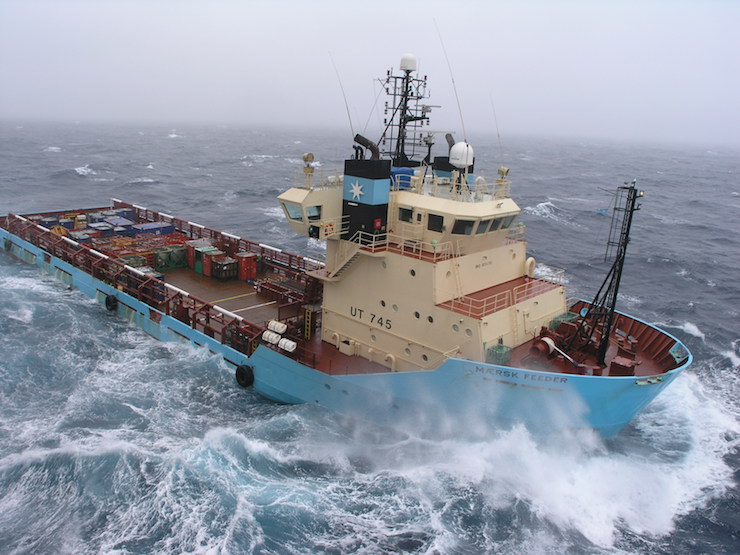
In the development of the European supply vessel it is not possible to ignore Ulstein, and the progress of the UT designs, or as we are finding out, the input of Maersk Supply who have been equally innovative in their approach to the operation of offshore vessels. So as the terrible effect of the 1985 oil crash was coming to an end, Maersk commissioned Ulstein to develop the UT 745. It was an enhanced version of the 705 and was a platform ship apparently capable of doing everything. The owners claimed that it could remain within the range of an offshore crane in 50 knot winds, and since most offshore cranes were required to shut down at 45 knots, this claim suggested that there were no conditions in which the vessel type could not operate. To achieve this stunning performance 4000 of its 7200 bhp could be channelled to its transverse thrusters. Interestingly this would seem to transfer the responsibility for operations in “marginal” conditions from the captain of the ship to the senior person on the rig or platform. So no longer would the captain be asked whether he would be prepared to go to work; if asked he would say yes, and the ship would close up with the object no matter what the weather. But would the OIM really want a 4500 tonne ship alongside in 45 knots of wind? Maersk also claimed that the UT 745 was able to pump liquids at 250 tonnes per hour and cement at 100 tonnes per hour, both delivery rates which would tax the pipework of many offshore installations. The first UT 745, the Maersk Fighter entered service in May 1992 to be followed by the Maersk Forwarder and the Maersk Frontier in the same year and the Feeder in 1993 (photographed offshore by the author in 2007) and by two further ships, the last, the Maersk Fetcher, entering service in 1995, all built at Ulsteinvik. Other owners also placed orders at other Norwegian yards for the type. Farstad built four between 1995 and 1999, Trico built five between 1994 and 2002 one of which was the Northern Gambler and Gulf Offshore built three between 1998 and 2002, which appears to be the last year in which the type was built. Of the original six Maersk ships the Maersk Fetcher was sold to Far Eastern buyers in 2014 and is now the Han Ji 2, the Finder was sold in 2016 and is now the Koray Bey, the Forwarder, Feeder and the Fighter were sold outside the offshore industry in late 2016. And surprisingly the Maersk Frontier, now 25 years old has just been awarded a year’s charter supporting the Gryphon FPSO.