TITANIC II - ANOTHER SHOT AT GETTING IT RIGHT
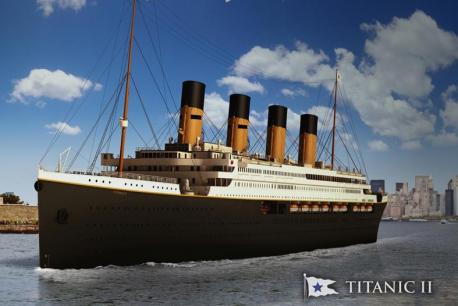
The Titanic II from the Blue Star Line Press Release
You could embark on a facsimile of the Titanic in 2016, according to a press release by Blue Star Line. The new ship is being being built in China and its first voyage will be from Southampton to New York.
It will have accommodation for 2435 passengers and 900 crew. The article about the ship which features in the April edition of the Nautilus paper, the Telegraph, states that it will be provided with 372 first class cabins, 206 second class and 257 third class. And very much against the modern trend in passenger ship design, the second that third class cabins will be as close to the originals as practicable. Does this mean that they will be pokey little spaces without sufficient room to swing a cat. Well, yes probably. I realise that I have just described the average ferry cabin.
The Nautilus Telegraph, being a union paper, also asked from what country the crew would be sourced. The reply was that the crew would be sourced from the “global community”. Good words, one suspects to convey the possibility that they will be crewing the ship as cheaply as possible.
Alan Graveson of Nautilus suggested that it might be a good time to action all the recommendations from the investigation into the loss of the Titanic, which was chaired by Lord Mersey. One recommendation still to be carried out says “ In order to facilitate an orderly evacuation it is necessary to improve the water-tight integrity with increased subdivision including the provision of two longitudinal bulkheads – extending from as far aft, to as far forward as possible. This would facilitate counterflooding…” I’m not quite sure how this would stand with angles of loll, but we live in a age when investigations take place, recommendations are made and then nothing is done.
MEMORIES OF MRS THATCHER
I write this on the day Lady Thatcher is being buried, and there are many words being spoken for and against her. I have a memory of going to see my MP who was a Tory, a couple of years after the Falklands War, in which numerous merchant ships were involved, to protest at the lack of government support for the declining British merchant service. Of course they did nothing and I believe they showed the shipping industry the way to become the cutthroat business it is today. I left the MP’s office, and he followed me out, to see me unlocked the driver’s door of a new bright red Audi Quattro. “So, nice car!” he said, obviously consigning my complaint to the “no action” bin.
EMMA MAERSK

What in 2006 was the world’s largest container ship is not the luckiest in the world. In early February it was well reported throughout the marine press that it had sprung al leak somewhere, which resulted in the engine room filling up with water. I was amazed at the spec of the engine by the way, a single 14 cylinder prime mover developing 108000 bhp.
Anyway, as it has turned out it seems that on operation of the stern thruster some sort of a seal leaked water into the prop shaft and from there into the engine room which flooded to a depth of 18 metres.
There-after the ship was rescued and put alongside in Port Said, and the 13,500 containers unloaded. Then one of the Fairmount ships, the Fairmount Alpine took it in tow and it ended up in Palermo, Sicily on February 25th, where repairs were being carried out. I had meant to feature the accident before but it was elbowed out by other events.
But as our photo shows, this is not the only misfortune to befall the ship. During construction the bridge caught fire, to the point that it was completely burnt out.
Fortunately the shipyard happened to have another bridge to hand and so was able to remove the damaged one and replace it with a new one.
This extremely large ship apparently supposed to be operated by a crew of 13 entered service in 2006 – it seems like only the other day. It was followed by a further 7 of the same class. Maersk have on order a number of 18000 teu ships and I think some of even greater capacity.
One assumes that they will be using the new London Gateway – see the next page!
THE MAERSK DETECTOR COLLISION WITH THE GSF GRAND BANKS

The Maersk Detrector in Aberdeen. Photo Victor Gibson
On November 24th 2011 the Maersk Detector collided with the third port side leg of the semi-submersible, GSF Grand Banks resulting in both vessels being holed, the rig in a void space and the ship in a drill water tank. There were no injuries, but never-the-less the Transport Safety Board of Canada carried out an investigation and their report was released on 9th April this year, hence its feature here.
I have read this report fully several times, and am still having a job to make sense of it, and if anyone else wants to have a look it is “Marine Investigation Report M11N0047”.
The ship is a modern Maersk design with about 18000 bhp available, an azimuthing thruster and a tunnel thruster forward and two tunnel thrusters aft, all of which can be controlled manually, by joystick or by a Kongsberg SDP 21 DP system. This is a Class 2 system provided with 3 gyros two consoles, multiple reference systems including 2 GPS systems, 1 laser radar system and 1 acoustic system.
The GSF Grand Banks is a thirty year old eight legged semi-submersible moored at the time by eight chains in a water depth of 122 metres (403 ft).
The accident took place during the afternoon of 24th November. The ship had taken up position on the port side of the rig at 0806, which was at the time was the lee side, and started work, and during the morning the ship moved off to allow the Maersk Chancellor to go alongside to do something.
The Maersk Chancellor went away and the Maersk Detector returned to the rig and took up position at 1330. The report says that the vessel moved into a position about 100 metres off in joystick mode and then switched into DP and edged into position about 15 metres off the rig.
During the period between 1330 and 1400 the wind veered from northerly to southeasterly, turning the lee side of the rig to the windward side. At that time there was discussion between the rig – the crane operator - and the ship – the master. They decided that they would keep going for the time being. The actual words in the report are “they agreed to stop when conditions became unsuitable”.
At about 1400 the relative positioning laser radar system was added as a third position reference for the DP system. And at about 1430 the heading had been changed putting the wind about 45º from the starboard bow.
At about 1445 the master took over as DP operator from the First officer (Navigation), who remained on the bridge observing the cargo work. (And now we get to some technical stuff about DP – outside my area of knowledge.) The master did a capability plot using a swell of 5 metres with positive results. No problems then. And the heading continued to be changed. But on the rig the crew were taking notice of what was going on.
The driller, having a cup of coffee, spied the ship through the porthole and called the BCO to say he thought it was too close! And the barge supervisor went out and observed it for 10 minutes. At 1510 the Husky rep called the ship and discussed the weather. It was collectively concluded that the operation could be terminated at any time by the master, if warranted by the weather conditions.
By 1530 the ship was heading due south head to wind, and the rig was about to load pipe at the stern. The swell was about 4 metres. The first lift of pipe was landed and during a series of five larger swells the ship began to move astern at about 0.4 m/s. Despite the fact that the master input an instruction into the DP to step forward 4 metres the ship continued astern and hit the leg. He said that he did not engage the manual controls because he was afraid of pulling the crane down, the hoist of pipe being on the deck.
After the contact the ship immediately moved off into its assigned DP position.
There is much more to the report, including stuff from the VDR – voyage data recorder - and the DP system. It struck me that there were 75 position/heading alarms once the ship was on the weather side, one every 1.2 minutes. There must have been a lot of button pressing going on, surely writing on the wall!
The report made some recommendations, the main one being that the crew should be trained in Bridge Resource Management. However they failed to determine why the ship had backed into the rig.
I have two ideas. When I was driving head to the swell I used to power the ship up the swells and then reduce the power as they passed. Can a DP system do this? The other is that rigs do move on their moorings. Was the rig oscillating and therefore confusing the DP system which had its laser system engaged. Read the report and give me a view which I can publish.
LONDON GATEWAY
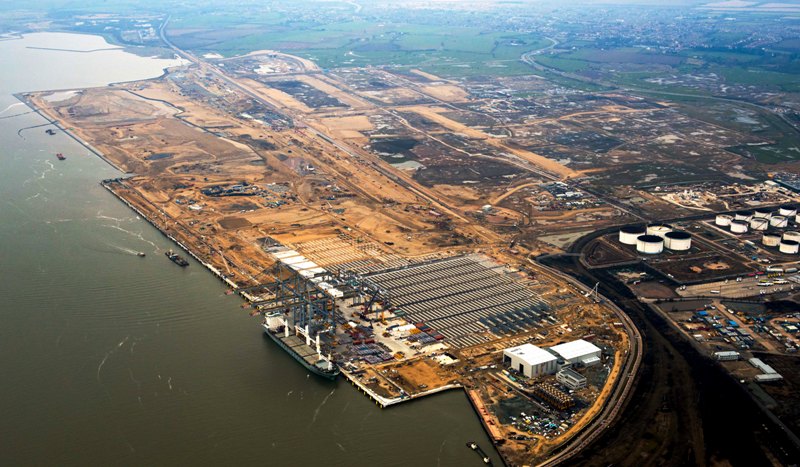
The London Gateway from the air.
You would probably have to be in that part of the business to be aware of the enormous port development taking place on the North side of the Thames seemingly just a bit down river from Thameshaven, which back in the day used to be a small refinery with an associated jetty for a couple of small tankers. Maybe it still is.
The new port is the London Gateway, and it will be capable of supporting six of the largest container ships currently no more than a twinkle in the naval architects eyes. They will probably have a capacity of 22,000 teus.
Much dredging has taken place in the approach, and maybe well down the river, because the Thames is not very deep, and even deeper alongside the berths, which indicates that probably they are expecting that at some point the ships will only be able to approach at certain states of tide.
How far away this is from the ships I described in the last newsletter which used to sail to distant parts of the world and then lie alongside, sometimes for weeks discharging and loading cargo, to the point that the crew almost became residents of the port. Even if you could get ashore in Thameshaven, would you want to?