CHRISTMAS WISHES
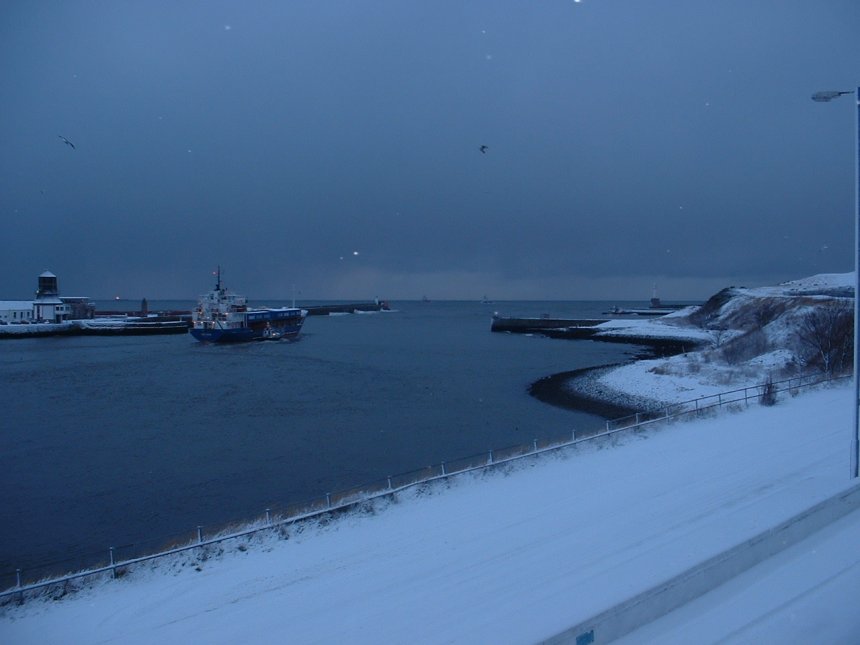
A snowy day in Aberdeen Harbour.
Since this is the last newsletter for 2012, it might be time to consider what we might wish for in 2013, those of us with an interest in all things nautical, and more importantly those of us still out there doing the job. So here are a few possible wishes in no particular order.
It is surely time that the IMO got a grip of ship registries. If a country wishes to host a registry they should be able to demonstrate the necessary expertise and organization which would enable them to train seafarers, examine them and award certificates of competency and not least carry out investigations into accidents.
I know we keep talking about it, but could we possibly make some progress towards treating shipmasters who have had the misfortune to be involved in groundings resulting in pollution in a responsible manner, and stop immediately accusing them of being criminals.
Could we review the relationship between the ship-owner and class. Is it right that the insurers of ships rely on the inspection processes carried out by the classification societies who are paid by the ship-owners? Hence of the ship-owner does not like what class are doing they can find themselves another.
Could we start to get real about risk assessments, and start to make them meaningful, ie, a means of keeping people alive and uninjured, rather than a means of arse-covering.
I realize that I could go on. There are many lesser wishes, which might help seafarers enjoy a relatively untroubled life, most of them to do with asking ship-owners to act responsibly, and while many do, there are probably more who do not, so we don’t have a level playing field.
ANOTHER WISH - SOME SORT OF CONTROL OF THE PIRATE PROBLEM
I have a look at the MARITIME BULLETIN on occasion, which is edited by Voytenko Mikhail and is in the main informed by the misfortunes of Russian seafarers. Sadly it is shutting down due to lack of financial support, but if it is able to continue there will be more stories of piracy on both sides of Africa. Last week for instance we learnt about the Myre Seadiver, a vessel manned by a private Russian security service, which has been arrested by the Nigerian authorities. The editor suggests that the reason is that it is a real security service, rather than something else, and cites the tale of the Bourbon Libery 249 which was attacked minutes after its hired locally manned security boat had gone away for some reason. 6 Russians and 1 Estonian were kidnapped, and then released after 2 weeks!!
NOROVIRUS

This winter vomiting virus is very unpleasant, and that’s even if you’re just reading about it. There is nothing worse that large numbers of people in a confined space who are unable to control their bodily functions. Hence the photo of the Oriana which made the news last week because over 400 passengers were suffering from the Norovirus, and their whole cruise and that of other passengers, one assumes, was spoilt.
I clicked on a link in Google and was taken to the Daily Mail website, now becoming notorious for its sensationalist approach to the news. So it was no surprise that the article included a photo of the Captain smiling at us over the telegraphs, probably taken on a happier day, but more surprising that at least one of the readers comments seemed to be directed personally at him. I don’t do Twitter, but I suppose if you do you must get used to people directing comments at you.
A couple of days ago the ship was preparing for a new 23 day Mediterranean cruise, and it made the news again. This time because during the cleaning of the ship, to eradicate the remains of the virus “the disabled passengers were left for hours in the terminal”. They really can’t win can they? And finally we have to remember that even the largest liners are still ships at sea. As usual we could say more!!
THE VOS SAILOR

The VOS Sailor when it was the Dea Sailor. entering Aberdeen
As we go to press (I’ve always wanted to use this phrase) the unfortunate VOS Sailor is being towed towards the North east coast of Scotland after being disabled in rough seas. The crew of the North Sea Producer an FPSO were evacuated to other installations as the drifting vessel threatened to collide with it.
At present the news about the accident is scanty, we only know that the ship was swamped by a large wave in high winds, and that one crew member lost his life. The reports say “sustained fatal injuries” so it may be that when the wave came aboard he was caught in its path in some way.
The eleven remaining crew members were winched onto a a Bond Jigsaw helicopter, and the winchman apparently sustained injuries to one foot while remaining on board to supervise the rescue of the crew.
If you look at the photograph of this vessel it may occur to you that this little ship appears to be unsuited to the task of going out into the Northern North Sea, and standing by some sort of installation which would appear to be better equipped for the environment that the ship itself. So it may be appropriate to look briefly at the history of the ERRV – or standby boat as they used to be known.
It was the loss of the Sea Gem in 1965 which resulted in the requirement that offshore installations of all sorts should be provided with a standby boat, and as offshore oil exploration increased the fishing industry provided the service using retired trawlers – side draggers – as they were known. These old ships were seaworthy, but ill suited to the task, mainly due to the lack of maneuvering capability. However, nothing changed until Piper Alpha (25 years ago next year) when the standby vessel Silver Pit, another side dragger, proved itself to have limited capability to take its part in the rescue. The ship was then 40 years old.
Lord Cullen said “I am entirely satisfied that in the above respects (Maneuvering capability) the Silver Pit was essentially unsuitable for the purpose of effecting the rescue of survivors”.
The code which was developed subsequent to Piper Alpha required among other things that standby boats should be provided with “a single screw and azimuthing thruster capable of producing a speed of four knots in the ahead direction or twin screw propulsion and a side thruster”.
The result of these requirements was that in addition to the traditional providers of standby vessels, usually former fishing fleet owners, a number of support vessel owners decided to get into the business either using older units from their own fleets or else going out into the world to find suitable second hand craft.
At least one owner specialized in checking out the bayous in Louisiana for suitable hulls, and brought over to Europe a number of traditional North American ships, had the necessary additional accommodation added on the deck and put them to work. Others used old Norwegian and British anchor-handlers, similarly putting accommodation on the afterdeck, adding the rescue craft and sending them to sea. The VOS Sailor and its sister ship the VOS Scout were built in Vancouver in 1981 as the Canmar Wigeon and the Canmar Teal, and were discovered by a Sealion superintendent laid up in the ice in Canada in 1991. Of course they met the essential requirements of the new standby vessel legislation. If one looks at their specification one might doubt that a 100 bhp bow thruster is powerful enough and wonder whether the 1700 bhp developed by the main engines is adequate, but this is in the light of our experience with much more powerful ships today.
So on the face of it, it seems surprising that there have not been more accidents to standby vessels (ERRVs) out there, and this must be in part due to the experience of those on board them, and the fact that in general if you are not trying to get anywhere quite small ships remain safe in extreme weather. But this is not always true. I was once mate of an anchor handler which was dodging (just hanging about on station) in extreme weather, when a wave pushed in one of the bridge windows. The only system left to us was the steering, and just as well. We ran before the sea for a day while filling in the hole with an engine room plate.
The good news in this rather bleak situation is that the oil companies and standby vessel owners are gradually replacing the old tonnage with new ships. Indeed Vroon, the owners of the VOS Sailor are building new ships, and scrapping the very old supply boats in the fleet at such a rate that it is difficult to keep up with them.
BASKET TRANSFERS

The Island Enforcer from the Island Offshore website.
The recent failings of the Super Puma EC225 helicopter, on one occasion resulting in the deaths of 16 people, have resulted in extensive “reinstatement” of the type. In turn, this has given the personnel departments of the oil companies problems as they have attempted to maintain their crew change schedules.
Hence we have seen a return to the use of the “personnel transfer device” , moving people to and from offshore installations to and from ships. The Island Enforcer, for instance has been hired by Talisman to carry out transfers from Fulmar, Clyde and Auk platforms.
There have also been calls for an alternative means of transport to and from offshore installations due to the recent spate of helicopter accidents. With some apparently calling for a combination of helicopter and ship operations, ie a short ride from the installation by helicopter and a longer ride by ship to a port.
Over time there have been modifications to the original “Billy Pugh” which required one to stand on the outside of a ring, holding on grimly to rope netting while being swung about by the crane. Now there is the Frog, which you sit inside, slightly restrained, and the new Billy Pugh which apparently you stand inside, lightly attached.
Here we are dealing with two diametrically opposed risks, one is that you might fall off but that you would survive if the whole thing fell into the sea. The other is that you won’t fall off, but probably would not survive the fall into the sea inside the device.