THE QUEEN'S DIAMOND JUBILEE
The latest celebration of our queen’s lengthy reign was an impressive four day event mainly in London, but probably all of us who have experienced previous jubilees looked back to them. In a similar manner to the events of 2012, back in 1977 the queen visited different parts of the United Kingdom allowing her devoted subjects to line the streets and wave small union jacks at her.
Back in 1977, the year of the silver jubilee, I was master of the seismic survey ship Oil Hunter, which was a converted Norwegian stern trawler. It was engaged at the time in carrying out a survey line completely encircling the United Kingdom on behalf of the UK government (Don’t ask me why). At the time when the queen was visiting Northern Ireland , our ship was lying alongside in the Limerick port of Foynes in the Irish Republic. As part of the delightful hospitality shown to us by the locals the Mate and I were invited to the Foynes yacht club where we attempted to maintain the nautical reputation for alcoholic consumption with limited success. “Don’t worry boys,” said one of our hosts late in the evening. “we’ll make sure nothing happens to you”. And typically, in the way of mariners everywhere, we had never thought that anything was going to happen to us anyway – up until that moment.
The following day then, I was less than totally surprised when two very large suited gentlemen, elbowed their way into my cabin without any introduction. “We’re the Irish Special Branch,” they said, “and it seems that your ship is the only British registered vessel in Ireland at the moment, and so you could be a target. We’d like you to take your ship out and anchor it in the river.” I gave their suggestion a bit of thought before answering. “But that would mean that if there was a bomb planted we couldn’t get off” I replied, “so I think we’ll stay here.” And we did. I try to limit my reminiscences but could not resist this one.
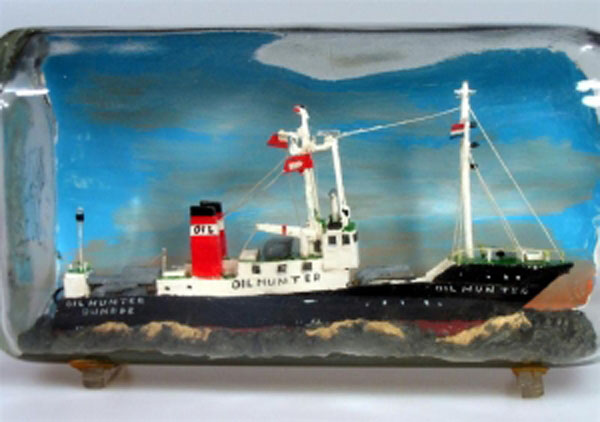
This is the Oil Hunter in a bottle (downloaded from an internet auction site!) The leading hand on the ship when I was captain used to make them, back in 1977.
THE ELGIN GAS LEAK
Good news then for Total and everyone involved with the Elgin Platform. If I had delayed my newsletter until 17thMay I could have reported that the well had been killed using, according the “The Scotsman” 1000 tonnes of oil based mud. Since then, apparently, personnel have been returning during daylight hours to work on the platform, and finally it was reported a couple of days ago that most of the platform crew are now back at work, although it may take towards the end of the year before the platform is producing again. It appears that the only people who are distressed by this news are the greens who have ben unable to find any evidence of pollution of the environment.
THE ITS CONFERENCE
It would seem churlish today not to mention the ITS Conference which took place in Barcelona at the end of last month.
This is a biennial event organized by the ABR Company, and provides a fun week for the movers and shakers in the tug business, in some major city of the world. Last time it was in Vancouver and the next one in 2014 is in Panama. There is a conference, where pertinent papers are presented, and a load of stands promoting everything from shipyards to steering gear.
The magazine published by the same company is now called International Tug & OSV, showing that the organization has taken on the relationship between oil industry vessels and the tug and salvage business.
However, when it came to it the speakers stuck pretty resolutely the subjects they knew about, salvaging, towing and building and operating tugs. Cross over points might have been the papers about ETVs – Emergency Towing Vessels – many of which were, or are, types of anchor-handler.
Some people were in favour of ETVs, but the traditional salvage spokesmen, headed by Andreas Tsavliris, of Tsavliris Salvage and Towage were in favour of the commercial approach, and he felt that the involvement of offshore ships in the salvage business was inappropriate. This old record has been playing since 1975, and I was amazed he is still at it.
There’s more, and I might get down to writing a proper review later in the month.
HEADING FOR THE RIG

The Big Orange XVIII Photo Scott Boulter
I though I would continue for another newsletter with a narrative about a marine accident, and with a second one following the theme of uninten-tionally running into things.
This accident occurred on 8th June 2009, and the principle player was the well stimulation vessel Big Orange XVIII. Yes, if you were wondering, the Big Orange XVIII used to be orange, together with Big Oranges I to XIX all of which used to be well stimulation vessels. The Big Orange XVIII was a modern ship capable of DP operations while connected up to a rig or platform, pumping thousands of gallons of noxious fluids down the wells , to well, stimulate them. Pertinent to this event it was powered by two azimuthing propellers which had to be rotated to go astern.
The other main player in this event was Ekofisk, and it may be worth remembering that back in 2005 The Ocean Carrier had run into a bridge between two of the Ekofisk platforms, resulting in an enhancement of the procedures and systems in order to prevent such a thing happening again. Ekofisk is a complex field with a whole range of different types of platform connected by bridges, and at all times provided with jack-ups carrying out various activities at some of the platforms.
So, the BO XVIII had spent some time at the end of the previous month stimulating wells at Ekofisk, and hence there was some familiarity between the ship and the field, but the ship had returned to Montrose (the location of the photo) for a crew change, and had then returned to the field to stand by. On the day in question the ship was called in a t 0340 in the morning to carry out the stimulation of well X16. The Second Mate was on watch. It was his first trip on the BO XVIII.
The master was called to the bridge and at 0400 he asked for permission to enter the 500 metre zone, and changed the steering mode from auto to manual. The communications took place with “Ekofisk Radar”.
Subsequent to this communication, from the viewpoint of the platform the Big Orange XVIII continued to approach the facility at reduced speed, and then unaccountably increased speed considerably and with some difficulty avoided hitting one of the platforms and, steadily increasing in speed, passed under a connecting bridge. It just avoided the jack-up COSL Rigmar and then veered off to starboard, running into the water injection platform Ekofisk 2/4-W at 0417, at a speed approaching ten knots. The damage to the platform was considerable, both above and below the waterline, and the ship suffered a loss of all items protruding above the bridge and a two metre dent in the bow. No-one was injured.
On board the ship one can only say that the master failed to understand what was going on, and that the Second Mate was unlikely to have been of much help since he was a new arrival, although the investigation did not say what other offshore experience he had, if any. Of course, had they not been heading straight for the complex then there would have been no problem.
We have already said that the master took over at 0400. Shortly afterwards he went to the radio room to take a short phone-call, and then returned to the pilot house. Approaching the point where he was going to stop and test the systems he put the helm over but nothing happened, the ship ploughed on. He then increased speed because sometimes the ship failed to respond to the steering at low speed. Nothing. He then turned the controls for the propulsion through 180 degrees for full astern, and increased the power to maximum. The speed of the ship increased.
The Captain resorted to steering with the bow thruster, managing to avoid some of the fixed structures, and passing under the connecting bridge. By now, in desperation, he pressed the emergency stops for the engines, which, although it is not expressly stated, probably also cut off the power to the thrusters. So the ship hammered into the platform and came to a halt. There was a flurry of communications between the various personnel and ships involved, and the Big Orange XVIII started up the engines again, and backed off straight into the Northern Crusader, after which it limped off to await further instructions.
Oh – and why did all this happen? The Captain went to answer the phone. Because the second Mate was inexperienced he re-engaged the autopilot before he went. When he returned to the pilot house he forgot to put it back into hand steering!!
AFRICAN PIRACY
The Russian site, Maritime Bulletin is currently running a campaign to in some way raise the consciousness of the international community against piracy in places other than the Horn of Africa.
They are attempting to raise the awareness of anyone who can read to the possible misfortunes that can occur to seafarers in African ports.
And we all agree, and I’m please that I am sitting here at my comfortable desk, rather than commanding a ship attempting to survive in places where there is no way that the ISPS Code has any place. The people you are dealing with are in uniform and carrying guns, but they are also asking for money, and anything else worthwhile you might have.
And then there are the ones who will be deterred by sandbags. In the end they are the ones who we might prefer to deal with.
BP SHIPPING - WHAT COMES AROUND
Back in the 1970s BP operated a small fleet of offshore vessels ranging from platform ships to an advanced standby vessel, which launched its FRCs in all weather up to a force 9. Then they sold the ships and closed down. Actually it was not quite like that. Both the management and the ships were taken over by Gulf Offshore, then a very small player in the North Sea. There-after they placed management of the “jigsaw” ships, one in the photo, with Vector Offshore. But now BP Shipping are are building four new platform ships in Korea, and in a somewhat complex arrangement, if reports are correct, will bareboat them to BP Exploration. This process is apparently consistent with BP’s strategy, “That promotes vessel ownership where long term life of field can be demonstrated.”