THE DEEP SEA SUPPLY IMPROVEMENT NOTICE
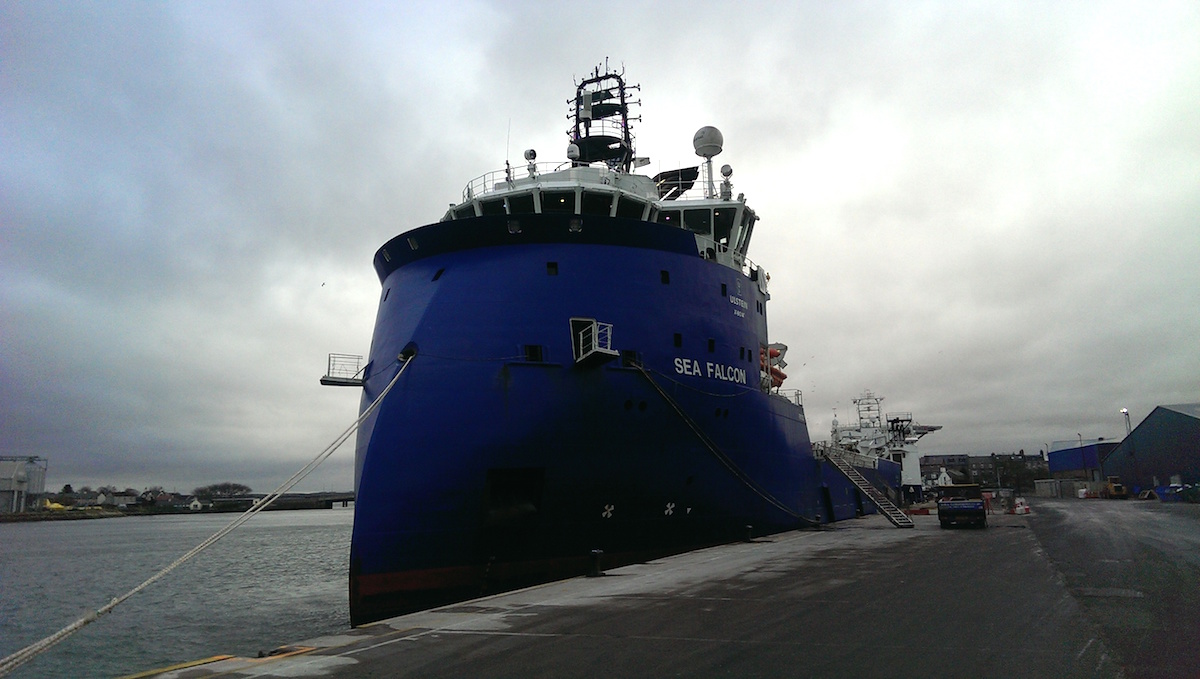
The Sea Falcon alongside in Montrose. Photo: Scott Boulter
On 10th April this year Deep Sea Supply of Singapore were issued with an Improvement Notice by the UK HSE because their ship the Sea Falcon had run into the Forties Echo platform. As far as I can tell this is a first for two reasons. I was under the impression that only companies with UK addresses could be issued notices by the HSE, and I don’t think giving the address of the company as “Forties Echo” really cuts it, and secondly I think it is the first time that a merchant ship has been issued with a notice, although I would happily be corrected in either case. The HSE would probably justify their activity by saying that the breach, actually to the Health and Safety at Work Act, occurred within the 500 metre safety zone.
Basically the ship approached the platform at excessive speed and ran into it – they say. The ship did not follow the Apache operating procedures and “recognised marine industry practice and guidelines” in that it approached the platform at speeds up to and exceeding four knots, instead of approaching at a speed of 0.5 knots and adopting a final set up position before moving alongside.
I was going to say that I had never heard of a procedure which required vessels to transit the 500 metre zone at 0.5 knots, after all the approach would take about 40 minutes, if such a low speed could be achieved. But on consulting the NW European Guidelines for the operation of such vessels I find that it says that ships should manoeuvre to a position about 50 metres off to set up, and then should make the final approach at 0.5 knots. I’m not at all sure that that is what the Sea Falcon has been found guilty of not doing. And if you go the HSE website and check on the progress of the notice you will see that “it has been complied with”. One assumes that compliance was achieved when Deep Sea Supply said “sorry, we won’t let it happen again”. For those with a professional interest it is Notice 306292067
THE CAPTAIN OF THE COSTA CONCORDIA WRITES
We learnt last week that the Captain of the Costa Concordia has written a book about the accident to the ship together with an Italian journalist Vittoriana Abate. The former captain was sentenced to 16 years in prison on multiple counts of manslaughter, but remains free pending appeal. He has been ridiculed in the Italian media subsequent to the disaster, claiming that he had tripped and fallen into a lifeboat as it was being lowered away. The book will tell the story of his life both before and after the disaster. Vittoriana Abate seems to have her own place in the gossip columns of the Italian media, being photographed looking glamorous on numerous Italian websites and once photographed on the back of the captain’s motor scooter. Just for once I wish that I could read Italian.
THE IMCA MEETING IN LIVORNO
I thought that I might include a bit of advertising for the IMCA, the International Marine Contractor’s Association which is the organisation supporting all those contractors who operate at the edge of the upstream oil industry. The company of which I am a director is a very small marine and risk contractor, and really all we do is help keep people safe. But at the other end of the scale in terms of size, not not keeping people safe, are the organisations which operate heavy lift ships, dive vessels and other craft supporting offshore construction.
IMCA is based in London, but in order to keep in touch with their members, hold meetings in different parts of the world, despite the fact that the majority of the membership is based either in UK or in Scandinavia. The meeting attended by myself, and the photographed seagull was in Livorno, which turns out to be the location of Italy’s main Naval college, which was attended among others by the representative from RINA who pointed out to us the places where the best looking Italian girls were reputed to sunbath.
I got the train from Rome which passed Civitavecchia, where a number of cruise ships could be seen alongside, one a clone of the Costa Concordia, or so it seemed.
Livorno is also the Italian destination of a ferry from Barcelona, and I thought about using it, but in the end it would have been more expensive than taking the plane and the train. Particularly the Madrid to Barcelona segment. But in the end both the seagull and I enjoyed the event, so if you are a marine contractor why not join? The seagull by the way made use of the hotel’s rooftop swimming pool.
THE NEGATA REEFER ACCIDENT
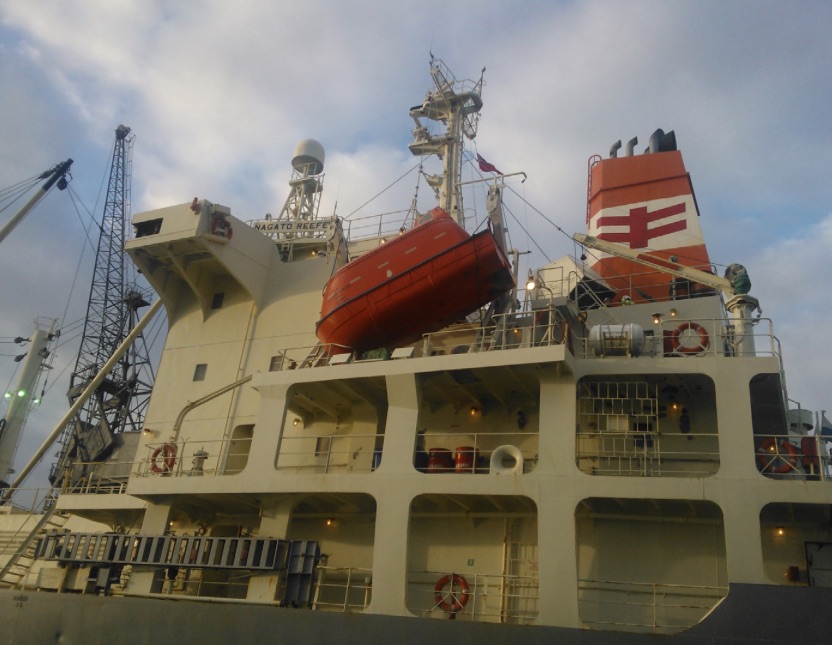
Last month I wrote a few words about the detention and subsequent accident on one of the lifeboats of the Negata Reefer in Southampton. This ship was said, in the MAIB report, to have been carrying fruit from the Canary Islands, and other sources indicate that it was a regular visitor to the port, which probably means that it was carrying bananas or tomatoes from the islands. Back in the old days Fyffes and Geest carried bananas into the UK. All their ships were British registered and the Geest ships in particular were much featured in advertising, as their spectacular white shapes brightened the dour former coal port of Barry in South Wales. But like nearly all the cargo ships of the former British merchant navy, they are no more, and fruit is carried into the country on ships like the Negata Reefer.
The managers of the British shipping companies seemed to have forgotten that they were commercial organisations, and their fate was finally nailed by Mrs Thatcher, whose enthusiasm for free market economics did not take into account the financial advantages of flagging out.
So here we are today, as consumers, supporting companies like Kyokuyo the managers of the Nagata Reefer, which was crewed by Filipinos except for the Captain, the Chief Engineer and the Mate who were Korean. Some of the crew had been on the ship for 19 months and most for more than a year.
The ship came to the attention of the MCA due to complaints about the living conditions of the crew and so a Port State Inspection was arranged, and a Port State Control Officer boarded the ship on 9th April 2014 and carried out an “initial” inspection, which found numerous deficiencies, and as a result the master was informed that a “more detailed” inspection would be carried out, and this started with a fire drill.
The number of failings in the fire drill were such that the vessel was detained. One of the factors identified was the fact that the drill was not conducted in English, supposedly the selected language for the vessel. There were a number of other errors including the failure of the Chief Officer to take the fire team to the correct site.
Thereafter the inspector instructed the crew to carry out an abandon ship drill, and so the port boat was launched with the Chief Officer in charge and five crew on board. The boat was one of about 100 fitted of that make with on load release gear, or as it is now described Lifeboat Release and Retrieval System (LRRS).
Initially they were unable to release the boat, but by taking the weight they were able to get away and carry out about ten minutes motoring round the harbour. They then returned to the ship and with Some difficulty connected the davit suspension links, and then fitted the fall prevention devices (FPDs), webbing straps with a shackle at each end which connect the falls to the lifeboat hooks, and if correctly installed will keep those on board safe even if the on load release system accidentally releases the boat. However, the inspector noted that as the boat was recovered several crew members were not convinced that they were safe and could be seen praying.
Once the boat was in the stowed position the bosun instructed the crew to install the gripes, but Chief Officer arrived and told them to remove the FDPs. As a pin was being removed from a shackle, the boat fell and was impaled on the rails around the embarkation station, catching the bosun a glancing blow. He was dispatched to hospital, and the boat was dispatched to Rotterdam for repair. The bosun was returned to the ship the following day.
If only that had been the end of it, but no. In order to ensure that the crew’s ability to fight fires was improved, several days training were undertaken, and on 12th the inspector returned to re-evaluate their capabilities. He determined that the drill carried out in his presence was “just about satisfactory”. The training company produced a report which said that “the ship’s crew required a lot more training to improve the standard of emergency preparedness on board”. The report said that Kyokuyo provided no further training at that time.
Also on 12th a further abandon ship drill was carried out this time using the starboard boat. The boat was first lowered and then the crew and the inspector boarded, but it was found that the hooks could not be released. After about an hour’s work on the hooks the release mechanism was operated and then reset, and the boat was retrieved and secured.
The Port State Control Officer also required that an audit of the ship’s ISM code be carried out, and this was this was done on behalf of the Panamanian registry by Class NK. And in order to conform with the Class NK corrective action plan (CAP) the managers, Kyokuyo, issued a safety notice to its vessels on 29th May. This notice said:
· Crew’s routine patrol and inspection were not enough.
· Habitual practice on board was not correct.
· Not enough common sense to the safety device, lifesaving appliances and preparation of special work (sic).
The notice concluded:
· We would hope crews to learn that more of your own ship and safety boarding with highly own interesting to protect yourself and the company .
We are reminded that one of the boats had been sent to Rotterdam for repair and a report compiled on the work carried out . This type of on load release gear is operated by a lever on the starboard side of the coxswain’s station, which is connected by cables to cams on the forward and aft release hooks. In the safe position the lever is held in place by a pin, and also the system is provided with a hydrostatic lock which only allows the boat to be released when it is in the water. However, the lock can be overridden in an emergency. The report on the boat said that the cables were seized and that the forward cable had probably fractured internally, also that the hydrostatic unit was not working. The lifeboats had been inspected in the autumn of 2013 as part of the annual SOLAS survey, and had been found to have no faults. Although the MAIB made no comment about this, one wonders how the boats could have deteriorated to such an extent in six months.
On a subsequent visit to the port the Nagata Reefer was visited again and the reports of the safety meetings reviewed. On a meeting held only 10 days after the accident it was stated that there had been no occurrence of an accident or near miss during the previous month. Says it all really. People with an interest in on-load release gear should read the full report on the MAIB website.
THE KULLUK NTSB REPORT
One of my failings as an author is a reluctance to publicise my own work, and for the first time I realise that I am following in my father’s footsteps, who was reluctant to attend press conferences in his favour. He should have been so lucky. I have never been asked to attend a press conference.
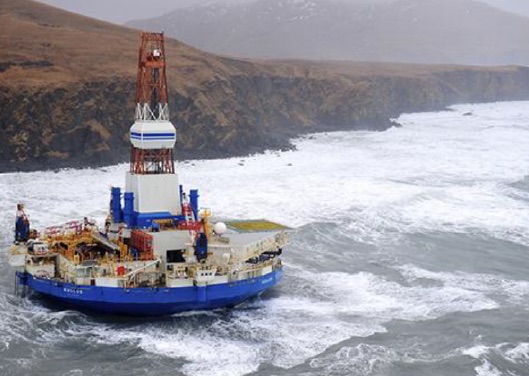
However, I am getting towards the end of my latest production “A Catalogue of Disasters” which includes stuff about the demise of the Kulluk, and which I thought I had pretty well to rights. That is until the National Transport Safety Board of USA published its report on the incident last month.
I had used the Coast Guard investigation, and the NSTB report might have been of a different accident, I assume because those interviewed were given time to think and therefore had improved their story.
It turns out that the emergency team had organised the mobilisation of the Alert two days before it arrived to almost rescue the situation. And ECO owners of the Aiviq suggested that rather than the engine failure being due to a design defect, it was actually a problem with contaminated fuel loaded in Dutch Harbour. The NTSB apparently were unable to comment, and seemed determined to nail Shell anyway