RUNNING AGROUND IN THE SOUTH ATLANTIC
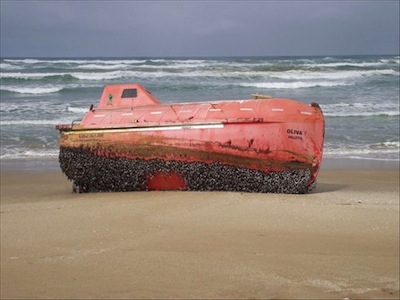
One of the Oliva's lifeboats on a beach in Australia
You might think that the possibility of running aground on one of the Tristan group, the most remote islands on the planet, would be pretty unlikely, and that therefore the grounding of “A Turtle” a drifting oil rig in 2007 after more than 200 days out of sight, was bad luck ( See News and Views for April 2012), but they are in the news again when one of the lifeboats from the bulk carrier Oliva was washed up on a beach in Australia last month.
The Oliva ran aground in 2011 on Nightingale Island, a tiny land mass to the south of Tristan de Cunha itself, inhabited solely by 20,000 penguins.
The accident was investigated by the flag state, Malta - well done them by the way - and they concluded that the navigators had allowed their navigation system to set course through the island due to incorrectly plotting a waypoint. The ship should have cleared the island by 10 miles, but the investigation also determine that using a chart of the whole of the South Atlantic for that sort of close approach was inappropriate.
Lastly they found that although the island appeared on the radar no-one took any notice. The Second Mate failed to identify or investigate it, and the Chief Mate dismissed the echo as a rain shower. One feels that there must have been more. After all there must have been an expectation that land was going to show up, and the navigators aught to have had particular interest in it. This must be a feature of navigation using GPS, the presence or not of land is of no interest except as a possible impediment to the likely success of the voyage. This time the voyage was terminated.
JULIETTE PRIDE I AND JULIETTE PRIDE II
The tugs Juliette Pride I and II both registered in Tanzania were recently detained in Newlyn Cornwall, after a flag state inspection. The Juliette Pride II had spent months in the Isle of Man, and the crew from Georgia had in the end been supported by the Salvation Army, and had had their wages and flight cost home recovered for them. It and its sister ship had only managed one sea passage before being stopped again. The crews had been replaced by Ghanaians, and according to the Tugs and Towing newsletter, the two tugs had slipped their moorings and sneaked off during the night, possibly bound for Nigeria. “They are certainly not safe enough to set sail” said a MCA spokesperson. Oh dear!
ACCOMMODATION
Organisations of all sorts and nationalities, which have the interests of seafarers at heart, are saying quite a bit about how accommodation could be improved to make life more bearable for those at sea.
Typically it was reported in this month’s Telegraph that the Senior National Secretary of Nautilus speaking on behalf of the International Federation of Shipmasters, said that accommodation should be excluded from gross tonnage, but at the same time acknowledged change to the 1969 tonnage measurement convention would be unlikely.
Meanwhile the Americans in particular seem to be building ships with absolutely no consideration for the crews at all. Some ship-owners, including Edison Chouest, are building ships with no portholes, one assumes solely on the basis of the cost of making a hole in the hull. How would they like to be living in a house with no windows?
And I was struck, while updating bits of the website, of the differences between the accommodation provided on two ships.
The first was the GulfMark owned G4000 Double Eagle (though actually built for some-one else). Its accommodation consists of 2 x 4 berth cabins and 4 x 2 berth cabins, plus galley and mess room.
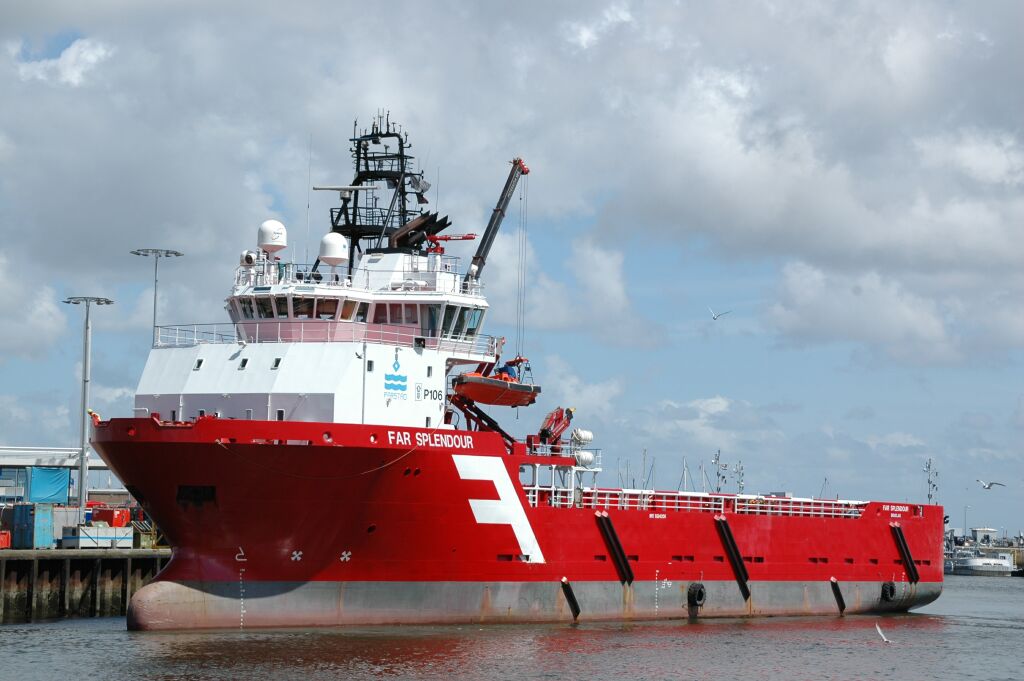
On the other hand the accommodation of the Ulstein P106 Far Splendour consists of the following:
Two cabins with stateroom and bedroom, two one bed state cabins, eight one bed cabins, three four bed cabins with salon, with mess room, day room and smoker’s day room. And they all have portholes.
THE MERCHANT SHIPPING ACT 1894

The P&O Cargo ship Ballarat in 1960, registered in London and operated under the 1894 Merchant Shipping Act. Photo john Lupton.
While clearing out some old documents I discovered a copy of the 1894 Shipping Act, the cornerstone of the manner in which the British Merchant Service operated until, wait for it -1998!
My copy of the document must have been printed on or about 1972, because the price is given in old money £1 10s 0d, and new money £1.50. There were a lot of advantages of going digital.
Strikingly the document runs to more than 300 pages, and many of them contain gems. Take page 89, for instance where destitute seamen are discussed, and bear in mind that this act was in force until 1998. Quote:
If any person being a native of any country in Asia or Africa, or of any island in the South Seas or the Pacific Ocean, or of any country not having a consular officer in the United Kingdom, is brought to the United Kingdom in a ship, British or foreign, as a seaman, and is left in the United Kingdom, and within six months of his being so left becomes chargeable upon the poor rate, or commits any act by reason whereof he is liable to be convicted as an idle and disorderly person, or any other act of vagrancy, the master or owner of the ship at the time of the seaman being so left as aforesaid, shall be liable to a fine not exceeding thirty pounds, unless he can show that the person left as aforesaid quitted the ship without the consent of the master, or that the master, owner or consignee, has afforded him due means of returning to his native country, or to the country in which he was shipped.
And I randomly opened a further page and found this:
Every emigrant ship shall be provided to the satisfaction of the emigration officer at the port of clearance with at least two privies, and with two additional privies on deck for every one hundred steerage passengers on board, and in ships carrying in as many as fifty female steerage passengers with at least two water closets under the poop or elsewhere on the upper deck to the satisfaction of the emigration officer for the exclusive use of women and young children. The privies shall be placed in equal numbers on each side of the ship, and need not in any case exceed twelve in number.
In 1906 some modifications to the Merchant Shipping Act were carried out in order to provide a scale of provisions for seafarer’s, and these were quite well known being appended to the Articles of Agreement and published in the Almanac’s available at the time. Brown’s Nautical Almanac for 1962 has the full victualling scale, known as ”The Board of Trade Scale”.
There are 36 items on the list and I found my attention drawn to the provision of eggs, which back in the 1960s were still a fairly rare commodity. Blue Star ships were said to provide eggs every day, but most of us were limited to one a week. Hence I was surprised to see that the scale requires that four eggs should be issued during the first fortnight of the voyage and two eggs for each week thereafter. For a long time it therefore seems that we were short changed by an egg a week.
Some other quantities seem quite high by today’s standards. 7lb 4oz of fresh meat per week is quite a lot, the equivalent of a medium sized steak a day although it is pointed out that on ships without refrigeration it may be unwise to issue fresh meat if it is more than 15 days old. It also says that the weight of the meat may include bone which provides a window of opportunity for the more unscrupulous ship owners.
Readers might also be surprised to learn that between 1894 and 1900 there had been 150 questions raised in the Houses of Parliament about the act, ranging from questions about “lascar accommodation on P&O vessels” to the patrolling of the Western Isles herring fisheries by the fishery cruisers. And the questions in the house go on into the 20th century with such frequency and in such detail that one wonders how they had time to do anything else.
Indeed, although the wage rates for the none British seafarers were not set at the same level as those for native British seafarers serving on British ships, even today when there is considerable effort made by international bodies to ensure that all wages are equal one wonders what was wrong with the system. The P&O for instance employed Bombay deck crew and Calcutta engine crew. They picked them up on the Indian coast, paid them, arranged for advances to be sent home to their families and after their year of service redelivered them to a port on the Indian continent.
I don’t take too much of a view one way or the other, but it seems to me that to pay seafarers enough in wages to make them rich in their own village, and to ensure that they and their families are looked after, is better than not paying them at all and abandoning them in some distant part of the world when the ship fails a port state inspection!
ISLAND TRADER
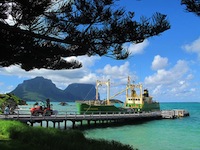
Back in the 1960s there seemed to be quite a few films about, telling stories of ship captains operating small and quaint little vessels around the more attractive islands in the Pacific, and if you were a junior officer working on a bulk carrier bashing its way across the Atlantic in winter you could only dream of such an idyllic existence. But it was only a dream.
Well, it turns out that for some-one it wasn’t. I was looking for an offshore vessel, the Island Trader on the internet the other day, and accidently discovered another. This little ship carries cargo between the Australian mainland and Lord Howe Island, billed by its website as the most beautiful island in the Pacific.
Mind you, it had only made the news because it had run aground during departure from its berth, and caused considerable consternation in the Australian Government. It was said to be “an accident waiting to happen”.
Not really, said the ship owners. It was sitting on the sand just as it had been designed to do. But who knows, for those who are still holding on to the dream, they might be looking for a new master.