THE ELGIN GAS-LEAK UPDATE
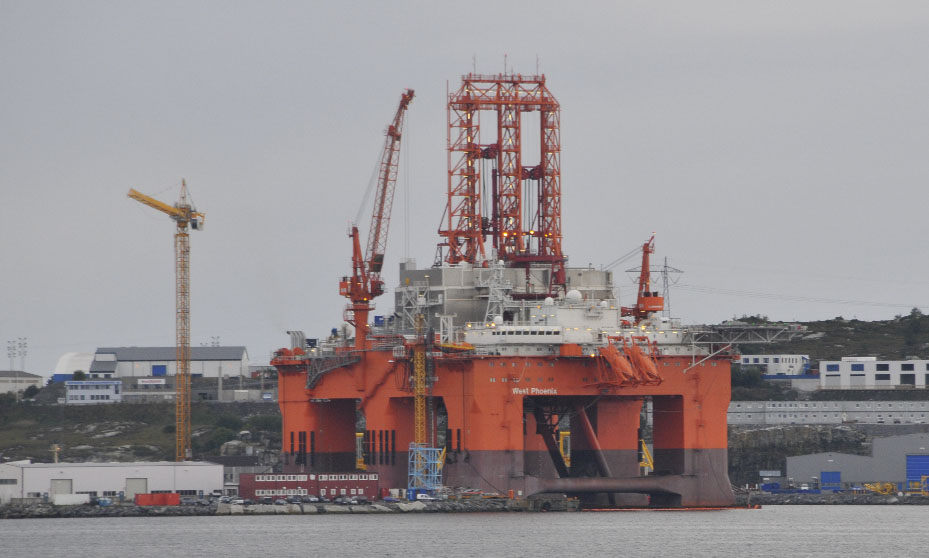
The Seadrill West Phoenix. Photo Robbie Norman
Remember 25th March, the day we learnt that the Elgin Platform had suffered a gas leak and that the complex had been, for want of a better word, abandoned. After the initial excitement created by the flare, which was still burning, and might, if things had gone particularly badly, served as an ignition source for the accumulated gas, we all went back to our normal lives. And when the flare went out on 31st March even the news teams who had been accumulating with their satellite broadcasting vans on Greyhope Road, went on their way in pursuit of more exciting events.
But of course it has not been fun and games for Total who have mustered all their forces in an effort to bring the leak under control. These have included the Transocean moored semi, the Sedco 714, now a veteran of many years campaigning in the North Sea, the modern jack-up Rowan Gorilla V replaced at the Elgin WHP by the Rowan Viking, which if course is still in position, shut down and unmanned, and the DP semi-submersible Seadrill West Phoenix, a recent addition to the Total chartered fleet.
The latest news, on 15th May, is that the West Phoenix is in a position to commence killing the well with heavy mud via a temporarily installed flexible pipeline. This is known as a “dynamic well kill” for which permission was granted by the Department of Energy and Climate Change, on 4th May. If this job goes according to plan the well should be back under control in a day or two, and for those who are unfamiliar with these processes, the work is quite different from the attempt to kill the Macondo well in the Gulf of Mexico back in 2010. They are going to make, or maybe have already made, a connection to existing pipework on the deck of the Wellhead platform, as opposed to trying to stuff a pipe down end of a broken riser on the seabed several thousand feet down.
THE CRUISE SHIP AND THE CASTAWAYS
It would be a nightmare for any shipmaster to find out that he had ignored seafarers in distress, and that there had been deaths as a consequence. So it must be for the Captain of the Star Princess which steamed unknowingly past a small boat containing three distressed fishermen, in the Pacific near the Galapagos. Apparently a number of birdwatching passengers saw the boat, and the waving men on board it, and told crew members on the ship. But the officer of the watch was never informed. The fishing boat was adrift for 16 days before they saw the ship, and the one survivor was rescued after a further 14 days, his two friends having died of thirst.
MASSIVE TIDE IN AUSTRALIA
While undertaking my regular activity of updating the “Fleet Information” I came across the Massive Tide, and thought I might try to see if it had had any previous names. There is actually a comprehensive list of all the UT 704s on the website but for some reason the Massive Tide does not appear. So, I googled the name and accidentally came up with an Australian Government accident report.

The Massive Tide. Photo Kenny Polson
The accident was minor. There were no injuries except for a few red faces, and very limited damage to the ship. But as usual there are lessons to be learnt.
Over the years I have campaigned – unsuccessfully – for a change in attitude of deck officers serving on offshore support vessels. I have suggested that they should stop setting course directly for oil rigs, so that if they become inattentive, or for some reason go below, forgetting why they were on the bridge, or fall asleep, they will not be brought back to reality by the grinding of metal as their craft embeds itself in some completely innocent offshore structure. But the Massive Tide accident did not involve an oil rig, it involved an island.
The summary of the accident investigation states that at 0445 in the morning the while travelling at 9.8 knots the ship grounded on a shoal on the western coast of Rosemary Island, in the approaches to Dampier Western Australia.. The weather was fine and the visibility was about eight miles.
The ship left Dampier at 1400 on 28th August 2006, and arrived at the Ensco 106 at 1950. For the duration of the passage the Second Mate had been on watch, and when the ship arrived at the rig he called the Master and remained on the bridge to operate the bulk system. The report says that the Master took over the watch. But one of the problems with the old UT 704, and maybe other Norwegian built support vessels is that the bulk operating system is situated on the bridge and is normally operated by one of the deck officers. This is as an alternative to it being in the engine room and operated by the engine men.
So, the Second Mate took the watch to get out to the rig, and remained up there for the transfer of the bulk cargo at the rig which was completed at 2315. At that time the Master suggested that he go down until midnight, but since he was due back at that time he elected to carry on. Hence the Master suggested that he call the Mate before 0400 which was his planned hand-over.
At 0100 the ship was released by the rig with the Second Mate and the lookout on the bridge. The Second Mare set the course at 129 degrees, and recorded a GPS position in the log book at 0200 and 0400, and since the ship was to arrive at the Dampier Sea Buoy before 0500 he decided to leave the Mate in bed. But at 0445 the ship ground to a halt on the shoal.
The nub of the problem was that the second Mate had read a course 129 degrees off the GPS which was the one directly to the last waypoint at the berth, rather than the 119 degrees required get the ship to the fairway buoy. And rather than plotting the position on the chart at 0200 and 0400, which would have instantly identified the error, he chose just to write the position in the log book. Surely this would be the equivalent to making a small cross in the log and appending the statement “you are here”. The report does not really tell us why the Second Mate failed to identify the light on Rosemary Island, but it did suggest that the ship’s management of its watch periods was less than efficient.
The reason for the rather curious watch periods was that the Master and the Mate both had driving experience, while the Second Mate was still learning, so he was to do the transits and the other to do the port and rig times. Why then did he remain on the bridge to look after the bulk discharge? Could the lookout have done the job? Might the Captain have done a bit of transit watchkeeping?
Within the detail of the report is the fact that the Second Mate was unfamiliar with the radar, and had set it up, so he thought to enhance possible targets, but there was a lot of clutter. When the Master adjusted the radar after the collision the clutter turned out to be Rosemary Island. You could not make it up! And it may be that the lesson to be learnt is to manage ones watchkeeping time efficiently to limit the possibility of fatigue.
EXPERT COMMENTS
The correspondence pages of the Nautical Institute magazine usually contain a number of exchanges of views, a slow motion activity since the magazine only comes out monthly.
Two months ago I wrote a letter to the NI suggesting that they sort themselves out and be prepared to make expert comment, rather than hiding behind investigation reports. The main thrust of my argument is that many accidents take place without any form of investigation being carried out due to inertia or inability on the part of the country in which the ship is registered.
Now that I have this newletter I do not need to respond to Hong Kong based Captain Alan Loynd in the magazine, and therefore extend the correspondence over yet another month.
I had used an example of the failures of Costa Cruises to support their senior staff, by not carrying out proper training. My example was that of a 19 year old female dancer who had been put in charge of an evacuation station.
Captain Loynd had suggested that maybe she was not in charge, or that she was actually well qualified to be in charge. Here is a typical example of how assumptions can be made, and readers of the NI magazine who have forgotten the content of my letter will be thinking he had a point.
No he did not!! The girl was interviewed on a BBC investigative report into the Costa Concordia accident. I heard her speak. If she was not in charge she did not understand that. Or if she was qualified she did not understand that she was!
OFFSHORE WIND

The photo looks north from the south side of Nigg Bay towards Balmedie, the place where Donald Trump has now stopped building his billion dollar golf course, apparently in protest that they are going to put some windmills offshore there. He, Donald, is resorting to hurling insults at Alex Salmond, but to no effect.
When his plan was first proposed Aberdeen the council decided to move the windfarm to Aberdeen Bay, here just to the North of Girdleness, the lighthouse, but this would have prevented ships from anchoring out there, and the energy used in steaming up and down woukld probably have far exceeded any wind power generation.
The next anchorage is in Fraserburgh Bay about 40 miles away. Ships have to anchor where the seabed is composed of either mud or sand, otherwise they are vulnerable in high winds, rather like Donald Trump’s hair.
THE WRECK OF THE SAMTAMPA
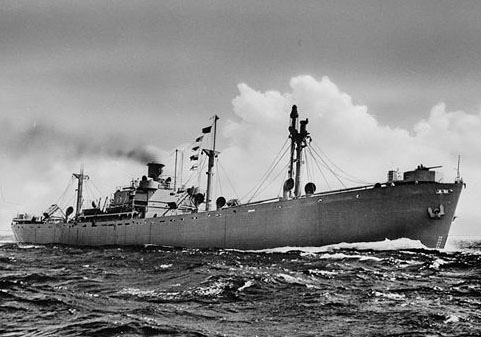
Some of us remember that most of the Uk shipping industry was sunk during the Second World War, and that after the war, British ship-owners started to trade again using Liberty ships and Victory ships. These ships were built in America for one trip, but never the less traded well into the 1960s. One of these was the Samtampa, built in 1943 and operated after the war by Houlder Brothers. BBC Wales recently commemorated its loss, which took place on 23rd April 1947. The ship anchored in heavy weather in the Bristol Channel, but the anchor dragged and it was driven ashore and broke up almost immediately. The Porthcawl lifeboat was launched, but was also lost. The thirty nine crew of the ship died as well as the eight volunteers on the lifeboat. All a few hundred metres from the beach.