A BIT OF CRUISING HISTORY
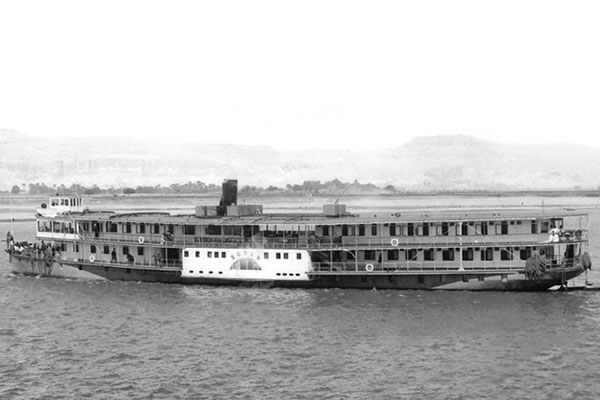
The Nile cruiser Sudan, from a travel website
Some years ago, after the death of my father, I inherited a couple of his favourite books which were entitled “Shipping Wonders of the World” in two volumes. They are undated but judging from the contents they were published some time in the 1930s. So in search of some history I thumbed through them the other day, and came across an article on Nile Cruises.
The cruises were started by Thomas Cook – the man – back in 1869 using a ship hired from the Khedive. Subsequently the company established its own shipyard in Egypt and built numerous river cruisers for themselves and others. Back in 1902 when the Aswan Dam was built the ships cruised the Nile between Cairo and Aswan, but were too big to pass through the locks at that point and so it was necessary for the passengers to disembark at join smaller shallow draught ships to continue southwards. And at that time it was possible to continue by various vessels to Lake Victoria, continuing up the White Nile on ships owned by the Sudan Government.
In the book there is some space given over to Lord Kitchener’s expedition to Khartoum to avenge the death of General Gordon, who the British had failed to rescue in 1885. Gordon himself had ordered some gunboats to be shipped from Britain and these had arrived and were assembled from sections at Wadi Halfa, and two of them had set off for Khartoum in 1885 braving four hours of artillery fire to get to the city, only to find that the it had been taken and the general killed. Lord Kitchener’s expedition took place in 1898, and the article says “not many years have passed since those days of strife”.
In those days Cook’s operated three large steamers from Cairo, the Arabia, the Egypt and the Sudan. The last had apparently been presented to King Fouad as a gift on 1885, and was still doing its stuff in the 1930s when Agatha Christie travelled on it and, amazingly, you can still go on it today!
FISH POISONING
Parts of the marine press recently carried an article about a ship’s crew who were taken seriously ill after catching an eating some fish. And the article recommended that crews should not catch their own dinners, but should buy their fish from reputable fishmongers. This seems a bit extreme and I remembered that I had written about this very problem back in 2008, when the crew of a ship had been takens seriously ill after catching and eating a barraccuda. The problem is a poison carried by some reef fish called ciquatoxin or CTX. The quantities involved are minute and it is immune to heating or freezing. It seems that the most likely carriers are fish which eat other fish, and the larger they are the more likely that they are carrying the poison. There is a paper available on the subject which contains a list of the most dangerous fish. It is available at http://www.mdpi.com/1660-3397/6/3/456/pdf
THE QUEENS IN LIVERPOOL

The Cunard passenger ships, Queen Elizabeth, Queen Mary 2 and Queen Victoria visited Liverpool the other day to celebrate Cunard’s 175th anniversary, in a spectacular and undoubtedly expensive PR event.
They posed in front of Cunard’s former offices which overlooked the Mersey next to Liverpool’s iconic Liver Building, topped as it is by two enormous bronze birds. These were said to flap their wings in the event of some particularly unlikely circumstances (in Liverpool).
But back to the 175th anniversary which indicates that the company started up in business in 1840. A number of investors including Samuel Cunard started up the “British and North American Royal Mail Steam Packet Company” which as the name implies had obtained the mail contract to take letters and parcels from UK to Halifax Nova Scotia. The first voyage was undertaken by the paddle steamer Unicorn in May of that year.
In 1879 the company was reorganised and became the Cunard Steamship Company Ltd, which might have been a more appropriate start date. And this new organisation commissioned a number of steel hulled passenger liners. The first of these, the Servia was the first ship to be provided with electric lighting throughout.
Over the years the company has been supported by the British government, most famously it was given money to complete hull 534, which was to become the first Queen Mary. Despite further government support it finally sank into oblivion, to be rescued by Carnival Cruises of which it is, these days, a minor part.
THE JIGSAW PIECES BACK IN THE BOX
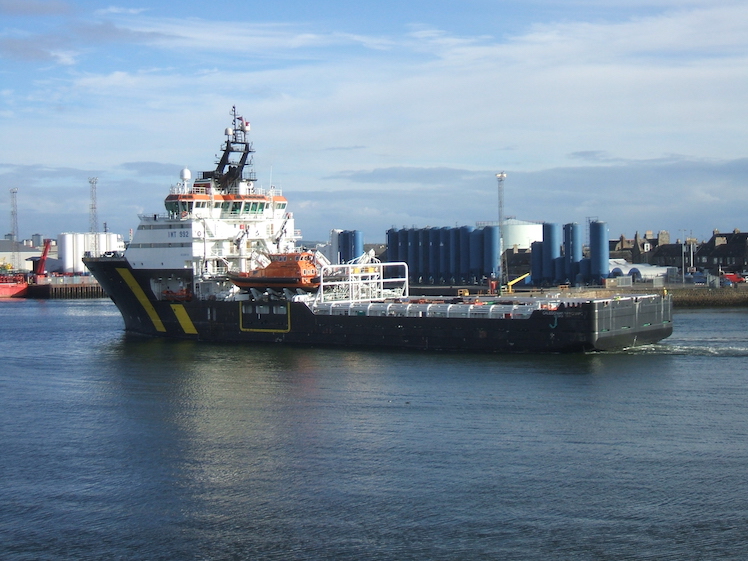
The Caledonian Vanguard with one of the ARRCs in the davits
Back in the autumn of the first year of the new millennium BP made a surprising announcement, which turned the standby vessel world upside down. They said that they are going to replace up to 15 standby boats, or as they are now called Emergency Response and Rescue Vessels (ERRVs)… No, that’s not the way to start. Let’s go back to the beginning.
Back in 1969 the BP rig Sea Gem sank during its transit from jacked up to afloat with the loss of 13 lives. A subsequent government enquiry resulted in a requirement for “standby vessels” to be attached to platforms and rigs in the UK sector of the North Sea, to recover anyone who fell into the sea. The rules concerning their operations and equipment were nebulous, which resulted in the industry recruiting old deep sea trawlers which had become available due to changes in the available fishing grounds.
In 1988 when the Piper Alpha platform was destroyed with the loss of 167 of the 228 people on board, the resulting public enquiry looked into the suitability of the standby vessel, the Silver Pit, and found it wanting in virtually all respects, and as a result the industry developed what was known as ”the Green Code” which set standards for the ships, the equipment and the crew. Thereafter on the United Kingdom Continental Shelf (UKCS) the installations out there were required to conform to the Safety Case legislation, and the supporting legislation, one of which was the Prevention of Fire and Explosion and Emergency Response Regulations (PFEER). In the emergency response part of this law was a requirement for anyone who had fallen into the sea, had been dunked by a falling helicopter or had evacuated as a result of their installation becoming unviable, to be provided with a “good prospect” of being taken to a place of safety. This left the owners or operators with the requirement to calculate how long people might survive in the sea, and then to work out how they might be rescued within this time frame. The usual technique was to provide a small ship with fast rescue craft and medical aid which would lurk in the vicinity – the ERRV.
But the regulations do not actually require that there be a small ship in the area. There could be other means, and back in 2000, BP decided that they would explore these possibilities. They proposed to the HSE, the UK Health and Safety Executive, who would finally rule on these things, that they would replace about 15 standby boats, as we still call ERRVs after all these years, with a number of high specification helicopters. These advanced aircraft were to be located at four points offshore and two onshore, and would be capable of a form of automatic hover, and a means of recovering people from the sea. Also anticipating difficult questions, they had proposed the deployment of some sort of diver manned small craft which could go under the structure of offshore platforms to recover people from the sea. They also suggested that some platforms would also be provided with FRCs.
It seems that they felt confident enough to enter into a contract with Bond who would provide the helicopters, and that company started the development of these unique aircraft. However, some of the possible scenarios could not be overcome solely using aircraft, and so the plan was modified to include some ships. The asked for ideas from the existing standby vessel owners, and Vector Offshore came up with the idea of operating some large ships which would have the capability of deploying very large FRCs, which BP called ARRCs, Autonomous Rescue and Recovery Craft. These very substantial vessels would be carried on the large ships, which would also be able to function as platform supply vessels. The big advantage of the ARRC was to be that in adverse weather, where it would be too rough for the ARRCs to be recovered to the mother ship, they could set off for the beach, since nowhere on the UKCS would they be out of range of a port. BP offered management of the ships to whichever company came up with the idea which they adopted, and so Vector became the managers of the four ships. BP themselves also had an operations centre with on duty marine controllers out at their Aberdeen headquarters in Dyce. In the event only two helicopters were to enter service, one based at Sumburgh, the Shetland Islands airport and the other on BP’s Miller platform.
The first of the vessels the Caledonian Vanguard entered service in 2005, and it was shortly followed by a further three ships. And then over the next couple of years the ARRCs gradually entered service. It would be worthy of a small book to describe the painful integration of the ARRCs into the fleet, since they were really breaking new ground in their attempts to launch a 14 tonne craft from the deck of a ship. Initially there were problems with the lifting points on the ARRCs and thereafter with the davits themselves, and hence there always seemed to be some rescue craft missing from the davits of the ships as they departed from Aberdeen on their regular cargo runs. The ships themselves also suffered from some problems since they seemed to be underpowered in terms of their ability to manoeuvre, and were dry-docked over time for the installation of extra thruster power.
But since the full service was introduced in 2006, the system has carried out 300 emergency missions, which were mainly medivacs, but one of the helicopters picked up six of the passengers from a ditched helicopter in 2012.
So why are we bringing all this up again now? It seemed to have settled down, and actually the BP fleet has increased by a couple of new platform ships, and Vector lost the management of the Jigsaw ships to Bibby Offshore in September 2013. So it just seemed like routine stuff.
Well. It has not been announced that the Jigsaw service is to be shut down. Yes, ended. Terminated. The puzzle although completed, is to be broken up and the pieces put back in the box. This means that the helicopters are going to be gradually removed from service and even now the ships are being modified into standard platform supply ships, with the removal of the rescue craft and their davits, and doubtless the removal of the large crews which were carried, starting with the specially trained ARRC personnel. Perhaps the weakest part of the plan, which was actually never tested, was the ability of the rescue craft to get from some point in the middle of the North Sea back to the beach in adverse weather, that is without shaking the occupants beyond endurance. If any of them are still out there it would be great to see one give it a go on YouTube
THE NEGATA REEFER
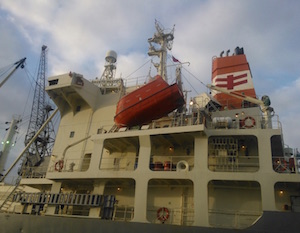
The Negata Reefer Lifeboat ABP Photo
On 7th May 2015 the UK MAIB (The Marine Accident Investigation Branch) published a report into the accidental release of a lifeboat on board the Japanese managed ship Nagata Reefer.
The accident had occurred on 9th April 2014 in Southampton, while a lifeboat drill was being undertaken as part of a Port State Inspection.
Although not explicitly stated in the report it seemed that the ship was on a regular run from the Canary Islands to Southampton carrying bananas. It was registered in Panama, managed by the Japanese company Kyokuyo Shipping Co, and was operated by 20 crew, all Filipino apart from the Captain, the Chief Officer and the Chief Engineer who were Korean.
The inspection found that the crew lacked the ability to carry out fire drills and to launch and recover the boats, and the lifeboat release systems were defective to the point that during the recovery of the boat after the drill some of the crew were seen to be praying.
The ship was detained and crew training undertaken over several days. The damaged life-boat was repaired and the release systems were found to be seriously defective, despite reports on board that it was in good condition. The managers seemed to be totally disinterested in the failings of their ship, issuing an instruction to the crew to “do better” . More next month!