There were many individual events in my ten years of driving offshore ships which stick in my mind, but one of the most surprising, when I look back might have been the rescue of the P84 when I was captain of the upgraded UT704 Star Polaris.
P84 was a Pentagone semi-submersible, which was employed for years by Total to drill holes all over the North Sea. Pentagones were primitive semi-submersibles, early developments from the first model which had floated in America.
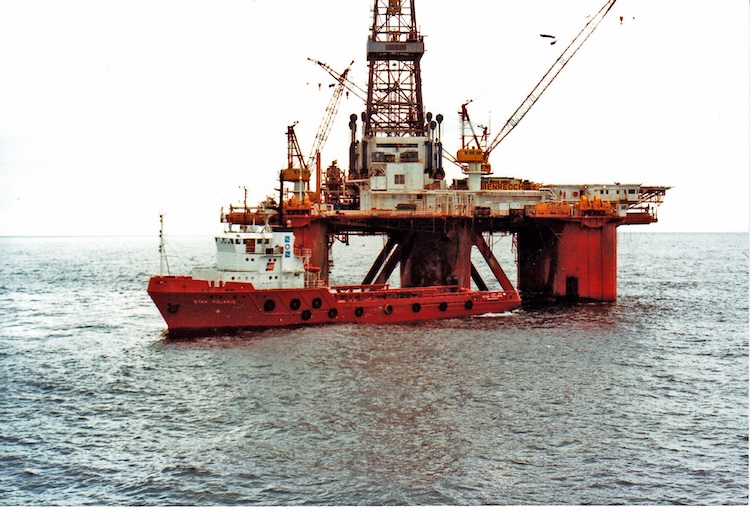
This is the Star Polaris alongside the Benreoch during a deepwater rig move. An operation particularly suited to this type of vessel.
They had five columns, each with a bulbous pump room, and series of tanks on the bottom, and from each column two anchor wires could be extended to the distance of about a mile securing them in position. The five legs were lettered from the port aft let to the starboard aft leg, A, B, C which was the bow leg, D and E. Half way between the B leg and the C leg, and the C leg and the D leg was a crane and in the dead centre of the deck was the derrick which did the work.
The weakness in the design was the mooring system, and while it was easy for the ships to pull the mooring out to the full extent, it was only the weight of the anchors which held the thing in position. In very soft seabeds additional anchors were required, and ships could spend days out there laying them.
Then it came to pass, that on one day during a particularly vicious winter blow in the early 1980s both the anchor wires on the B leg broke off just outside the leg, putting the rig in danger of being blown off the location. It is good practice in adverse weather to reduce the tensions in the lee moorings, which is a bit counter intuitive, so who knows, maybe someone made a mistake.
Anyway, the Star Polaris, then almost new, and taken to the hearts of the Total guys as a replacement for the much older Star Aquarius, which had been sold to the Hong Kong Chinese, was lying alongside the Total quay at the bottom of Baxter Street in Aberdeen, when I received a message that we were to go to sea and rescue the rig. Looking out towards the entrance to the harbour I could see rollers marching past, so it was not going to too easy even to get there, but the Star Polaris was the best opportunity for the rig to be made safe so what alternative was there.
For a start my crew secured some recovery hooks on the deck. I went down there to check the work, but found that I could kick the securings off, so they had to do it again, and there after off we went. I had been now been experimenting with techniques for making passage in adverse weather and to get north to the P84 I used one of them.
Leaving the port in the afternoon gloaming we battered into the seas head on for a couple of hours until we were far enough from the land to turn to the northwest, putting the seas fractionally abaft the beam. Then increasing speed until we were going as fast as we could, we were sort of surfing along the wave crests, making terrific speed, sometimes looking up at the wave crests through the starboard bridge window. Eventually we had to turn again to starboard and batter into the seas for a while before we could go surfing again. It was an exhilarating and heart stopping experience. The second mate, who was a recent addition to our team, said he was pleased that it was dark, so he could not see exactly what was happening.
If any of you out there fancy giving it a go, you have to make sure that you have considerable GM and probably as much draught as reasonably possible, nothing in the anti-roll tank and little cargo on deck. And most importantly, have the means of making the hull watertight, and ensuring that all the doors are closed. Obviously the process is one which can only be undertaken by offshore ships.
Later we were to arrive at the location of the P84. It was still extremely rough and in the morning light we could see that one of the wonderful Tempest class tugs - perhaps the Tempest itself - was on the tow wire, steaming ahead of the rig, disappearing completely behind the waves, then shaking the water off like a dog after a swim in a duck pond, and carrying on.

The Tempest photographed by Oddgeir Refvik in 2002. These superb tugs were much used as support out in the oilfields in the 1980s.
The anchors were each marked by a buoy, large yellow structures which supported the wire with which the anchor could be recovered. There they were bobbing in the surf, waiting for our attention. So even though the wires were no longer connected to the rig, they could still be recovered if we could deck the buoy, lift the anchor until it was on the deck and then reel the whole length of the anchor wire onto one of our two work drums.
To start with I needed to chat with my guys so I called then up to the bridge and, with them looking out of the back window next to me, I closed up with one of the buoys holding the ship head to the wind. It was normal practice to back up stern to the wind but in this case had we done that the crew would have been swept up the deck by mounting seas, so it was essential for me to undertake the more difficult manoeuvre of holding the ship in position head to wind. The crew watched the buoy for a few minutes, and gave me a thumbs up then off they went to don their waterproofs. I discussed the intended action with the captain of the rig who, unusually, was a mariner who I had met when we had changed some anchor wires while the rig had been undertaking maintenance in the deepwater port of Haugesund. Now he wanted us to tow the anchor wire out of the anchor pattern once we had decked the anchor and secured the end in our shark’s jaw.
The Star Polaris was a slightly unusual vessel in an era where the sheer size of the ship’s work drum, the winch used for deploying and recovering anchors, was important. The company had required it to be provided with two enormous work drums so we could store a lot of wire on the winch. It was a design which had advantages for a number of jobs and it and its later sisters used the drums for recovering anchor wires and deploying deep water moorings in later life.
Now we went out to the first anchor buoy and I headed the ship into the waves, then allowed it to ease astern towards the buoy, which was apparently rising above the roller and disappearing under it. Two of the crew stood fearlessly on the stern holding a lasso between them, the standard technique for capturing an anchor buoy. As the buoy rose past them they threw the lasso over it and indicated to the man on the winch to heave away. The buoy eased onto the deck and was heaved forward until the first connection of the buoy wire could be secured in the sharks jaw. The buoy was disconnected and pulled away to one side and the anchor wire connected up to the work wire. By now of course I did not have any points of reference, so while I still held the ship head to wind I could no longer tell quite where it was in relation to the anchor.
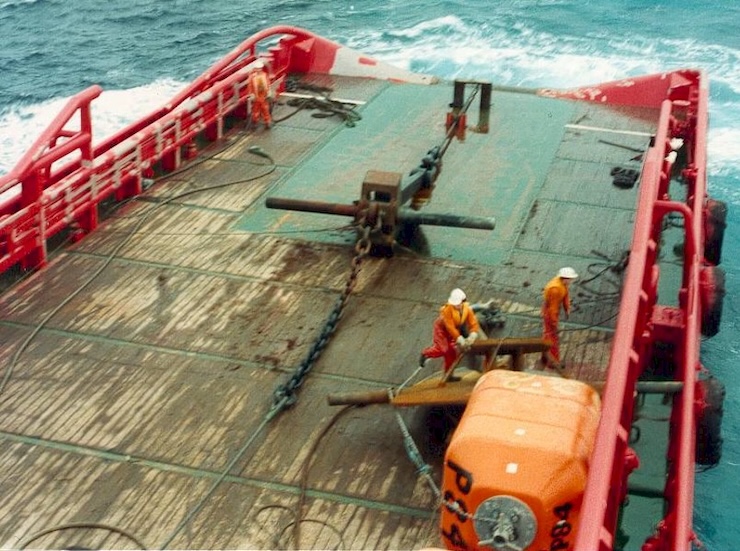
A P84 anchor on the deck of the Star Polaris. The wire can be seen to be secured in the Sharks Jaw which is being operated by a man at the starboard quarter. There is an anchor buoy close to the camera. Photo George Craigen.
But the winch began to take the weight and with ease lifted the anchor off the seabed. The mate acting as my assistant was able to identify the bearing and distance of the rig, so we were more or less able to remain in place until the anchor rumbled onto the deck and the first connection on the anchor wire was captured in the shark’s jaw. The weather was easing off a bit by now so the passing rollers did not hamper the work on deck in quite they way they had been doing, so we turned away and towed the anchor wire out of the buoy pattern, slowly.
This part of the plan, which I had accepted without really thinking about it, possibly because we were in uncharted operational waters, proved to be something which was to give us serious problems. Initially we recovered a couple of hundred metres of anchor wire onto the winch, but maybe as the seabed no longer exerted pressure it started curling up into spirals on the deck, looking like ivy which had become self supporting in its effort to propagate. It was a worrying feature a three inch diameter wire curling round itself.
In an effort to recover the wire onto the drum we set up a system of looping, curling the wire a couple of times round one of the work drums, leading it back down the deck round one of the posts and back up onto the other drum. There was no particular reason why this arrangement should have worked and it didn’t. Eventually after many hours of reeling and unreeling the wire we abandoned the project, returned it to the seabed and buoyed it off again.
I determined that the reason for the problem had been the fact that we had towed the wire out of the buoy pattern while one end was free to unravel and, effectively out of control it did, putting in an unwanted tension, which became effective once the wire was able to rotate - probably.
Now with the weather much calmer we made our way to the other anchor buoy, recovered it and this time wound the wire onto the work drum while backing up towards the rig, therefore, hopefully, not adding any tension to it. Sure enough it seemed to work, and so, wound on carefully, the wire, all the 1500 metres of it, was secured on one of the ship’s work drums. Then we hovered about close to the B leg while the rig’s crew recovered the end through the various sheaves and leads and secured the end once more to the anchor winch. Then once the end was fixed and they had made sure that they could reel it in, we sailed out towards the anchoring position unreeling the wire from our winch, then reconnected the anchor, lowered it over the stern and eased out the pennant until it was on the seabed then, in a moment of celebration, launched the buoy. The rig was now anchored with nine instead of ten anchor wires, but was deemed to be safe to operate. We returned to Aberdeen to load the next cargo. Life was continuing.
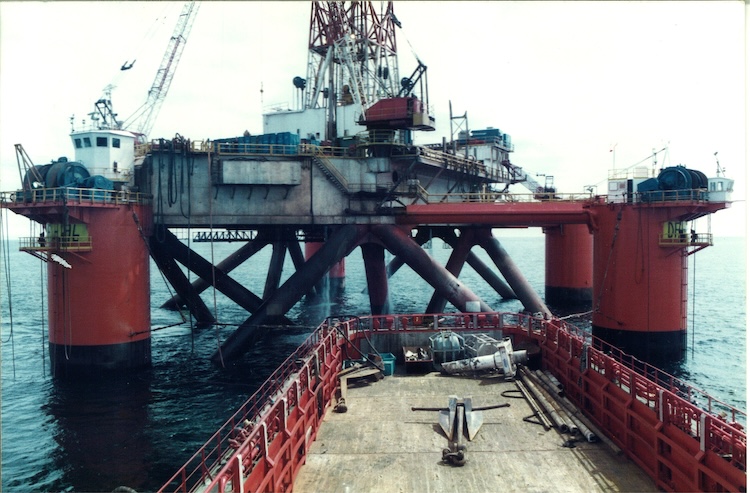
A platform ship discharign cargo at a Pentagone at the crane situated between the B leg, on the ship's port side, and the C leg which has the pilot house on the top.