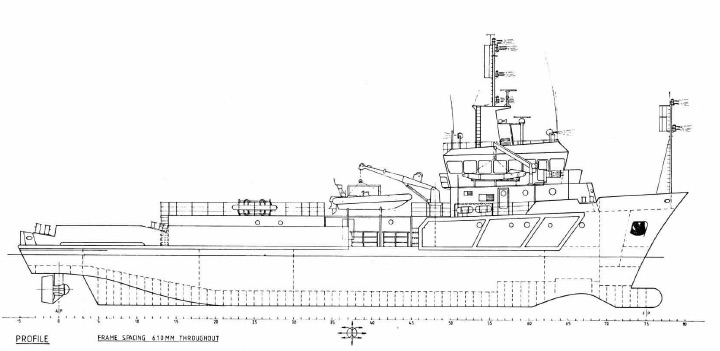
It will be evident that while the Gulf of Mexico offshore support industry was developed and operated by tug companies and rig owners, in Europe it was the major shipowners who took up the challenge. One of these was Harrisons (Clyde) Ltd who were, by British standards, a new kid on the block having only been incorporated in 1956 and become shipowners in 1964. But they were innovative thinkers and created a subsidiary, Stirling Shipping, in the mid 1970s with a number of small platform ships mostly built in Japan. At the turn of the decade their ambitious ship design department were faced with the opportunity of finding a replacement for some of the Gulf of Mexico designs which were still servicing the rigs and platforms in the southern North Sea. The area had, and still has, particular problems for support vessesl due to the strength of the tides which can at times run to several knots, taxing the ability of low powered ships with limited manoevrability to get under the crane. Their answer was what they called the “Imp” class, and the first of the class, the Stirling Imp entered service in 1981. These ships were only 52 metres long with a single azimuthing propeller aft and a Gill Jet forward. The Gill Jet had by then been installed at the forward end of nearly all the British supply vessels in operation. It consisted of a rotatable grill which projected a jet of water at an angle sufficient to provide thrust in any direction depending on the position of the control on the Bridge. It was therefore possible, with a bit of out of the box thinking on the part of the driver, to get the vessels to move in any direction and were capable in the words of the Harrison’s Managing Director “of spinning round like London taxis”. But the oil industry is surprisingly conservative, and the operators were unenthusiastic about hiring ships with a single main engine, even though in an emergency the Gill Jet would be capable of returning the ships to port. And so despite the potential advantages of the Imp Class as supply vessels they were a failure, and all five were purchased by North Star and others and turned into standby vessels. The Stirling Imp itself became the Burnhaven and then the Grampian Falcon and the Stirling Puck was to become the Sandhaven which was one of the vessels involved in the rescue of survivors from the Piper Alpha disaster and whose FRC was lost, together with the crew and six people rescued from the sea, when a gas pipeline exploded. The vessel was presented with a plaque in memory of those lost, which the owners donated to the Piper Alpha memorial in Aberdeen when it went to the breakers in September 2015.
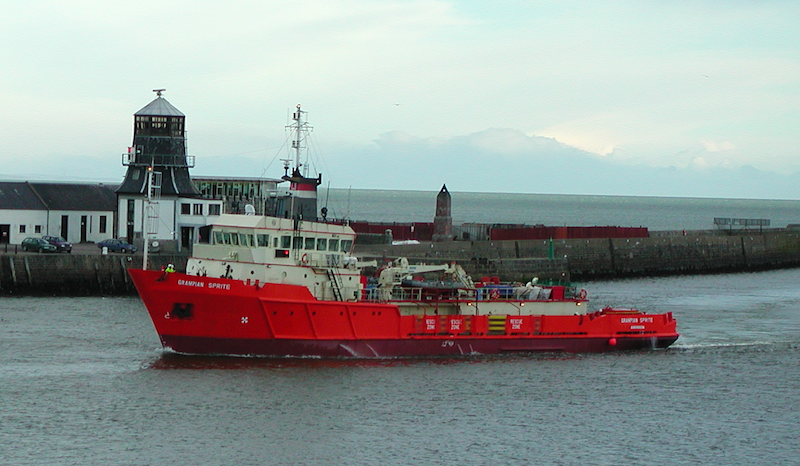
Photographs: A GA of the former Stirling Imp at the time of its conversion into a standby vessel, and another of the class, the former Stirling Sprite entering Aberdeen in 2003 by Victor Gibson.