During the 1970s an unprecidented level of construction was taking place out there in the unfriendly waters of the North Sea. Hamilton Brothers had, by 1975, managed to bring the first North Sea oilfield, the Argyll Field, into production using an old semi-submersible, the Transworld 58, and other operators were having jackets and concrete bases constructed in the northern ports of Great Britain and Norway. Out at sea what were then considered to be state of the art heavy lift ships, usually consisting of a three or four hundred ton crane mounted on the bow of a large tanker, were assembling the topsides in small blocks, more like making houses out of Lego than anything else. The Forties jackets took to the sea from Hartlepool on the Tees and Burnt Island on the Forth, and pipelayers were towed across from the Gulf of Mexico to lay the pipe necessary to connect the offshore fields with refineries and tank farms in the Shetland Islands and Scotland. In order to cater for this new requirement a number of shipowners ordered pipe cariers from European yards. They needed vessels which would be able to carry either two lengths of pipe, or three lengths of pipe, and in order to cater for the latter Ulsteins designed and constructed the UT 705. The first of the ship type was delivered in 1974 for Wilhelmsens, a Norwegian shipowner who had entered the offshore business in 1972 with two American built anchor-handlers. The two pipe carriers were the Tender Clipper and Tender Carrier. They were 80 metres long and 18 metres wide with a deadweight of about 3300 tonnes. They were powered by two engines developing 4800 bhp, with two bow thrusters and a single stern thruster providing manoeurving and sideways power. But as is common in the offshore business the pipe carrier market was quickly oversupplied and some owners had their ships delivered as diving ships. But by the latter part of the 1970s it was becoming common for ships in the field to hover within range of the crane in order to load and discharge cargo. This was, and is, known as snatching and so it became possible for ships to lie alongside the offshore installations, rather than presenting the stern to the crane, and this made the UT 705 available as a platform ship. In this role orders for large numbers of the design were placed, with considerable improvement in the detail up until the UT 745 arrived on the scene. Many are still in service often with their second third or fourth owner. The Tender Carrier itself was converted into a diving ship in 1977 and was used to investigate the loss of the Glomar Java Sea in 1984.

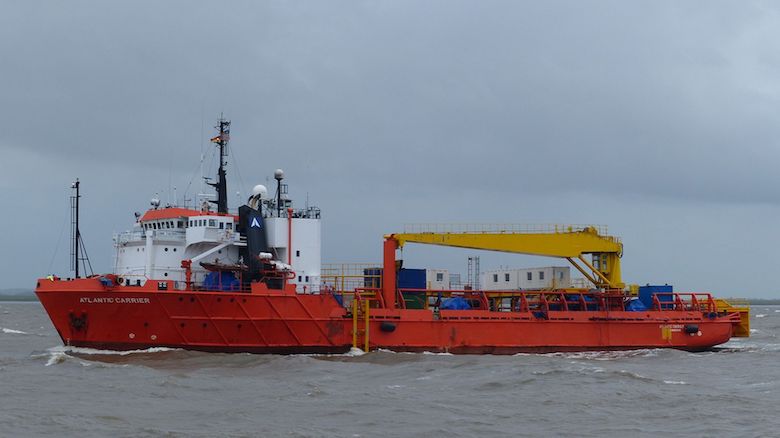
PHOTOGRAPHS: The Tender Carrier as it is today, as the Atlantic Carrier still a diving ship by Willi Thiel and the 1976 built Tender Commander as the Olympic Commander entering Aberdeen in 2004 by Victor Gibson.