On 14th July 2015, while attending the Attwood Osprey semi-submersible off the Northwest coast of Australia, an accident occurred on board the Skandi Pacific, resulting in a fatality. The Australian Transport Safety Bureau carried out an investigation and published their report on 23rd November 2016.
The Skandi Pacific is a STX AH08 anchor-handler built in Vietnam in 2011, and is one of two of the vessel type operated by DOF (District Offshore). It is a substantial craft 75 metres long and 3000 tons deadweight with, apparently, 1.5 metres freeboard at maximum draught. It has two bow thrusters, two stern thrusters and two propellers in Kort nozzles providing 180 tons bollard pull. It has DPII capability but due to the non operation of one of the bowthruster this capability had been slightly downgraded at the time. According to the investigation report it was crewed by “multi-national” personnel. But if this was true the nationalities were not identified.
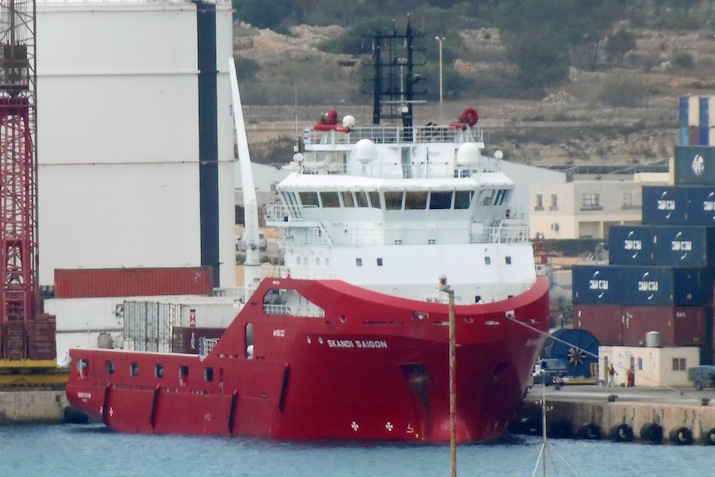
The Skandi Saigon, sister ship of the Skando Pacific. Photo Gaetano Spiteri.
Briefly, the circumstances of the accident were as follows. The ship had been called into the rig to carry out cargo operations, discharging and backloading containers at about midnight on 13th July, in what were worsening weather conditions. It was operating on DP, on the lee side of the rig, stern to the weather, gaining some protection from the rig structure. At 0505 the Chief Mate, who was the senior watch keeper stopped the cargo work since the ship had strayed outside its operating limits, and seas were frequently mounting the stern and flooding the main deck. He then stepped off 30 metres in DP, maintaining the heading to stand by, and instructed the deck crew of two, described as “Integrated Ratings”, IRs, to secure the cargo. While this work was being carried out two large waves mounted the stern and shifted the cargo on the starboard side, crushing one of the crew members, who was trapped within the securing system. He appears to have died immediately.
The investigators interviewed the crew from the master downwards as well as the management of the shipping company and assessed the safety management system of the ship, including the manner in which the risks of the operation had been identified and the levels of preparation undertaken. They, in essence, decided that the DOF safety management system was less than adequate, since the assessment of the weather conditions was subjective, i.e. there were no defined operating limits. They then reviewed the existing documentation from all sources, including the MCA and the G-OMO. G-OMO? The Guidelines for Offshore Marine Operations, which replaced the NW European Guidelines for the Operation of Offshore Vessels. They also sampled the DOF Cargo Securing Manual which says:
Open stern anchor handling vessels require special care, especially with regards to freeboard. Consideration should be given to the open stern being physically barriered. Use RA and TBT to minimise crew or cargo exposure to elements, particularly when working with the stern towards the weather.
Note the words “especially with regard to freeboard”. And in the 38 pages of the report this is the only reference to the freeboard of the vessel, although there are frequent references to the waves coming aboard, and therefore one would have thought that there would be an interest in the draught, freeboard and trim of the ship, and the quantities and distribution of cargo, fuel and ballast. We know that there was virtually nothing on deck of any consequence, but it is remotely possible that a lot of ballast was required in order to maintain the stability, or that out of habit they kept it ballasted down. It is also possible that the anti-roll system required large quantities of liquids, but without further information the question remains: why were seas mounting the stern and flooding the deck so frequently?
There will be those who say that this is bound to happen. If you have an open stern ship in rough seas surely waves are going to come aboard. Well, this is not at all certain, although it seems a bit odd that DOF’s own cargo securing manual recommends creating a barrier at the stern of an open stern vessel. Surely if they recommended it, then they should have done it, and this remains an unfulfilled recommendation in the report. Historically Shell in Aberdeen in the 1990s had their anchor-handlers fitted with a solid gate at the stern, but as the ships got larger this idea was discarded. Also back in the 1980s I was captain of an anchor-handler which was given the task of standing by a semi-submersible north of the Shetland Islands, in case it broke free, in adverse weather. Our job in that event would have been to take it in tow. Luckily we were never required to undertake this difficult task, but we did have the opportunity of testing the ship’s capabilities in a variety of conditions, including drifting with the engines off for long periods of time, in quite adverse weather. We found that the ship drifted with the wind on the quarter and always lifted over the oncoming waves. As an anchor-handler master I always adopted the principle of keeping the deck dry, usually with some success, and when I wrote my book “Supply Ship Operations” in 1991 I included the following guidance in the hope of helping others to achieve the same objective.
The main danger to crews working on the deck during cargo work is the possibility of being crushed by containers. All cargo remains fairly well attached to the wooden deck planking even if the vessels are rolling, but in the event of a wave getting aboard, the adhesion is reduced and heavy objects can easily move, to squash the unwary.
Over the years in the UK MCA guidance has been issued to attempt to deal with this problem, recommending the provision of a look-out to yell when a sea climbs aboard as well as the individual lashing of individual consignments of cargo. Sadly neither of these recommendations have really proved practical, though the incidence of seas washing aboard has been much reduced as the size of supply vessels has increased world wide.
Indeed, for cargo operations it is worthwhile for the Master to check the loading of the ship to see whether more freeboard can be gained by removing ballast water or altering the trim. Stability tanks have a tendency to be either at the fore or after end of the vessel, and to be operated partially filled with ballast. In many situations if these tanks are emptied ballast may be removed from the other end of the vessel and the freeboard increased accordingly.
When working stern to the weather, it is also sometimes worth trimming the ship slightly by the head, so raising the stern and reducing the possibility of waves climbing aboard. In an emergency the Master should not hesitate in asking permission from the installation to discharge excess drill or potable water to increase the freeboard.
But we are still left with one question, whether holding the ship in DP stern to the weather reduces or changes the vessel’s natural movement. If we were trying to do the same thing using the manual controls we would probably apply a steady thrust astern just using the main engines, but one assumes that the DP system will tend to reduce thrust in troughs and then increase the astern thrust as it is pushed ahead by the oncoming wave. This might be an area for investigation.
So, moving on the safety processes carried out on board the ship during this activity. Prior to the ship going alongside to back load the master, in accordance with the company safety management manual, had carried out a toolbox talk with the mate, the second mate and the two crew members who were to be working on deck. At 0200 at the change of watch the crew member who was going on watch came to the bridge, received his toolbox talk and “signed the briefing form”. He then went to the deck and took over from the man who was to be relieved. But the vessel was shipping seas aft, and so work with the rig ceased, and it was during the securing of the cargo that the casualty occurred. So what good was the toolbox talk? It turns out that the crew had become accustomed to waves sweeping up the deck, and one assumes they were therefore familiar with cargo shifting about. It was just bad luck that one of the them was trapped within the lashing system. The Skandi Pacific safety management system contained risk assessments which included details of the tasks, the people involved, the identified risks and the control measures, and apparently these risk assessments were discussed at the tooblbox talks, and the company apparently promoted a “stop the job” culture. The SMS also contained a management of change process. But none of this prevented the man from being killed.
So what can we take away from this accident and the subsequent investigation? Seriously, even after the crew of the Skandi Pacific had carried out everything that the company required of it in terms of risk assessments and toolbox talks, there was still the worst possible outcome from what was supposed to be a routine activity. Why did one of the deck crew not stop the job if he thought the situation was dangerous? Did anyone even realise that the situation was dangerous? In some respects it could be that the DP system was to blame, since it allowed the second mate to step the ship away from the rig but to maintain the heading at the second position, and it was stern to the sea. Had the ship not been capable of DP operations then there is no doubt that it would have been allowed to drift downwind, automatically reducing the possiblity of seas coming aboard. And honestly as a former anchor-handler master I have to ask why was anyone allowing seas to come aboard anyway. Even stern to the weather it was just a matter of getting the draught and trim right in the moderate sea condition prevailing at the time.
So rather than getting people to sign that they have received and understood the safety briefing surely it would be better to make sure that people remain safe, thereby keeping the responsibility with the people in charge, rather than handing it over to the individual by means of a signature.