

THE ELGIN GAS LEAK

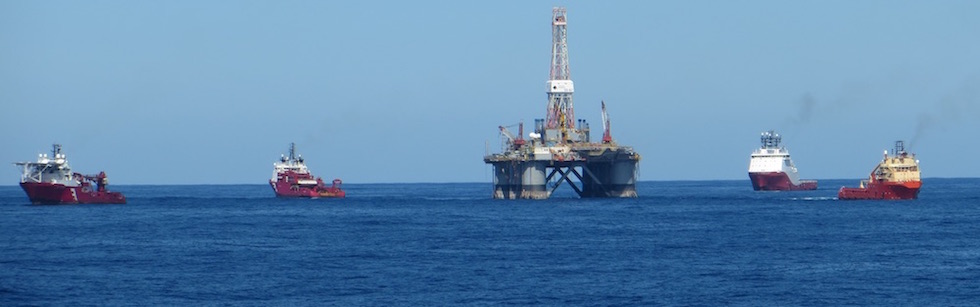
The Elgin Platform with the Rowan Gorilla V alongside. Photo by the Island Pride Crew
We all found it difficult to believe that the Elgin Platform and the drilling rig Rowan Viking had been abandoned on 25th March. Well, not quite. Nineteen people were left on board, but overnight on the same night they also were airlifted off. So there it was completely unmanned in the middle of the North Sea, with an unknown volume of gas leaking from the pipework of an abandoned well at the WHP, the wellheads platform. As far as I can tell the last time a platform was abandoned intact was the Hewett A in 1967.
To add to the excitement the flare was still burning, so there was some holding of breath as we waited to see if the lower explosive limit might be exceeded in the area of the flame. One imagined that things must have been pretty tense in the boardroom of Total – the owners of the installation. But on the 31st March the flame went out, and the news teams who had been ranged along Greyhope Road in Aberdeen, so as to provide a backdrop of the harbour for their pieces to camera, packed up and went home.
It is important to note that the evacuation procedures initiated by the Company were totally successful. Everyone was evacuated without injury, the first helicopter to reach the scene being a rescue aircraft from Norway. Additionally despite efforts on the part of Greenpeace, pollution has been minimal.
The latest press release from Total indicates that they have sent people from “Wild Well Control” together with some of their own experts out to the rig, and they have reported back that things are looking good. Meanwhile they are in the process of positioning the Rowan Gorilla V (seen in the photo at the Elgin WHP) to drill a relief well and are also bringing in the Sedco 714. The BBC have also reported that the Skandi Acergy may be involved in the possible well kill.
THE ICEBERG 1
On 29th March 2010 pirates hijacked the small ro/ro Iceberg I, which was crewed by 8 Yeminis, 6 Indians, 4 Ghanaians, 2 Sudanese, 2 Pakistanis and 1 Filipino. It was incorrectly reported that they had been released late last year, so except for one crew member who committed suicide, they remain in captivity. They are all locked in the hold, and have been there for nine months. Their owners have gone out of business. What next for them??
AMY JONES AND THE DEEP OCEAN CLARION
A number of offshore and marine media sources have reported on the suing of Ensco Offshore by Amy Jones a graduate of the Maine Marine Academy who was hired as an engineer by Pride and assigned to the Deep Ocean Clarion in 2010.
Her problem was that she was assigned to a cabin with male engineers, a situation which she found unacceptable, and this even though she had volunteered to share with other female employees.
Because of the disagreement her employment was terminated, and hence she is suing Ensco, now the owners of the vessel, renamed Ensco DS-4, for $3.3 million.
The basis of her claim is that “this assignment was dangerous, discriminatory and against the plaintiff’s religious and moral values”, and that sharing quarters with unmarried men would also have “exposed her to attack, even death in certain countries” through whose territories the vessel could have passed.
Honestly one has some sympathy for her. In civilized parts of the world we have become used to having our own little space, no matter how small, and sharing sleeping quarters comes hard, even without the male/female problem. But $3.3 million, and exposed to attack, even death!!
We should also bear in mind that this brand new drill ship is apparently provided with at least some three and four berth cabins. It is unlikely that this accommodation would be acceptable to the regulators in North West Europe.
THE MIGHTY DELIVERER AND A TURTLE
In the March/April edition of “Tug and OSV” magazine a lawyer has written a short article about the problems of knock for knock clauses in the TOWCON contract. Although he did not name names it rang a bell, and so I did a bit of research

The case he cited was that of the Might Deliverer and the oil rig “A Turtle” formerly the Petrobras XXI, and before that something in the North Sea. Back in the spring of 2006 the Mighty Deliverer was contracted to tow A Turtle from Brazil to Singapore. On the way, things went wrong, reported at the time as loss of tow due to bad weather, and the rig disappeared into the mist apparently never to be seen again. Then later in the year some of the inhabitants of Tristan de Cunha were on a search for some cattle in a remote part of the island, when they were surprised to see an oil rig aground about 250 metres from the beach. This resulted in a salvage, actually more of a demolition operation, which took 50 days, resulted in the rig being floated off into the ocean, and sunk in deep water, at a cost $20,000,000.
Of course some-one had to pay the bill, and it turned out to be the insurers of the rig who had to do it, but they took the owners of the Mighty Deliverer to court to get a contribution. They were unsuccessful because of the knock for knock clause in Towcon, although they did not have to pay nearly all of the contract price for the tow, because the rig had not been delivered.
In the court it was revealed that the reason the tow had been released was because the tug was running out of fuel. Various problems were presented one of which being that progress was impeded by the level of marine growth on the rig after its layup, and therefore the possible speed of the tug and tow had been miscalculated, and in the end they only managed an average speed of 1.7 knots.
Incidentally the Mighty Deliverer was previously part of a tug and barge setup. The bow was supposed to fit into the notch on the back of the barge. It is therefore really a pusher tug, not a puller. They say that the engine power was 15200 bhp, which allowed Noble Denton to calculate the bollard pull at 180 tonnes, or in other reports 152 tonnes, but whichever it was it was a rule of thumb estimate. However, the fuel consumption was said to be 3.5 tonnes per day, making one wonder how much of the 15000 bhp was actually being used. And even at that daily consumption it was evident that they were not even going to get to Capetown.
The calculation of the bhp by Noble Denton was part of the towing approval, and it was this that was relied on by the owners of the rig as an assurance of suitability of the ship to carry out the task. This seems to raise an interesting point regarding the suitability of vessels for the task they are being requested to carry out, and who might have the responsibility of ensuring it. This is particularly relevant today where, after an accident, flag states may choose to prosecute the charterer rather than the vessel owners no matter what has gone wrong.
Looking at the photograph of the Mighty Deliverer, it appears that the tow wire is stowed on that reel on the afterdeck, which would indicate that it was secured in some other way – quite possible – but not common, and of course towing approval probably does not specify what sort of floating objects can be towed.
So in the end one can only ask a question. Would we hire a pusher tug, recently re-activated after a long layup and classified with the Russian register, fitted with what appears to be temporary towing equipment, to tow a rig half way across the world? This without even thinking about whether it would be likely to run out of fuel or not.
The answer seems to lie with the costs. A Turtle was purchased for $5,000,000 and the lump sum fee for the tow was $2,000,000, and there was no-one on board the rig. But it still seems odd. Any one of the many UT 704s still in service could have done it.
BLACK FISH
Black fish are not a species with dark scales. The term is used in UK to describe fish landed illegally in excess of the EU quotas set for the species.
I had meant to catch this bit of news from February earlier, but so much has been going on that I did not get round to it. Anyway, thirteen Shetland fishermen, and a number of Peterhead skippers have been in court and have been fined as part of a roll up of a scandal that has been going on for years.
Also involved have been a number of fish processing plants in both Lerwick and Peterhead. The full extent of the scam had a value of £62.8 million. One of the processers, Shetland Catch, pleaded guilty to landing £47.5 million of fish.
Apparently a variety of techniques were used. The least sophisticated seems to have been a hidden pipe in a Peterhead plant, allowing part of the catch to be diverted into an unmonitored tank. Other processors had weighing systems which showed an incorrect weight.
The skippers have had to repay a total of £2.9 million, and have been fined as well. It was big money!
SHELL'S LEAKS

After Macondo every time there is a bit of an oil leak everyone goes mad, and hence there has been some distress in the GoM when Shell reported a bit of an oil sheen close to two of its platforms. This follows a revelation earlier this year that after the 2011 Gannet incident which resulted in more that 1300 bbls of oil leaking into the sea. The subsequent investigation found that the Company had failed to do quite a lot of administration, in relation to pipeline emergencies. Unhappily for Shell they had also had a pipeline problem in Nigeria at their Bonga field which resulted in the loss of 40,000 bbls of oil to the environment. Doubtless the legal consequences were less in that part of the world than in UK, or the Gulf of Mexico.