

THE PRESTIGE COURT CASE STARTS
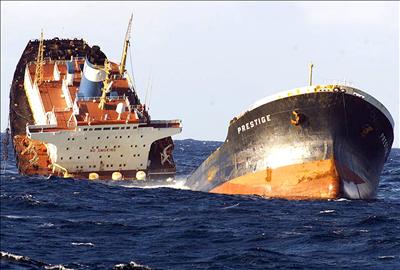
A well known photo in the public domain capturing the last moments before the Prestige sank.
Ten years after the sinking of the tanker Prestige out in the Atlantic the trial of the captain and three other men has commenced in Coruña. The other day images from the court room were briefly featured on the Spanish news at the time of the first appearance of the former captain, Apostolos Mangouras who is now 78, so even when he was on the ship he was 68. There’s a lesson straight away. Don’t keep working when you should be retired. The prosecution is asking that he be jailed for 10 years. Also in court is the Chief Engineer and Jose Luis Lopez-Sors, said by news reports in English to be “head of the Spanish merchant navy”, and also accused is the Mate, a Filipino who had disappeared.
For once I am in agreement with Greenpeace who say that there are others who should be in court, including members of the current government who were in power at the time. According to Greenpeace it was the deputy Prime Minister Mariano Rajoy (pronounced Rahoy), now the PM, who ignored an existing emergency plan which suggested that the ship should be brought into port, and ordered it to be taken out to sea, one assumes under the misguided impression that it would be far enough away to prevent any oil reaching the coast. And given that accusation, if it is correct and it was a government error which resulted in the pollution, surely the captain should not be in court at all. Indeed it is generally accepted that he acted in a commendable manner, which resulted in all the crew being rescued. It would appear that his only error was to accept command of a ship which, despite any assurances from ABS the classification society, must obviously have been past its best years, carrying a cargo with the potential to destroy large areas of the environment. The cargo, by the way, was heavy fuel oil, the bottom ends of the refining process, which must be heated to get it moving. No wonder it made a mess.
TRANSOCEAN AND CHEVRON IN BRAZIL
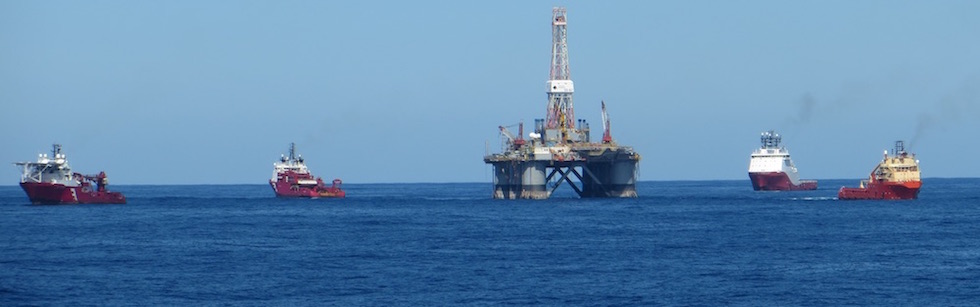
This is an update on last month’s cliff hanger which reported on the possible expulsion of all 10 Transocean rigs currently working in Brazil, and the shutting down of all Chevron operations in its offshore fields. Today it turns out that the Brazilian government has been convinced by its own department which looks after the oil industry, that to expel Transocean would cost the country more than it would cost Transocean, since seven of the 10 rigs are working for Petrobras and some of them are a selection of the few units available world wide which are capable of working in very deep water, ie more than about 2000 metres. Chevron is also being allowed to continue to work in a limited way after being fined $17,000,000 (I think).
DITCHING

On 23rd of last month a CHC EC 225 helicopter ditched in the North Sea, with 19 passengers and two crew on board.
It was a nice day and the crew inflated the buoyancy aids prior to the ditching and as a result the aircraft floated like a little duck on a mill pond. A bit unusual for the seas close to Fair Isle.
Despite the large number of offshore vessels in the area, so much so that when some thing goes wrong in the North Sea, ships have to be discouraged from attending, the rescue of the crew was undertaken by a Danish product tanker, the Nord Nightingale.
Apparently everything went well. The helicopter’s liferafts were inflated and everyone got into them, with their gloves and hoods on. (For those who don’t know, the hoods are stowed in a pocket on the leg of the survival suits and you have to get out the hood and put it on, and then put on the gloves which are contained in another pocket).
This is the fourth ditching of this helicopter type in recent years, in this case due to a low oil pressure warning, but in one case there was a catastrophic gearbox failure which resulted in the aircraft plummeting into the sea and all on board losing their lives.
The helicopter was recovered onto the deck of the Olympic Zeus and repatriated to Peterhead the following day.
NORTH SEA OIL SPILLS
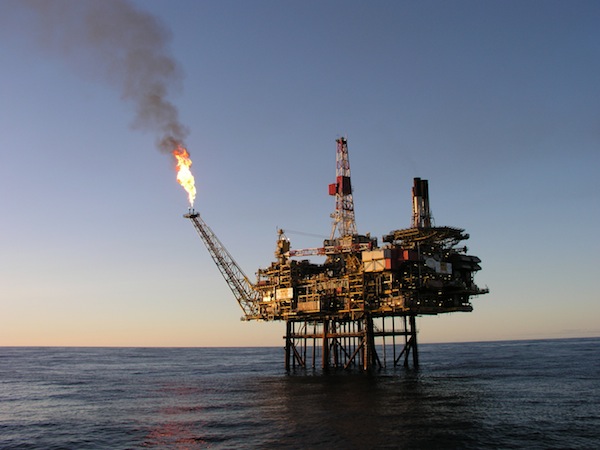
The Gannet A Platform - the source of an oil leak in 2011.
A few days ago BP came to an agreement with the US government about the payment of a fine for their part in the Deepwater Horizon disaster. The sum which they agreed to pay was $4.5 bn, and they hope that this, the largest corporate fine ever, will limit its liabilities elsewhere. However, it appears that they have put aside $40 bn to cover future related costs.
While all this has been going on there has been much enthusiasm in the press to give the oil companies a bit more of a bashing than usual, and the Guardian has published a story about oil spills in the North Sea since the year 2000. Apparently there have been 4123 oil spills but only seven fines.
On this occasion a Greenpeace spokesman said “Ministers and oil companies can spout their carefully crafted quotes; they like, to tell us how safe drilling at seas is. But while they’re spouting these words, their rigs are all too often spouting oil into our oceans.”
Most of the spills have been of diesel which actually evaporates into the environment without much of a problem. Other spills have been of crude oil which, in small quantities, has a limited effect on the environment. When the Braer ran aground on Shetland full of Norwegian crude, all of it dispersed into the atmosphere. It was smelly but the anti-oil brigade was hard pushed to find a cormorant covered in the black stuff. It was nothing like the boiler fuel being carried by the Prestige.
The Guardian’s research found that the total amount of oil spilt excluding the larger amounts was about 1150 tonnes which indicates that the 4116 events for which oil companies were not fined averaged 260 litres each. This is probably the same amount that the average truck fills up with at one time.
CONFINED SPACE ENTRY

There has just been a confined space entry conference in Aberdeen, so now might be an opportunity to have a look at one of the most tragic accidents of this type, which took place on the Viking Islay in 2007. We know all about it because the MAIB investigated it and published their report. In addition in 2009 the master was prosecuted but was found innocent by the jury, and the company, Vroon was found guilty of not having an oxygen meter on board and were fined £280,000.
The captain had allowed the men to enter a chain locker to secure a noisy anchor chain. And if you have been master of an offshore vessel tell me that you have never done exactly that. There is usually some-one’s bunk against the collision bulkhead, and a banging anchor chain can be a serious impediment to sleep. Maybe the difference here is that they had sealed the spurling pipes with expanding foam, (a product which was not available in my day, and just as well) and the spaces were not ventilated in any other way.
Possibly in order to avoid the need to provide an oxygen meter or to train personnel in the proper way to enter confined spaces, the company had issued a blanket instruction that confined spaces were not to be entered at sea, a policy which would be difficult to follow.
The ship had in place a risk assessment process which was seen by the crew as little more than an administrative problem and was usually filled in after the work had been carried out.
According to something I read about oxygen depletion, you take the first breath – you are still alive – it is the second breath that kills you.
THE ECDIS PROBLEM
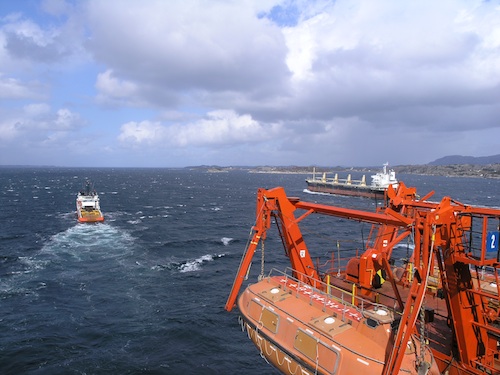
The rig under tow out of Norway. The ship to starboard did not have its AIS working and we were amazed when it appeared alongside.
Apparently the world’s merchant fleet is now formerly moving from paper charts to using the electronic chart display and information system, a move which has not been universally welcomed by the industry.
At first sight it seems to be a wonderful idea to have a presentation which not only shows you where the dangerous bits are, but also shows the position of the ship on the chart, and if you have all the right interfaces installed, all the other ships in you vicinity as well.
Being old and out of date I have little experience of these systems, but I was once a rig mover on an accommodation unit which had to go to sea from Norway. The pilot arrived with his laptop which when set up showed us, the rig, our towing vessel and the rocks and shoals in our near vicinity. And it also showed all the vessels around which had their AIS systems on. It was wonderful.
However I noticed a couple of things. One was that the rocks in the real world looked a lot closer when I eyeballed then out of the bridge windows, and the other was that we were overtaken by a bulk carrier which did not have its AIS on, and we were taken completely by surprise when it sneaked up close to our starboard side.
So my point is that maybe over time people will no longer bother to look out of the windows. I come across this problem when I am discussing collision risk management with rig crews. They look at me blankly when I suggest they go outside and have a look round.