

TRANSOCEAN AND CHEVRON IN BRAZIL - OR NOT
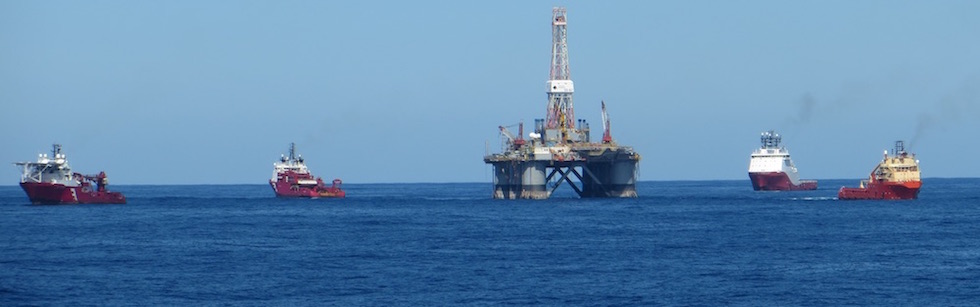
The Sedco 707 well testing out in Brazilian waters Photo: Tony Poll.
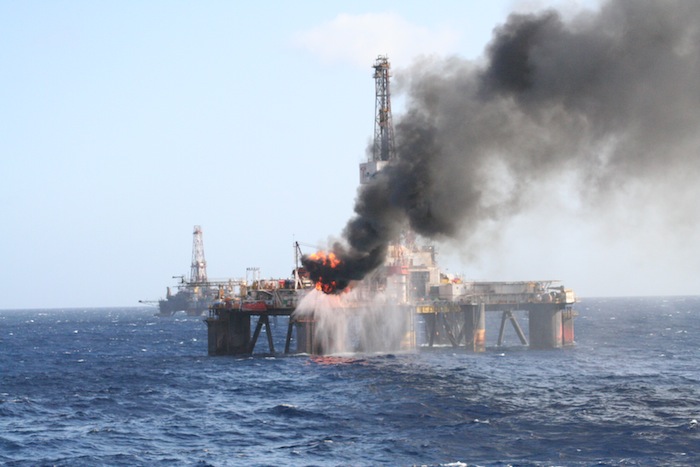
Back in November 2011 there was an oil spill of 3600 barrels on the Frade Field North East of Rio de Janeiro. The exact source of the spill remains obscure to those of us in the public domain, but Youtube videos indicate that it was a small formation blowout which was quickly killed. It’s not too technical, there’s a crack in the seabed from which droplets of oil can be seen drifting up. Then there are pictures after the kill which show occasional droplets emerging.
As a result of this spill both Chevron and Transocean have been banned from operating in Brazilian waters, and despite numerous legal appeals by both companies and, unusually, the Brazilian oil regulator the ban seems to still stand as of 15th October. They have also been fined collectively $11 billion and seventeen of their employees in the country have been threatened with up to 31 years in jail. ANP, the Brazilian oil regulator has stated that there were problems with the Chevron well plan but that Transocean had no responsibility for the accident. They also stated that there was no discernable environmental damage as a result of the accident, nor was any wildlife harmed. ANP are concerned that the banning of the ten Transocean rigs will have an adverse effect on the country’s oil output. And doubtless Transocean must be a bit concerned at the possibility that 7% of its fleet may shortly become unemployed. They would have the choice of finding work elsewhere for them or else selling them to another rig operator.
To put this sanction in perspective when two guys unfortunately died in 2003 after being overcome by gas on Brent Bravo, Shell, the operators of the platform were fined GBP 1,000,000. But on the other hand, of the five major registries of offshore oil rigs, only one, the US flag, required that accidents resulting in the deaths of five or more workers needed to be reported, although all required that even the most minor oil spill be reported.
SHELL SECURITY
I suppose if you are a major oil company you are often going to be in the news pretty often, particularly now that the paparazzi are keeping an eye open for any birds smeared with crude oil, when they aren’t looking for the ones smeared with suntan oil. And so it is for Shell. The Guardian has published an article about Shell’s security costs, which were apparently nearly $1 billion between 2007 and 2009. Much of this was apparently spent in Nigeria. Campaigners in the area suggest that much of Shell’s spend in the country is directed towards the military and the local police, and that these bodies may not always act in the most ethical manner, But what are Shell to do? In 2008 62 employees or contractors were kidnapped and three were killed. It just happens that much of the oil under the earth's crust is located in unfriendly places.
SHIPS AGROUND

This is a photograph which appeared in the Tugs and Towing News a couple of weeks ago. They are two cargo ships which dragged their anchors and found themselves on the beach just outside the Spanish port of Valencia. The accidents were the result of adverse weather.
The photo reminded me of my visit to Las Palmas – on holiday – a couple of years ago. There were quite a few ships at anchor, some of them only a few hundred metres from the shore. They looked pretty close to me standing on the beach, so from their bridges they must have been able to see all the girls in their bikinis with consummate ease. I have also sailed on ships in my youth which took about six hours to fire up the main engines from cold, because first a boiler had to be lit and produce stream and then the steam had to be directed to a steam driven compressor, which finally would provide the compressed air to start the engine.
Surely ship masters are better off today, and can start their main engines in fairly short order, and on receipt of an adverse weather forecast they can up anchor and move off into deeper water. Or, as I write this it occurs to me that maybe they think they would lose their place, if there is a queue.
This is not just a one or two off problem. It seems that nearly all groundings are due to dragging anchors, so either those currently in command lack anchoring ability, or weather forecasting ability.
ONE FROM THE ARCHIVE
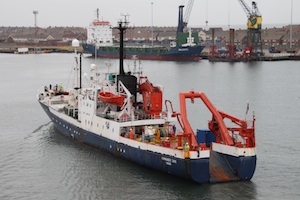
The survey ship Kommander Jack entering Hartlepool. Photo Jan Plug.
I am currently dragging some interesting stuff out or my archive, for the perusal of my readers. It can be found on the website somewhere, but there is getting to be so much there that it might take days to find it. This is a short history of the departure of a survey ship, in the Arabian Gulf, which was passed around the safety departments of a number of companies in Aberdeen a few years ago. The name of the ship and its chase boat had been removed, but it is still a fair illustration of the progress of an accident, to a distressing conclusion, from small beginnings. I have no idea what the actual ship looked like, but have used the 30 year old Kommandor Jack as an illustration. The Kommandor Jack is still afloat and working in Nigeria, so it was not her, or anything to do with her or her owners:-
“It was the Xxxx Xxxxxr Survey Vessel. All got off ok and no injuries. This past Wednesday, the ship sank about 300 miles offshore of Iran.
Around 6AM in about 1 meter seas, the navigator went down to the engine room to lower the UBSL pole, so that we could begin surveying. The chain used to lower the pole suddenly snapped. There was no safety chain attached and the flange at the top of the pole, which would have prevented the pole from dropping all the way through the hole flew off. Therefore, the USBL pole fell 3000 meters down to the bottom of the ocean, leaving a 12 inch hole in the ships hull. As you can expect, water started flooding the engine room. Crew members tried to fit a metal plate over the hole, however this proved to be impossible due to the pressure of the water. Non-essential personnel, were immediately transferred by FRC to the chase boat. Meanwhile, the crew continued to try to contain the flooding.
The engines and ship power were quickly shut down, and emergency power was turned on. The pumps proved too small to be effective, so the engine room's watertight door was closed & dogged down. Unfortunately, this door was not exactly watertight, and water proceeded to flood compartment next to the engine room.
Meanwhile, MAYDAY calls were issued from both the OV and the MS. The first to respond was a Coalition Warship, which later turned out to be the USS SEATTLE (AOE 3), a fast combat support ship. Since it would take a while for the SEATTLE to arrive, a Canadian C-130, and a Japanese helicopter were dispatched to the location. These aircraft remained until the end. Soon, a US helicopter also arrived carrying with it 2 large pumps and a damage control (DC) crew to operate the pumps. When the equipment and personnel were safely lowered onto the OV, the helo returned to pick up and deliver a third pump.
Unfortunately, two of these pumps became clogged with debris, and the DC crew were never able to get them to operate. The Commanding Officer (CO) on board the SEATTLE was informed by the DC crew the only chance that the ship had to stay afloat was if divers were dispatched to try and repair the hole. This solution was rejected by the CO. As a last ditch effort, a tarp was unfurled over the side and under the keel to try and cover the hole and slow the flooding. However, this effort proved futile. Eventually, the SEATTLE arrived on site. The CO assessed the situation and decided that despite all efforts, the OV was going to be a "long-term loss." He instructed all crew and instruments to be removed and the ship was then abandoned.
When all crew member were onboard the MS, the Captain and Party Chief made one last trip back by FRC to try and release the second towfish (the first was released earlier by FSSI marine techs) and try retrieve whatever personal effects that they could. Things retrieved included some undergarments, camera, 3 bottles of alcohol, one flip flop (right foot)and one Teva (left foot), various souvenirs. However, things such as wallets, house keys, cell phone, address book, and CD's now reside on the bottom of the Arabian Sea .
It took a few hours before the OV finally sank, but when it happened, she went down by the port bow. Afterwards, MS then began a rather rough 16 hour transit to Muscat, Oman. While the MS was steaming, the crew of the former-OV spent the night consuming the salvaged alcohol, and trying to sleep on spare mattresses, which were placed on the deck for us.
Once we arrived in Oman , it took many hours for officials to take statements and issue visas. Crew members, who were able to save their money and credit cards, supported those of us who lost everything. We left Oman very late Thursday night and spent the next 24 hours on airplanes.
I cannot even venture a guess on what will be the repercussions of this event. Besides our personal losses, my company lost about US$2 million worth of uninsured gear, including 20 km of fiber optic cable (10 km of which was flaked on the deck in two 5 km pieces due to a previous incident). Additionally, it is unknown how much of the data, from the survey, was recovered. I do know that there are already gaggles of lawyers hovering around and I am relatively certain that there will be many lawsuits between my company, our clients and their clients.”
While this was an extremely harrowing experience, I am thankful that everyone was able to safely get off the ship. I am fully aware that things can be replaced, while people cannot. We were very lucky that this happened in daylight hours in calm seas. We were also lucky that we had a chase boat following us and a Navy warship, so close by.
THE STAR PRINCESS
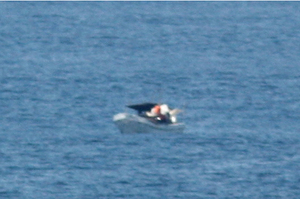
Back in May in this newsletter I wrote about the Star Princess, apparently failing to respond to distress signs, (not really signals) from a small boat, which was photographed by some birdwatchers who had been on the ship.
The birdwatchers informed one of the crew that they thought the guys in the boat were in distress, and were told that the message would be passed on. Nothing happened. Subsequently the surviving crew member of a small boat was picked up by a larger fishing vessel, his two fellow crew having died, and claimed that he had seen a cruise ship, and that it must have been the Star Princess.
Princess Cruises have recently published some evidence that the small boat which had contained the three unfortunate seafarers was not the one photographed by the birdwatcher. They have produced evidence showing that the boat adrift was called 50 Cent and the name was writ large on the bow. Since there is nothing written on the bow of the craft photographed it can’t have been the one.
THE UK ETVs
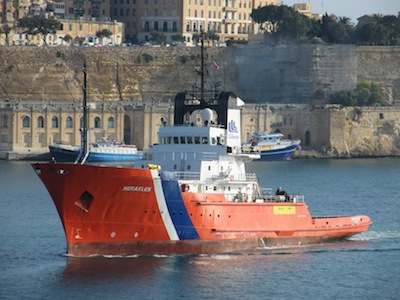
I suppose we might all have been hoping that the government would change its mind and continue with the ETV service around British coasts, but the sight of two of the former JPKnight vessels in Smit colours the other day may have put paid to all that. However the former Anglian Prince, now the Swedish owned and Maltese registered Herakles has returned to the western isles, until, if I read it right, 2015.
The vessels were put in place as a result of the Braer accident in 1993, when the tanker piled up at the southern tip of the Shetland Island Islands. So for the benefit of our legislators, how often is often for major accidents such as this. The answer – once in a thousand years. So only 999 years to go.