
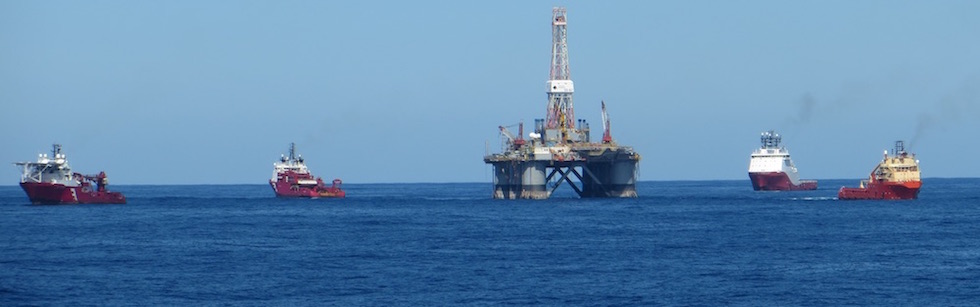

RECENT PIRATE ACTIVITY
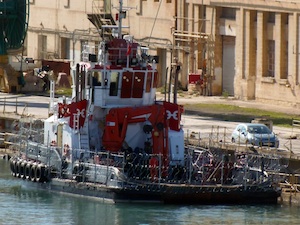
A small tug the Afon Wen, preparing for a trip through pirate infested waters. Photo Gaetano Spiteri
Sadly, although pirate activity continues off West Africa and at a lower level off East Africa, reporting in the national presses seems to have declined. It has ceased to be news that ships are attacked and the crews taken hostage, and in some cases their release negotiated resulting in an exchange of money. These events are still occurring, and mostly the personnel involved are from India, Pakistan, the Philippines or Indonesia. Indeed if it was not for the value of the ships and the cargoes one wonders whether anyone would bother to do anything. An an example of this is the saga of the Iceberg 1 which was taken hostage off Puntland in March 2010.
The ship and the crew were finally released on Christmas eve this year after a military action by the Puntland Maritime Police Force. This action was reputedly paid for by the owners of the cargo, and a figure of $1.5 million has been mentioned. Indeed it is suggested in the maritime press that the shipowner, Azal Shipping of Dubai had abandoned their ship and its crew, and on one blog it was alleged that they had stopped the crew’s pay after they had been taken hostage.
A slightly more cheerful story is that the three Italians and one Ukranian taken hostage from the Augusta PSV Asso Ventuno before Christmas have been released. One news report suggested that a large ransom had been paid. Here-in appears to be the difference between the Nigerian events and the Somali ones. Those taking ships hostage have no idea before they carry out the attack, of the nationalities of the crew, while the Nigerians are selective. They pick out Europeans, usually employed by Western companies, and therefore there is both the incentive and the finance which will result in a quick resolution.
THE CORMORANT ALPHA OIL LEAK
This just in! Taqa, the Abu Dhabi based oil company announced this morning, 16th January, that there has been, or is, a leak on the Cormorant Alpha platform. The platform has a concrete base, and concrete legs and apparently the leak is within one of the legs. The platform has been partially downmanned and production shut down. But possibly more importantly the platform is a hub for a number of other fields, and the export pipeline from it eventually surfaces at Sullom Voe. French company Total, which suffered loss of gas production from the Elgin Platform in early 2012 due to a leak, is one of the companies to suffer, since production from Dunbar and Alwyn North is routed to Cormorant A.
COSTA CONCORDIA
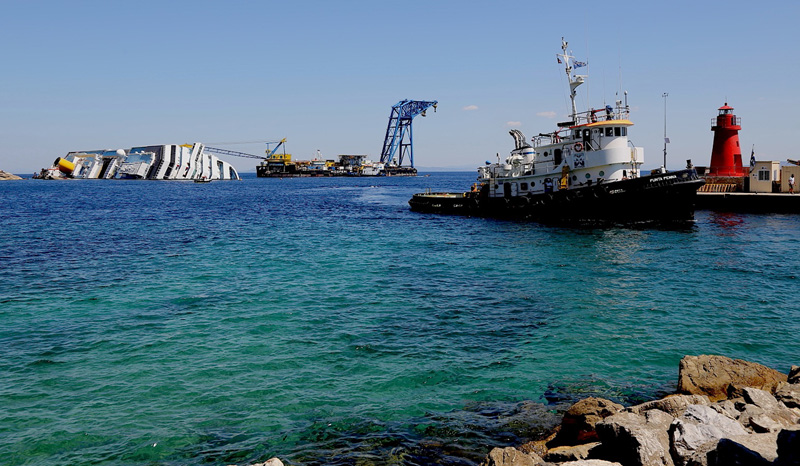
A photo from the Microperi website.
We are at the anniversary of the loss of the Costa Concordia, which has resulted in some new pictures and a bit of news.
The salvage companies are struggling on with their preparations to roll the ship upright and tow it away, and instead of this happening in a few weeks it is now scheduled to take place in the autumn. Without for a moment denigrating their efforts, are we surprised? It is a desperately difficult job. Usually when I am talking to non marine people about offshore activities, I sometimes say “you might be able to do this in the bath but you can’t do it out there.” When you see what they are doing, you would think twice about trying it even in the bath.
Meanwhile discussions continue about the reasons for the accident itself, and apparently the Italian investigation is stalled by the fact that the courts have the black box. The captain has not been indicted, and a couple of days ago gave an interview to an Italian newspaper. He claims that the helmsman had made two errors in his response to helm instructions, and that the officer manning the radar had failed to provide him with correct information.
Of course there are two sides to everything, but one cannot get away from the fact that the master is responsible for his ship, and he deserves the support of his management. And the ship was very close to the beach.
THE KULLUK INCIDENT

The Kulluk at work in the Beaufort Sea in the 1980s
During the last days of the Christmas holidays, for those of us lucky enough to be able to take them, we have been following the saga of the Kulluk. And as a commentator on marine events I wonder what the various parties involved are going to take away from the event.
The Kulluk is a floating drilling unit built in the 1980s by the Canadian company Beaudril, and operated in the Arctic together with a submersible caisson, the Molikpaq, which is now part of a platform complex offshore Sakhalin. They were serviced by four icebreaking supply vessels, the Ikaluk, the Miscaroo, the Kalvik and the Terry Fox. The latter vessels were for many years the most powerful supply vessels in the world. The Kulluk drilled five wells in the Beaufort Sea between 1983 and 1985, out of a total of about 100 wells drilled in the area between 1972 and 1989. However none of the wells resulted in the discovery of commercially viable quantities of hydrocarbons. As a result interest in the area waned and the Kulluk was laid up until revived and restored by Shell.
So, it appears that the Kulluk manned by 18 crew, probably the employees of the Noble Drilling company, was being towed south towards Seattle where it was due for maintenance work, from the Alaskan port of Dutch Harbour, by the brand new Edison Chouest anchor-handler Aiviq. Some people suggested that carrying out the tow at this time of year was unwise, but had been prompted by the possibility of an Alaskan asset tax being levied on the rig if it remained in state controlled waters.
If you Google Aiviq you can find lots of information about the ship, and in one report about it a Shell manager Pete Slaiby says “You only have one chance to do it right in Alaska and I feel this is proof that everybody takes our commitment to doing things in Alaska in an environmentally sound manner very, very seriously.” The ship is claimed to have cost $200 million so you can see what he means, but spending money is not the answer to everything.
But on with the saga. On 27th December the tow parted, in one report at a shackle, but who actually knows, but the ship re-established the tow, using the “emergency towing system”. They were probably breathing a sigh of relief when, according to the Coastguard timeline, the Aiviq lost power, but “generators were activated to help avoid significant drift”.
On 29th the crew were evacuated by helicopter, but it seems that the Aiviq has almost as much power available to its thrusters as it has to the main engines, about 20,000 bhp so the thrusters were used in an attempt to maintain station, and a second ship the Nanuq was connected. However, on 30th the tow wires failed and on 31st the rig grounded on Sitkalidak island. The Aiviq retired to Dutch Harbour, having had spares to be flown in by helicopter during the attempts to prevent the grounding. These were reputed to have been new main engine fuel injectors, and all hell broke loose in the media.
The reports focused on the amount of diesel on the rig which was reported as 155,000 gallons, which is 155 cubic metres. Shell rightly pointed out that the fuel tanks are well protected, and emphasized that this was a marine problem not a drilling one. Even so this distinction may have been lost on many readers who think that oil rigs are connected by some sort of pipe to the source of the oil at all times which unless properly controlled will result in complete environmental devastation, or else that all marine craft are the same as the Exxon Valdez. When it became apparent that there was not going to be any leak of the 155 cubic metres, of diesel there was a focus on the fuel tanks of the lifeboats which were pictures on the beach near the rig. Well come on!!
On 6th January the rig was refloated and towed by the Aiviq to what was considered to be a safe location for a thorough assessment of its status. I think it is still there.
From this point I wonder if those of us who have an interest in the whole business of moving oil rigs will ever find out what went wrong. Since the bollard pull of the Aiviq could be slightly less than that of the Terry Fox or the Kalvik it is likely that the rig’s towing system was suitable for the task, so was it just old? Or were new components substandard? And how on earth did an almost new ship suffer from an complete main engine failure while leaving the secondary power systems still operational?
But in the end, while the environmentalists will claim that the incident provides evidence that drilling should not take place in the Arctic, the oil industry can also claim that even though they had lost control of the event, nothing bad happened!
LIFE OF PI

“The Life of Pi” I hear you exclaim, surely that’s a film. It is, and I went to see it the other day. I’m sure I’m not spoiling anyone’s enjoyment by telling you that it involves a large number of animals being carried as cargo on a Japanese owned ship in the 1970s. I am still unable to get over the number of nautical errors.
Like all ship based films it tends to be rough on the outside and calm on the inside, but what else could you do? The alternative would be to watch the actors being thrown about, as boring on the screen as in real life. But the animal’s cages were not secured in any way, and a ship with cranes had a lifeboat with rope falls, oh and the cranes were not even stowed in a hurricane!
The lifeboat in which our hero spends many many days is riveted on the outside and fibreglass on the inside and is equipped with a Very pistol. And even when the sinking ship is under water the lights are still on. It must have looked good in 3D.