
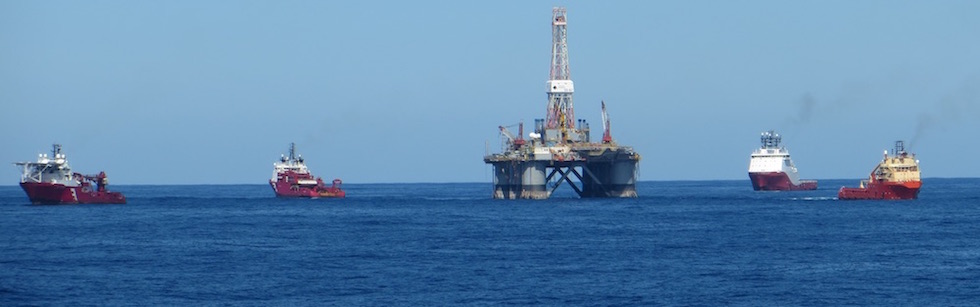

GREENPEACE AT WORK IN AUSTRALIA

A still taken from a video taken by Greenpeace of the assault on the Korean bulk carrier.
I’m not against environmental campaigning, but I am against people putting their lives at risk in the pursuit of publicity, because let’s face it, much of what environmental campaigners do is either to engender support, or for fun.
Here is a still taken from a video which was filmed by Greenpeace activists as they boarded a bulk carrier taking a cargo of coal from Australia to Korea. It was initially a bit difficult to see why they were doing this. Was it to improve safety in the Australian coal mines? Was it to reduce the carbon footprint developed by the ship as it took the coal to Korea? Or was it because they could do it? It might have been the last. They boarded the ship and put a banner across the bow, and filmed the event.
Apparently the real reason is, according to them, to publicize the fact that if you burn coal you do damage to the environment. We would agree? But we seafarers would suggest that there may well be places closer to Korea where you could mine coal and ship it. Even when coal was still being mined in UK, power suppliers imported coal from Australia, so obviously it should have cost more to ship.
But back to safety. These Greenpeace people often perform stunts like this, and in my view the only reason there have not been any accidents so far is that they do not do it quite often enough, with quite enough people, but it will happen. You can’t keep on doing dangerous stuff at sea without eventually having an accident. (Should I be addressing the intrepid FRC crews at this point?). Also featured in the video, dare I say ‘starring’ was the captain of the Greenpeace ship, the Esperanza. He was wearing a denim shirt ripped off at the shoulders and wrap around sunglasses. Is that what the cool captain is wearing these days? He probably has a teenage following on Twitter.
THE INDUSTRY UNITES!
As I was in the process of compiling this newsletter my copy of “The Telegraph” the Nautilus paper arrived, and it is full of stuff as usual. On the front page it reports that the Unions and owners are jointly to approach the IMO to demand the publication of accident investigations. They are also to be harangued by the International Federation of Shipmaster’s Associations in the near future. Nautilus has a particular interest into the loss of the Danny FII in 2009 in which two of their members died, as well as forty other crew members. I am particularly interested in the loss of the Demas Victory, in which 28 people lost their lives, mainly because no-one else is interested. Will anything change? I would love to be able to say yes, but I doubt it while ship registers proliferate purely as a means of making money.
MAERSK EEE
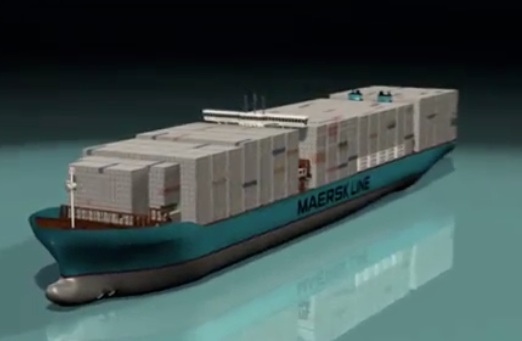
Maersk are telling us that they are within a few weeks of presenting the first of their 18000 teu container ships to the world. I find myself looking for good news, to make a change from what I mostly seem to comment on which are marine accident events. This may be because they make the news more often.
But the Triple E is quite something, a vast ship 400 metres long, so large that they have separated the superstructure topped by the bridge and the superstructure topped by the funnels. This class of ship, of which there will be twenty when construction is completed in a few years time, also has two engines two propellers, and two rudders. The company has initiated a special training programme on simulators to train pilots and the masters who will be in charge of these craft.
As well as the unique design of providing two propellers, they have also come up with a unique idea of operating the ships at a slower speed in order to save fuel, no, to reduce the carbon footprint.
But is this actually good news? Not for seafarers I suspect. It was suggested that the previous class of Maersk container ships would be operated by a crew of 13. I don’t know whether they were able to stick to this proposal but if they got anywhere close one assumes that the same number of people would be suggested for the EEEs. So the very small crew will only meet occasionally, mostly at the time of the change of the watch when someone who has just got up meets someone who is just going to bed. But with a bridge width of 59 metres you only have to walk across it 17 times for a kilometre.
THE JOLLY NERO ACCIDENT
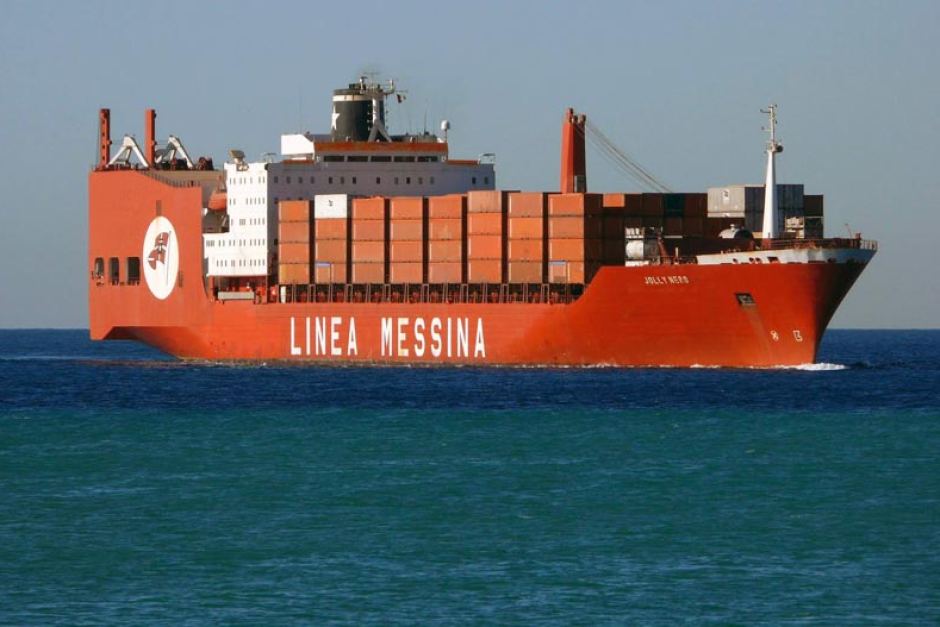
The Jolly Nero from one of the many sources on the internet.
At 2300 on Tuesday 7th May the multirole container ship the Jolly Nero crashed into the coastguard control tower in Genoa, causing it to collapse completely; partially into the harbour. Eight people were killed and a number injured. The captain of the ship seems to have been taken into custody and a team of investigators into the accident have been set up. According to the Italian news technical consultants appointed by the ‘prosecution’ include an Italian navy admiral and a rear-admiral.
There have been many photographs of the collapsed tower in the news, and one or two of the tower before the collapse. The tower was constructed on a mole sticking out into the harbour, more or less at the end of the channel from the berths. Even though it was out of the direct line of the approaching or departing vessels, it would not have taken much of a risk assessment to determine that it should have been positioned sufficiently far away from the edge of the quay for it to be safe from the possibility of collision (this may be the wrong word but it described the event).
The Jolly Nero is a thirty year old ship equipped according to the reports with a single two stroke diesel. In addition using a system which is at variance with modern engine controls it has a telegraph on the bridge which is rung by those in control there, and is answered by the engine room who then operate the engine. It is also suggested in one report that a pneumatic valve was not operating properly.
So if we assume these journalistic comments to be true the progress of the accident might have been as follows.
The ship would have been pulled astern from the berth by a tug attached to the stern. There was also a tug attached to the bow.
One assumes that the ship was then turned to starboard to make its way past a number of other berths towards the gap in the breakwaters and the sea. At this time the control tower was off to port out of the line of approach.
It is possible that the pilot then gave an instruction for an increase in speed, and maybe some-one rang half ahead. This is guesswork, and an Italian report suggests that there was a problem with the telegraph, maybe that the acknowledgement from the engine room was none operational, and that they were using radios.
Anyway, regardless of the means of communication, there was probably an instruction to increase speed. And then shortly thereafter for some reason the ship altered course to port in the direction of the control tower.
And here we get to the means by which the ship could go astern. Those in control on the bridge would give an instruction to stop the engine and then to go full astern, by what-ever means. Telegraph, radio or shouting.
This would require the engineers to stop the engine, and then to restart it in the reverse direction. If the reports in the Italian papers are to be believed the engineers succeeded in stopping the engine, but of course the ship was still storming towards the tower, but when they attempted to restart it in the reverse direction using compressed air, the system failed, and the ship continued onwards to hit the tower. This is all guesswork but if we don’t try to put something in the public domain the poor captain and pilot will be nailed up regardless.
SKANDI FOULA AND THE OMS RESOLUTION
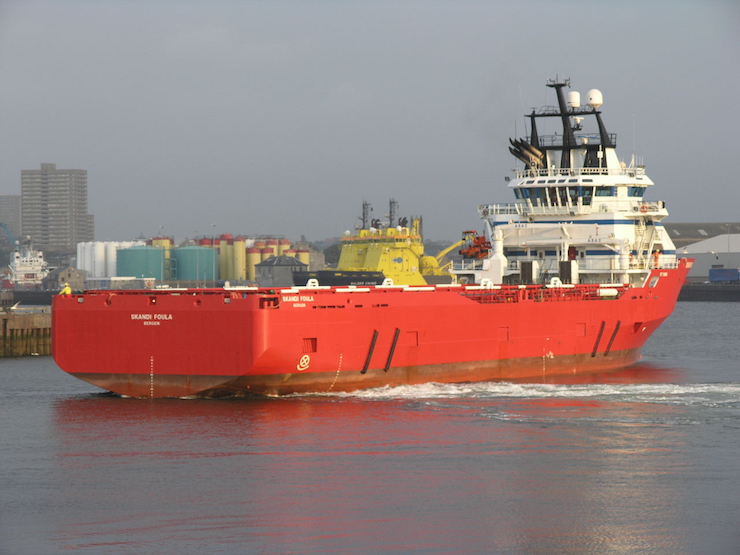
Skando Foula in Aberdeen Harbour. Phot Victor Gibson
I was looking for information about the OMS vessels the other day, in order to update the relevant page of the website, with not too much success I have to say, when I discovered this accident report from the MAIB.
Back in May 2010 the Skandi Foula, one of the DOF platform ships on hire to Shell, was moving from the Upper Dock in Aberdeen probably back to the River Dee berths. The ship had to pass between a berthed ferry and another vessel across the dock from it, through a gap which the report says allowed for a six metre gap on either side.
To do the job the master stood at the after controls while the Chief Officer drove the ship ahead from the forward controls. The MAIB report says that little time was given in preparation for the operation, and the checklist carried out failed to mention a mismatch between the control position and the readout for the port azimuthing thruster. Oh, salient, point this class of ship is provide with azimuthing thrusters at the stern rather than props and rudders, and for the move they were positioned about 20º out, so typically an increased thrust on the starboard thruster would result in the bow swinging to starboard. A description from the report follows:
As Skandi Foula navigated at less than 2 knots (kts) between the moored vessels her starboard quarter began to close on Hrossy. The chief officer briefly increased the power on the starboard azimuth thruster to compensate. This had the effect of then moving Skandi Foula’s port quarter closer to Geo Challenger and also increasing her speed. The master told the chief officer that the vessel’s port quarter was now closing rapidly on Geo Challenger, causing him to apply power on the port azimuth thruster to take Skandi Foula’s port quarter clear of Geo Challenger and neighbouring Amadeus. This increased Skandi Foula’s speed to over 4 kts and started a turn to port that offered her stem towards OMS Resolution. The chief officer applied full power to the tunnel bow thruster to initiate a starboard swing, but without any apparent effect. He shouted to the master that the ship was not responding, while simultaneously demanding maximum counteracting power to both azimuth thrusters as the master came to take control at the forward station. The master noted that both azimuth thrusters were in astern position and checked the bow tunnel thruster was fully engaged. In accordance with the vessel’s power management system, only 70% of the available power was allocated to the azimuth thrusters and the system automatically started an additional generator to cater for the increased power demand. However, before extra power could be delivered, Skandi Foula’s bow made heavy contact with the bridge wing of the moored PSV, OMS Resolution, shattering windows and damaging metalwork. Skandi Foula sustained damage mainly to her port bulwark area.
People used to do the same with the rudders on UT 704s. I always wondered why they did not use the rudders to steer. It’s easier.