
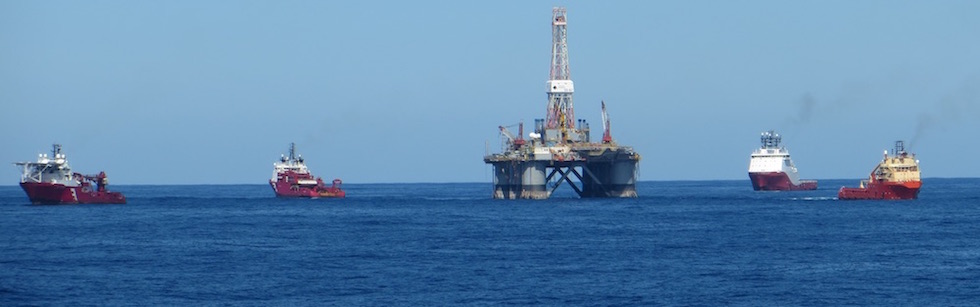

THE COSTA CONCORDIA IS UPRIGHTED

A screenshot form the live presentation on the internet of the wreck being uprighted.
On 17th September the air waves were electric as the team involved in the recovery of the Costa Concordia announced that they were about to take the dramatic step of uprighting the remains of the vessel. Over the previous few months we had been amazed by the sheer scale of the operation, which involved the installation of platforms under the water to extend the shelf on which the ship was resting and the installation of enormous tanks on the visible starboard side. The organization had then installed, I think, 24 jacks of some sort on the shore side and passed wires under the hull so that they would be able to ‘parbuckle’ the wreck into the upright position. I put the word parbuckle in inverted commas because the media focused on it, and constantly explained it. They also kept telling us that the ship weighted 114000 tonnes, and I though perhaps someone should tell them that the figure of 114000 gross tons is nothing to do with weight. But what’s the use, it’s probably a pretty silly measurement anyway.
But back to the big event. The job started on the morning of 17th and we were able to watch it live on a number of sites, in UK including the Daily Telegraph and the BBC. For a long time nothing much seemed to be happening but we bore in mind that in the marine world everything seems to take about ten times as long as we think it should. But then it was possible to see that the tide mark on the structure of the ship had risen out of the water, and in fact overnight the operation sped up and by dawn we were able to see that the ship was upright, but of course very low in the water. The job so far has cost about half a billion of our British pounds, and there is a lot more to do in the spring.
LOSS OF TWO CREW MEMBERS IN HEAVY WEATHER
The Nautical institute has published information about a recent accident on board a small cargo ship which resulted in the loss of the lives of two crew members. In six metre seas it was seen that some nylon mooring ropes were coming adrift at the aft mooring position which was immediately aft of the accommodation. Two guys were sent down on deck wearing lifejackets and attached to safety lines being paid out by other crew members. But while they were down there a large wave engulfed them and swept them over the side, breaking the safety lines. Despite an extensive search they were never seen again. Please see my previous items on keeping people safe in adverse weather!
PRIRAZIOMNAYA
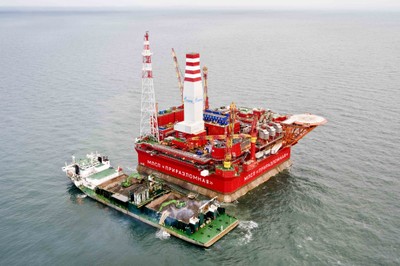
A Tideway rockdymber alongside the platform. Phot from the Tideway website.
The Priraziomnaya platform in the Barents Sea is in the news due to an assault by Greenpeace in mid September. This platform is actually a Caisson and was fairly recently put in place in water depths of about 20 metres. According to the Gazprom site a number of production wells are to be drilled from it. The plans on the Gazprom site give the impression that there are tanks in the bottom, and it appears that there are cantilever hose connections on the corners, giving the impression that the offtake tankers are going to cosy up to the rig in the same way as the Tideway rock dumper.
Maybe Greenpeace have achieved their objective in getting publicity for the operation, although this could be due to the fact that a Russian special forces squad abseiled down onto their ship the Arctic Sunrise, took it over and arrested the crew.
The Russians are now accusing some of the crew of piracy and have their ship under arrest in Murmansk. If found guilty they face several years in prison. Of course since the rig is not a ship maybe they could not be pirates.
Those of us who have observed the loony antics of some of these environmental protesters think that something should be done to curtail their activities, but spending time in a Russian prison may be a punishment too far.
REVISITING MACONDO
The Deepater Nautilus sister of the Deepwater Horizon from the Transocean website.
This month BP are back in court again but just to remind us of the traumatic experience of the crew of the Deepwater Horizon here is an extract from the testimony of the Senior Toolpusher, Miles Exell, who gave evidence to the USCG/MMS Investigation.
‘I remember a couple of people standing in the hallway, but I kind of had tunnel vision. I looked straight ahead and I don't -- I didn't even remember who those people were. And about the time I -- I made it to the doorway of the toolpusher's office was when a tremendous explosion occurred. It blew me probably twenty feet against a bulkhead, against the wall in that office. And I remember then that the lights went out, power went out. I could hear everything deathly calm. My next recollection was that I had a lot of debris on top of me. I tried two different times to get up, but whatever it was it was a substantial weight. The third time it was something like adrenalin had kicked in and I told myself "Either you get up or you're going to lay here and die". So, my right leg was hung on something, I don't know what still. But I pulled it as hard as I could and it came free. I attempted to stand up. That was the wrong thing to do because I immediately stuck my head into smoke. So, I felt -- I dropped back down. I got on my hands and knees and for a few moments I was totally disoriented. I mean I had lost orientation on which way the doorway was. And I remember just sitting there and just trying to think "Which way is it?"
Then I felt something and it felt like air. And I said to myself "Well, that's got to be the hallway. So, that's the direction I need to go. That leads out". So, I had to crawl very slowly because that end of the living quarters was pretty well demolished. Debris everywhere. But I made it to the doorway and what I thought was air was actually methane and I could actually feel like droplets. It was moist on the side of my face. I continued to -- to crawl down the hallway slowly and I put my hand on a body and it was Wyman Wheeler. I mean I didn't -- I didn't know it at the time because there was no light, I couldn't see. The next thing I recollect is I saw like a beam of light like a flashlight bouncing. And I saw that to be our electrical supervisor, Stan Carden. Along about that time Jimmy Harrell, the OIM, came out of his room. He told me he was in the shower when the explosion happened. He said "I think I've got something in my eyes." And I looked down and he didn't have any shoes either. And I said "Jimmy, I've got Wyman down right here." And he said "Yeah, okay. I got to see if I can find me some shoes." So, Stan and I were in the process of trying to remove some of the debris off of Wyman. And at that time or along about that time another flashlight entered and that was Chad Murray. And as soon as he got to where we could see him we asked him to go to the bow and get a stretcher. So, we continued to remove this debris off of Wyman. I helped him up and I was -- in my mind I was going to try to help walk him out thinking that that might be quicker to walk him out. Well, he made a couple of steps with his arm around my shoulder and he was in pain and he said "Set me down. Set me down." So, we set him back down and he said "Y'all go on. Save yourself." And I said "No, we're not going to leave you. We're not going to leave you in here." And along about that time I heard another voice saying "God help me. Somebody please help me." And I looked to where our maintenance office had been and all I could see was feet, a pair of feet sticking out from underneath a bunch of wreckage and debris. We -- we worked to get that off of this individual. We didn't know exactly who it was, but, when we got the debris off of this person, we saw that it was Buddy Trahan, who was one of the visiting Transocean dignitaries that came out for that trip. Looking at him we saw that the extent of his injuries were greater than that of Wyman's. So, naturally he got the first stretcher. So, we loaded him on the stretcher and it took three of us because we had to remove debris. It was hanging from the ceiling and the walls was jutted out, the floor was jutted up. I mean it was just total chaos in that area of the living quarters. But when we got him loaded on the stretcher Stan and Chad conveyed him all the way out of the front of the rig, the bow of the rig to the lifeboat station.
I stayed right there with Wyman Wheeler because I told him I wasn't going to leave him and I didn't. And it seemed like an eternity, but it was only a couple of minutes they came back with the second stretcher. We were able to get Wyman on that stretcher and we took him to the bow of the rig. When we got outside of the living quarters the first thing I observed is both of the main lifeboats had already been deployed and they left. I also looked to my left and I saw Captain Kurt and a few of his marine crew starting to deploy a life raft. And we continued down the walkway till we got to that life raft and we set the stretcher down. And after several minutes we had everything deployed and the chief mate, David Young, and myself got in the life raft and we were able to catch the head part of the stretcher and assist getting Wyman into the life raft, which I don't know if any of y'all ever been in a life raft, but it's hard to keep your balance and especially if you've got any type of weight. And I think we actually fell trying to, you know, get him into the life raft. But the main thing is Wyman was there. You know, he didn't get left behind.
From that point we were lowered down and I believe that was by Captain Kurt. We made it to the water. I remember intense heat. I remember fuel or oil or some type of hydrocarbon burning on the water extremely close to where our life raft was. And the painter was still attached to the rig. Well, we didn't have a whole lot of light. We were looking through the provisions trying to find a knife. I was pulling tension on the painter thinking by chance maybe it might part. When it did part. Okay, unbeknown to me at that exact moment it didn't part. It was cut. The captain of our rig was able to get a knife and cut the painter. And from that point I remember being thrown a rope from the fast rescue craft from the DAMON BANKSTON. And from there they were able to tow us to the BANKSTON and safely away from the rig.
In the days when only the litigation makes the news we should reread this.
NOTE: I think from the investigation reports a guy in the Damon B Bankston FRC handed a knife to the Captain of the rig.
PETROBRAS AND DP
More about Petrobras and DP. I have not included a photograph of a DP rig just in case our readers think that it is one of those mentioned by a guy from Petrobras who made a present-ation in 2009 at a DP conference in Houston.
His paper went into some length on what ESD systems were required for mobile units, and how they might be operated, focusing specifically on the locations of ESD buttons around the rig. Apparently in general there should be two buttons in different locations, but one has to admit there is a tendency for buttons to be located all over the place. He went on to describe three alarming incidents where DP units had been shut down.
- On a 6th generation deep water drill ship some-one operated an ESD switch near a lifeboat and blacked the rig out.
- While waiting for the commencement of a contract someone intent-ionally operated an ESD switch near the helideck and blacked the rig out.
- While performing a DNV test on one of the F&G emergency stations the operator made a mistake and pushed the wrong button blacking the rig out.
The message here seems to be, only install ESD buttons in places where trained and responsible people can operate them. He concludes that as a means of improving the reliability of DP vessels the existence of ESD buttons can be the source of problems rather than a solution. He is probably right!