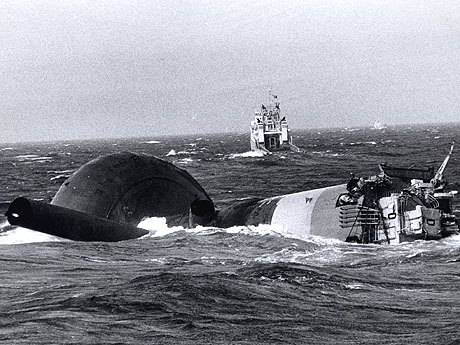
The accommodation rig Alexander L Kielland suffered structural failure and capsized while at work in the Norwegian Ekofisk Field on March 27 1980, with the loss of 123 of the 212 men who were on board at the time. The Norwegian government immediately appointed a Royal Commission to investigate the accident, which reported in November 1981.
THE VESSELS INVOLVED

This is the Petrolia. A Typical Pentagone. This one has been modified in the aftermath of the accident.
The Alexander L Kielland was a five column semi-submersible with each column terminating at the bottom at a circular pontoon. All the columns were interconnected by horizontal and diagonal bracings. It was 101 metres (331 feet) long and had a maximum width of 97 metres (318 feet). The rig had been designed by Forex Neptune and had been built as one of a number of “Pentagone” designs at the CFEM yard in Dunkirk. 10 were built at the CFEM yards in France, three in Finland and one in USA. The Alexander L Kielland had been built as an exploration rig but had never been fitted with a derrick. As a class the Pentagones were designed to work in water depths of up to 200 metres (670 feet). They had two moorings per column, each consisting of 1500 metres (4920 feet) of 2¾” wire terminating in a conventional anchor. The Alexander L Kielland was delivered to its owners on July 5 1975. The conversion of the unit to an accommodation rig and the gaining of the approvals from the Norwegian authorities took a considerable time.
As an accommodation unit, and therefore subject to the Norwegian Petroleum Directorate regulations for platforms, the rig was provided with seven Harding lifeboats each 26 feet (7.9 metres) long with seating for 50 people. The engines were SAAB 2GRGs installed because they were approved by the Norwegian Maritime Directorate as being to be able to continue to operate, even if inverted. The fall release gear fitted to the boats required them to be in the water before disconnection, effectively “off load” systems.
In addition to the lifeboats the rig was provided with 20 liferafts each with a capacity for 20 people. The rig was also provided with a total of 541 lifejackets. Norwegian regulations did not require survival suits to be provided, however some personnel on the rig had them, although some suits had been left on other Ekofisk platforms.
In the post accident activities there were two Solstad supply vessels involved the Normand Vibran and the Normand Skipper. Although the report does not choose to describe these vessels they were both PAT 75 designs, 59 metres (193 feet) long with 6000 bhp available. It is likely that they were provided with variable pitch propellers and had a single low power bowthruster. Solstad have replaced both these ships with modern vessels with the same names so finding details is not easy, however the Normand Vibran was operated as a standby vessel by the British company Nomis for some years. Also mentioned in the report but taking no part in the recovery of the survivors was the Silver Pit which we know due to its involvement in the Piper Alpha accident was, in any case, of limited capabilities.

A PAT 75 in its role as a standby boat.
PREAMBLE
The rig had spent the nine months prior to the accident anchored close to the Edda 2/7 C platform in the Ekofisk area of the Norwegian sector of the North Sea. The rig’s five columns were named A,B, C, D and E starting from starboard aft, so that the C leg was effectively the bow, and on top of it was a small Pilot House which would be occupied during rig moves. Each of the columns was provided with two moorings and so the A, B, D and E legs had their anchor wires deployed. It was usual practice that when high winds and rough seas were experienced the rig would recover its gangway, which had provided the walkway to the platform, and would move away to a safe distance by tightening up on the A and E leg moorings and slackening the B and D leg moorings.
SEQUENCE OF EVENTS.
March 27 1980.
Afternoon. In wind speeds of 16 to 20 metres per second (35 to 40 knots) and wave heights of six to eight metres (23 feet) are experienced and the shift of the rig away from the platform commences.
1750. The shift of the rig away from the platform by means of adjusting the forward and aft moorings is completed.
1820. Completely without warning Column D breaks off and the rig heals over almost at once to an angle of about 35 degrees.
1829. The platform manager on the Edda 2/7 C logs the fact that he has been informed that the Alexander L Kielland has sent out a Mayday. The text of the message is “Mayday, Mayday, Kielland is capsizing”.
From the platform it seems that the rig is continuing to list over slowly until it appears that only anchor wire B1 is preventing the rig from capsizing.
After 1829. The investigation determines that Column E quickly fills up with seawater, through the vents and the lift shaft, and that soon Column C also starts to fill. The deck spaces and the underdeck spaces in the upper hull also begin to fill due to the accesses being left open.
1835. The Phillips offshore manager receives a message on the emergency “red telephone” from Edda 2/7C. Also Rogoland Radio receives the information about the casualty and makes an all stations broadcast. This results is response from rescue services in Scotland, Denmark, Germany and the Netherlands.
After 1835. Lifeboat No 1 gets away from the rig.
1853. Anchor wire B1 has parted and the rig continues to heel over and capsizes completely, floating upside down in the sea. At this time lifeboat No 5 is released from the falls and floats upside down with 14 people inside.
1900. Rogoland Hospital is alerted and an emergency office is set up at the hospital.
1915. One man who had been holding on to the external ropes of a liferaft is located by one of the supply vessels and lifted aboard.
1930. The Normand Skipper finds lifeboat No 5 and 12 people are evacuated leaving 19 on board. The boat is thrown against the hull of the ship several times and so it is decided to terminate the operation.
At this time The UK rescue services dispatch two Sea King helicopters and a Nimrod aircraft, and the first Norwegian rescue helicopter takes off from Sola.
2055. Lifeboat No 1 contacts Ekofisk H and Normand Skipper by radio on 2182 KHz.
2115. An emergency team from Rogoland Hospital make their way to Sola Airport and set up a triage station, although it is not so described in the report.
March 28 1980.
0120. Lifeboat No 1 is observed by Normand Vibran six miles northeast of the platform. In adverse weather it is determined not to try to transfer personnel in the prevailing conditions, however the Normand Vibran manages to throw a portable VHF radio across to the lifeboat, and so communications are improved.
0130. The first person is evacuated from lifeboat No 1 by a rescue helicopter.
0200. One of the supply vessels locates the liferaft with five people aboard, and they attempt to jump aboard. One person does not make it and falls into the water and is lost.
Also at this time a raft with two people aboard is located by the other supply vessel, and they are taken aboard.
0230. The first person is taken off lifeboat No 5 by a rescue helicopter.
0400. The last person is taken off lifeboat No 5 by a rescue helicopter.
0500. The last person is evacuated by helicopter from lifeboat No 1.
March 29 1980.
1900. The rescue operation is officially terminated. 89 survivors have been recovered, and 40 bodies have been found. 83 people are still missing.
THE INVESTIGATION.
The investigation was extensive and in some respects concentrated on the construction of the rig in CFEM Dunkirk. It was established that a fracture had occurred in what was designated as bracing D6 which connected the D leg to a horizontal bracing between the C leg and the E leg. It should be noted that there was no connection directly between the C leg and the D leg to allow supply vessels to tie up close under the crane which was situated on the Main Deck equidistant between the C and D legs.
The reason for the fracture was that, during the construction, a hydrophone had been inserted in the underside of the bracing and that this had resulted in the beginnings of a crack. The technical assessment carried out on the bracing indicated that this crack had occurred prior to painting and that therefore it had been in existence before the rig entered service. The result of the break was that the two diagonal braces to the D leg and the other horizontal bracing between the D and E legs soon failed.
The investigation determined that even if both the C and E columns were filled with water, it would still require a considerable volume of liquid to enter the deck spaces through open accesses for the rig to overturn.
When the leg broke off the angle of heel was such that the main engines stopped working since they were only intended to operate up to an angle of 15 degrees. The emergency generator never started up since it was only supposed to operate up to an angle of 22.5 degrees.
At the time of the accident most of the personnel aboard were watching films in both the main cinema which had limited accommodation, and a larger temporary structure which had been set up in the Sack Store. Others were still in the Mess Room eating. Apparently the rig was being prepared to resume its role as a drilling rig and there were quantities of heavy oilfield equipment in the store. As the rig heeled over it was established that some of this equipment, none of which had been secured in any way, slid across the deck and crashed through the cinema bulkheads. In addition none of the seating in the temporary cinema was secured in any way and so the result must have been chaotic. It is a bit surprising that anyone escaped from the space. The report goes on to discuss the actual locations of everyone they could identify and the means by which they had escaped or failed to escape. Certainly some of the losses must have been due to the failures to launch of boats No 3,4 and 7, although there was uncertainty about precisely what happened to which boat mainly because those who survived were not sure which boat they had been in.
The investigators described the manner in which the boats were launched. No 6 boat had been mounted on the D leg and therefore was not available, additionally no effort was made to launch boat No 2. Boats, No 3, 4 and 7 were all smashed against the hull while attempts were being made to release them from the falls, and in some cases personnel were seen to be escaping from them. No 1 boat got away from the rig with 26 people on board. 14 people embarked on No 5 boat but it was not launched. But as the rig capsized it was released from the falls, and ended up upside down. Some survivors in the water, together with those inside the boat managed to right it, and there-after, with some difficulty due to the small size of the access hatches, a further 19 people were pulled aboard. An effort was made to start the engine, but the result was only a release of smoke and oil. (So, so much for the ability to operate upside down.) So finally there were 33 people on board.
No liferafts were released (There were 12 throwover rafts and eight davit launched rafts on board) but some floated off during the capsize. Some rafts were also thrown over from the Edda 2/7C. These had a capacity for 12 people.
Later nine men were found to have boarded one of the Edda 2/7C rafts and two men were able to board one of the Alexander L Kiellandrafts. A further man was found holding on to one of the other 20 man rafts. He had been wearing a survival suit which had filled with water and as a result he had been unable to pull himself aboard. In the narrative of the report the difficulties experienced by one of the survivors in his attempts to inflate one of the rafts are described. He began pulling out the cord with which the raft could be inflated, but over time his hands and arms became so numb that he had to keep on pulling the line out with his teeth. But he was finally successful and managed to get aboard with one other survivor. They were so cold that they were unable to do up the hatches on the raft.
Seven survivors were picked up by the supply vessels working in the area, and seven were recovered by the personnel basket hanging from the Edda 2/7C crane. Of the 212 men on board the Alexander L Kielland, 89 were saved and 123 lost their lives.
No-one was saved by the Silver Pit the standby vessel mainly because it thought that its sole job was to stand by a platform six miles way.
The report summarises the provision of the rescue craft of all sorts which had participated in the operation. These were eight helicopters from Helikopter Service A/S, the commercial service on hire to Ekofisk and 11 Sea Kings, three Norwegian, four British, two West German and two Danish. There were also one Norwegian fixed wing aircraft, and four British Nimrods. There were also 80 vessels involved, 71 civilian and nine naval vessels. Of the naval vessels there were three from Norway, three from Britain, two from the Netherlands and one from Denmark.
Initially radio coordination was carried out by Ekofisk Hotel, the coordination centre usually used for marine and helicopter operations in the area, but gradually as more and more assets arrived the station was overwhelmed and then the first British Nimrod was appointed as On Scene Commander of the air traffic.
The investigators went on to make recommendations, and the report included what is virtually a philosophical discourse on how to minimise the possibilities of accidents, primarily by suitable prevention techniques. In this discourse they discussed the limitations there are in the oversight of all activities relating to the construction and operation of mobile units. Typically, they determined that there were insufficient hours in a lifetime for all the welds on a mobile unit to be non-destructively tested. But they generally recommended that safety factors relating to the operation of these structures should be enhanced.
Quite specifically they decided that moorings should be inspected once a year, and that the means of detecting the ingress of water into what should be watertight compartments should be initiated.
The also suggested that the content of operations manuals should address various factors concerning structural strength and stability.
Practically the Commission determined that the initial point of downfloooding should be at a point beyond the angle of heel which might result from any two compartment damage (probably). Within the many pages of discussion it is left to the reader to take from them what they think will be most applicable and this resulted in rigs which operate on the Norwegian continental shelf being constructed so that on the loss of a complete column they would not sink.
The report goes to considerable lengths to discuss the possibilities of watertight doors being operated, both locally and remotely, this at least in part due to the fact that many watertight closures were known to have been left open on the Alexander L Kielland. And the report acknowledges that it is difficult to get people to close doors, when they appear to be many metres above the waves and the sun is shining. And all this discussion relates to the importance of at least part of the deck of a semi-submersible being buoyant to keep the structure afloat the right way up after an extreme failure.
It is suggested that as part of new regulations there be better control of variable weights on board, and that an inclining experiment be carried out every four years.
After dealing with the rig itself, the Commission went on to discuss the emergency procedures and the equipment provided. They felt that the emergency procedures, or as they have it “The Emergency Preparedness Plan” should be developed by the operator of the field, and reviewed for its suitability by the authorities.
Thereafter they considered the standby vessel, and the fact that the Silver Pit had never got anywhere near the accident until well after it had occurred, because it had been stationed elsewhere in the field. Because of this they did not discuss the failings, if any, of the standby vessel, but they did determine that each platform, or rig, unless they were combined as one unit should always have a standby vessel within one mile of it. And even though the standby vessel did not participate in the rescue activities, the two supply vessels were both involved in the rescue. The Commission therefore determined that even though supply vessels were not guaranteed to be within range of a disaster should one occur, since they would primarily be going about their normal business, nevertheless they should be provided with suitable equipment to assist with recovery of personnel from the sea.
They then considered the helicopters involved in the rescue, and what they shortcomings might have been. There was a commercial helicopter in the field, which was activated straight away, but which was unable to carry out any rescue operations due to the lack of a winch and suitably trained crew. The first Norwegian rescue helicopter to arrived did so after more than two hours had passed, and it was necessary to fly a pilot from another location on the mainland in order to get the second helicopter into the air. The Commission therefore made many recommendations about the location of rescue helicopters, the training of the crew and the provision of rescue equipment. They discussed, but did not come to conclusions about, the differences in size of possible rescue helicopters. The Bell aircraft usually located at Ekofisk were considered to be too small, however large helicopters might well have difficulty starting up in high winds, the most likely circumstance when rescue would be required. They recommended that further investigation be carried out.
The Commission went on to consider the lifeboat systems on the Alexander L Kielland, and made many recommendations dealing specifically with their failings. Firstly they decided that rigs should be provided with 200% lifeboat seats, that the release hooks and the design of the wire used to lower away the boats from inside should both be improved, and that the standard provision of lifeboat stores should be reduced and replaced with blankets and heaters – the last due to the fact that the people in the boats had become very cold. They also recommended an improvement in the communications systems, i.e. the provision of VHF radios in addition to the standard lifeboat radio, and they discussed the self righting properties of the boats, and the possible means by which this could be improved. While it was obvious that one of the major failings had been the “off load” release systems the Commission was reluctant to recommended “on load” release systems due to the possibility that the boats could be released while still above the sea, and therefore injure or kill the occupants. This had happened on at least one occasion in the Norwegian sector. However they recommended an investigation to find a solution to this problem.
The liferaft capacity of the Alexander L Kielland was 200% and the Commission decided that this was adequate, and that in future rigs should be provided with 200% capacity for up to 100 personnel on board, and 50% for the personnel in excess of this number. They also decided that since they had recommended an increase in the lifeboat capacity it would not be necessary for the liferafts to be other than throw-over type.
During the accident eight people had donned survival suits. Four had survived and four had not, and seven of them had not donned the suits correctly. However one person had survived for two and a half hours in a suit, giving the investigators confidence to recommend that by some means everyone would be provided with a suit. By the time the Commission reported there were requirements in place on the Norwegian Continental Shelf for personnel working offshore to be provided with a helicopter flight suit, they further recommended that there should be 200% survival suits on board each installation, and that in combination with suitable lifejackets they should ensure that personnel in the water would float face up.
It is possible to link the content of the report concerning training and drills. The Norwegian regulations at the time did not require that the industrial crew, the personnel who were accommodated on the rig but who worked on the platform, to undertake any safety training. Also many of the crew members of the rig had been exempted from formal training due to their former marine experience. Drills were, it seems, undertaken solely to conform with the regulatory requirements, and consisted of a muster at lifeboat stations. While the Commission recommended an improvement in both the training and drills, they accepted that there was already a reluctance to attend drills, and so it was recommended that in some way a means of involving crew members positively in safety should be achieved. They required specifically that on the first visit to the rig of any person they should be shown round and introduced to the safety features thereon.
In the final sections of the report it appears that the Commission was recommending some form of risk assessment process so that the risks to offshore installations could be predicted, and means put in place to minimise them, and also that the activity of improving safety should be a continual process.
The narrative compiled here is at best a summary of what is an extensive section of the report, presented in a complex manner, maybe in part due to the fact that it has been translated from Norwegian. However, the overall message is that the means of improving safety on offshore installations is not in the least a simple process, and just assessing the actual failings which were evident in the Alexander L Kielland disaster would be insufficient. In the next section some of the results of this enquiry are discussed which may provide a little more clarity as to what might have been intended.
COMMENT
It probably comes a surprise to us all that the Norwegians had not sorted it all out by 1980, but it is evident from the report that in that year they were not in much of a better position than the Americans or the British. But there were some direct results of the accident which could be seen in later construction, and in some cases modification.
As already mentioned when the Aker 4.2 was constructed, which was an extremely large semi-submersible the builders installed a whole load of sensors at connections on the hull, and the columns with a presentation on board in the Pilot House. It looked good, but probably didn’t do much. In addition semi-submersibles were becoming equipped with means of detection of liquid in the bracings. The means ranged from sensors with a read-out in the Pilot House or the Control Room, to little taps at the ends where there were connections to the hull, which someone was supposed to go round every day and check. Indeed the most primitive systems involved sounding pipes in a multitude of positions which would have provided continuous employment for one crew member. However, having gone this far, some owners were unsure of the purpose of the detection system, which was of course intended to show those on board when there had been a structural failure. Many thought that it indicated a stability problem and that the bracings required to be drained in some way.
While the Commission made many recommendations which were specific to lifeboats, it is unlikely that much was done on mobile units which were usually required to conform with SOLAS regulations and areas of the MODU Code.
By 1986 the influence of the Alexander L Kielland disaster was being felt in many aspects of construction for Norwegian registered rigs. One four legged semi-submersible was built so that even if one of the four columns was lost it would still remain afloat more or less the right way up. There were only two non watertight doors on the rig, one on the forward side of the Pilot House and one on the aft side. The Pilot House was situated on the highest point of the accommodation.
The Commission was right on the money when it came to identifying the lack of enthusiasm for drills. Even today the process is mostly limited to weekly gatherings at the lifeboats or elsewhere, rather than any meaningful exercise. In the UK sector of the North Sea the regulations have required that all offshore installations including mobile units be provided with a “Temporary Refuge” in which people can muster and at least be temporarily shielded from misfortune. And so it is common practice for personnel to be mustered inside the accommodation which usually makes up the TR, and then to move off to the embarkation stations where they will wait for a bit, and then go about their normal business. Often in order to reduce the inconvenience for the catering staff, mustering will take place in an alleyway, or in a space which would not be large enough for the complete crew – this because everyone who is working misses out on the drill. In the Gulf of Mexico there is no requirement for a TR and so people will muster at the boats and then go away.
Finally the Commission spent much time discussing what we have come to know as door discipline, since it was evident that the Alexander L Kielland sank so quickly due to the fact that there were so many doors open. If this missive has been read from the start it will be by now evident that one of the problems with floating offshore installations is that people will leave doors open within the structure, even if they are designated as watertight, and will leave watertight and weathertight closures open on the deck because after all, they are a long way above the sea.