
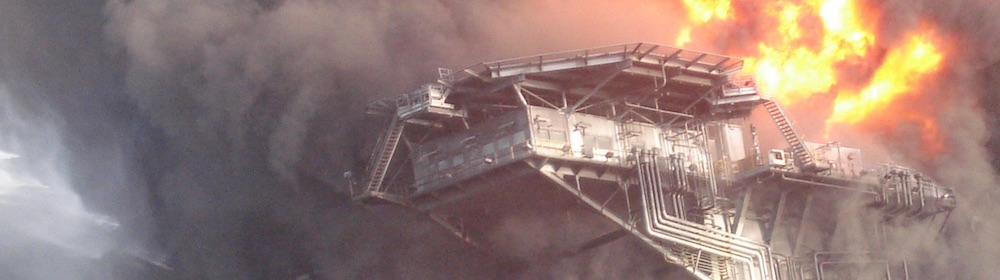

On 14th November 2019 there was a collision in the Sabine pass waterway between the offshore vessel the Cheramie Bo Truc 22 and the tug barge combination Mariya Moran/Texas.
The report is fascinating for a number of reasons, and we’ll start with the Cheramie Bo Truc No 22. It was 167 feet long and was crewed by a master, mate an unlicensed engineer and two ABs. Count them, that’s five guys. So we can probably assume that it was a vessel of under 200 grt, and hence required a very small crew with the minimum levels of qualification. The report did not choose to tell of their experience and qualifications, and anyway the captain did not feature in the accident except that, in accordance with company requirements, he tested the team for alcohol consumption. The Cheramie Bo Truc No 22 was built at the Bollinger Shipyard in 1975, it was a typical traditional gulf oilfield vessel with squat funnels half way down the main deck and a wheelhouse which looked as if it had been salvaged from a tug. It had 2000 bhp available, but the report does not tell us anything else about the propulsion or the rudders. Even when it entered service it was out of date; in 2019 it was 44 years old.
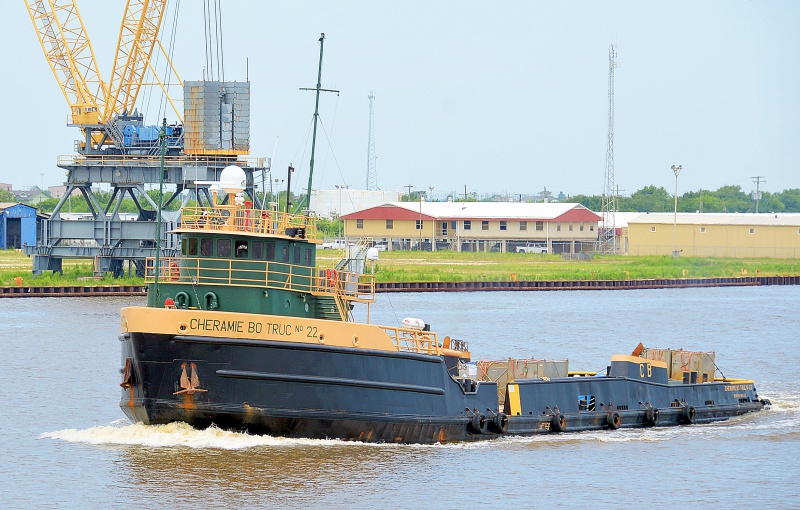
Photo from Shipspotting
So we should bear in mind that by 2019 the offshore marine industry was scrapping perfectly viable vessels all built after 2000 just to keep in business, but somehow this ancient vessel had kept going. Actually it is not really “somehow”. The reason it was still in service was because it was so cheap to operate, and it was probably one of the few left in the gulf under 200 grt, and hence able to operate with a minimum of essentially unqualified staff. Of course I could be wrong about that, there may be a lot of them, which does not actually make the situation any better.
The Mariya Moran was a 6000 bhp tug, connected to the oil product barge Texas by mechanical links. The tug/barge combination was inbound with pilot on board.
The mate of the Cheramie Bo Truc No 22 had been assigned the task of taking the supply ship to sea from the Genesis Energy berth in Sabine and the report says that on leaving the berth he had attempted to engage the auto-pilot, but had been unsuccessful and so had to resort to hand steering. The report fails to tell us the means of steering, was it a wheel with a compass in front of it. Or could it have been a little lever, which pushed to port would result in port rudder, or to starboard would result in starboard rudder; if it was the little lever then there would be no automatic return to midships of the rudder.
The means of steering is important because the report tells us that the mate never established a heading while at the controls. The vessel moved randomly back and forth across the channel at one point almost making contact with two laid up jack-ups. And finally when it was moving from one side of the channel to the other in front of the Mariya Moran, despite that comments of the engineers and the AB who were advising the mate as to his possible next action, the supply ship was impaled on the bow of the barge.
The report says that the tug had no assigned helmsman and that before the collision the mate of the tug who had been steering, handed over the steering to the pilot and went outside for a smoke. It was not until the pilot tapped on the window to get his attention that he realised that something was up.
I had never seriously thought about this but it was common back in the previous century in the North Sea for the captain or the mate to steer the ship, and probably its still the same now. The industry does not go in for helmsmen. When I worked briefly in Saudi my little ship’s autopilot did not operate properly in shallow water and one of the routes we worked required me to steer the ship for a couple of hours. None of my three ABs knew how to steer, but they were bright guys and so I taught them and it took the weight off me.
So it seems pretty obvious to me that the mate of the Cheramie Bo Truc No 22 had not learnt to steer, being usually able to rely on the auto-pilot. But doubtless his job was made a bit more difficult by the ebb tide. When I was an apprentice we all had to qualify as EDHs, Efficient Deck Hands and one part of the job was many hours behind the wheel, and finally a qualifying hour steering. So what’s going on?