

Yes, its that day again. This time I have been waiting for it, while reviewing what is happening out there in the world for seafarers. And, yes, it is also Goats Cheese Day and National Catfish Day. When the day was initially proposed in 2010 the IMO resolution determined that it ‘encourages government, shipping organisations, companies, shipowners an all other parties concerned to duly and appropriately promote the Day of the Seafarer and take action to celebrate it meaningfully’.
The Secretary-General of the IMO more recently said ‘The landbound among us are often “seablind”, unaware of the crucial importance of shipping until a crisis strikes. On this International Day of the Seafarer, let us honour the courage and skills of mariners, and stand with them to weather all storms.’
So it seems that this day of the seafarer is limited to those sailing on merchant ships, but surely some guys out there on military vessels are under stress, suffering from a variety of misfortunes, or maybe they are some sort of alternative breed of humanity. I only mention this because as well as all the ships and the guys on them which are still stuck in the Arabian Gulf there is the American military who are out there working beyond the call of duty, some having been there well in excess of their intended period of duty. I have no idea about how naval work/leave ratios work, but am aware that most naval vessels spend some time in port instead of at sea, being repaired and brought up to spec and doubtless the crews thereon can spend time with their families or good friends.
In this line of thought I noticed that a few weeks ago a British nuclear submarine returned to its home base to be greeted by the prime minister and doubtless other more minor functionaries, after it had spend 206 days at sea, all of them under water. It is difficult to imagine how really crappy such an assignment must be unless you are really well paid for it. Or perhaps the in port timing of the boat’s schedule makes all that worthwhile. But even so, 206 days under water, moving along at an extremely slow pace and, possibly alarmingly, never quite achieving the stealth requirement which might be hoped for, since nuclear propulsion does not allow for the stopping of all pumps and auxiliaries.
Out in the other world we are at some sort of a crucial stage in the Strait of Hormuz problem. Thousands of seafarers are currently stuck on board their ships at anchor in the gulf, instead of making their way across the oceans of the world, some of them at least on their way home for leave. But they are mere pawns in the current political conflict. Only two days ago on 23 June the Secretary-General of the IMO said that action was being taken to release the many trapped seafarers from their current prison. Naively I thought that this meant that there would be crew changes taking place, with chartered aircraft flying into the gulf airports and relieving the crews en mass.
That is what it sounds like, but actually the intent seems to be that ships will be helped to depart from the gulf by using a route developed by the government of Oman, close to the Omani coast, because - although it does not say it - apparently the official routes are full of mines. Apparently ships will be contacted individually and their departures co-ordinated. In fact, quite a few Iranian tankers have made their way out of the gulf as have a number of Chinese heavy lift ships. And in all this we should not forget that twenty-four seafarers have lost their lives in a conflict they did not sign up to be involved in. I have been attempting to find out how the IMO initiative is going but have been unsuccessful. The fate of the thousands of trapped seafarers is just not that interesting, even though we are finding out how Iranian crude oil is getting on, and Maersk have reported the departure of two ships after the company conducted detailed security assessments in ‘co-ordination with its regional security partners’.
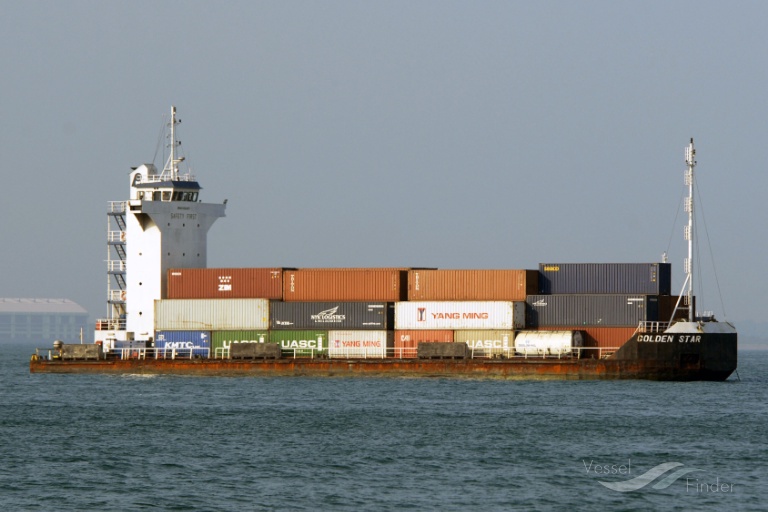
The Golden Star 1 from Vessel Finder.
Meanwhile, out in the Far East, a feeder container ship with a regular route between Singapore and a couple of close port sank with no loss of life, which prompted a bit of journalistic work about the Tanzanian registry. The ship was the 1995 built Golden Star 1, which suddenly disappeared beneath the waves on 6 June. At 31 years old it had skipped through multiple registries and at the time of its demise was part of the Tanzanian registry. The narrative relating to it suggests that it might have been at the time of the approach of special survey that the registries changed, and thereafter it was questioned why the authorities in Singapore had not investigated the ship. It was, after all, in port there every couple of days.
And the Tanzanian registry! It has spectacularly failed to be in any way to be responsible. Ships on its registry have been sunk, arrested from drug running and detained by port state inspections on multiple occasions. In the last year for which records are available 2024/5 twenty-six Tanzanian ships were abandoned with the crews on board and wages owing. The same apparently as St Kitts and Neves.
In all this what concerns me most is that crews are supplied routinely to almost every ship in the world by crewing agencies, and seafarers are under the assumption that the ships on which they are to serve are registered with a reputable flag, and are properly administered. How wrong they can be, but once they have taken the step of getting on the aircraft to get them to wherever the ship is, they are stuck.
But on the bright side, remember that misfortune off the UK coast when a small container ship ran into the US flagged tanker Stena Immaculate at full speed. The twenty-three man crew received ‘The Gallant Ship Award’ at National Maritime Day in Washington. Their award was given because the crew was recognised for its ‘co-ordinated response to a March 10 2025 allision (collision I would have thought) in the North Sea, safely evacuating without serious injury and helping prevent greater, vessel cargo and environmental damage’. We wouldn’t want to take anything away from them, but it sounds as if they received the award for successfully running away.
In this year of the seafarer I have not gone on a lot about the inability of seafarers to go ashore anywhere. Surely more important is their ability to get to the end of their voyages, and to get paid and to remain alive. But lastly just a couple of words about the few ships with English speaking crews working in the far north of the North Sea. On 27 June BBC transmissions on long wave will cease. Up there in the north BBC Radio 4 has remained an outpost of news and entertainment, to the point that the Russians have constantly played military music on the same frequency to prevent the Russian populace from listening to it. So now it will be gone, without a thought for those who have relied on it. But take heart guys, you are still better off than the catfish.