

This is a day which was promoted by the IMO (The International Maritime Organisation) to allow us, the general public, to appreciate what seafarers do for us, transporting much of the stuff we use, eat and drink across the world. Co-incidentally it is also Goat’s Cheese Day when we check out the goat’s cheeses in our local area and try them out, and also National Catfish Day. Not, of course, a good day for catfish, since we are encouraged to cook up some at home.
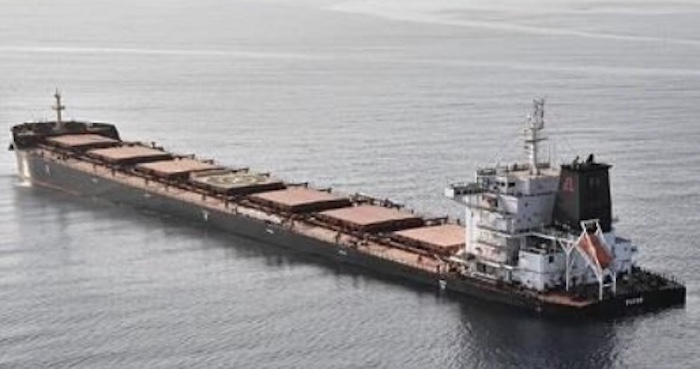
The Tutor while still afloat. Internet photo.
But anyway, lets have a look at how things have been for seafarers over the last twelve months or so, since the last Day of the Seafarer. Top of the list might be the Dali disaster, when a medium sized container ship destroyed the Francis Scott Key bridge in Baltimore on 26th March. In all the discussion about generators, steering motors and blackouts there has been little said about the crew, who, one presumes, have been retained on board for all this time. I think some of them were repatriated yesterday. Others have been held, imprisoned on their own ship.
It is unlikely that they have been allowed ashore in America, since it seems to have been the general policy amongst the Homeland Security people to treat seafarers as if they are criminals. This is not far way from how some employers treat their seafarers. A man in the offshore industry complained that if their ship was off hire it was unlikely that they would be supplied with food. Could that really be true? It is also common in the Gulf of Mexico for crews of offshore vessels not to be allowed ashore at all during their period of duty.
It is apparently one of the themes of this year’s Day of the Seafarer to promote safety, so let’s just look at one aspect. A CSOV (Commissioning Service Operations Vessel) for the wind industry, the VOS Stone, suffered from a minor collision in 2018, which eventually resulted in the captain being accused of criminal liability – incorrectly as it happens. Read the article on this site. But one of the facts revealed in the investigation was the “Safe Manning Certificate” for this craft. It is seven people. Considering the fact that 60 contractors can be housed on the ship, how would these seven people be distributed. Is it even possible to operate an 80 metre ship with seven people? It is rumoured that Maersk intended to operate their monster container ships with nine crew members, but it is unlikely that they actually manage do it. According the Nautilus, the officer’s union, there is to be a new International Transport Worker’s Federation (ITF) manning policy which will be initiated later this year. There have been conferences and meetings to achieve this, but many seafarers would say let’s have fewer meetings and more action.
In many sectors of the shipping industry there is still discussion about six hour watches, six on, six off. Why? It is not viable if ships are to be operated safely. In UK the latest initiative is research by Loughborough University. But the point is, why is this research continuing? If you spend 28 days working six on, six off, by the end of it you don’t know which planet you are on any more. And you could be a watchkeeper with the safety of the ship in your hands. This is hardly appropriate, but of course if it is safe to have a seven man crew operating a ship what alternative is there?
And of course I have yet to mention the attacks on merchant ships in the vicinity of the Red Sea by Houthi missiles. Two ships have been sunk and on ships which have not been sunk, seafarers killed. It is certain that the seamen put at risk did not sign on for that service.
In the UK seafarers continue to be faced with the possibility of “fire and rehire”. This is a wonderful technique initiated by P&O Ferries a couple of years ago, and is a good way of discarding years of collective bargaining wage and condition improvements. The employers just throw their hand in and employ new workers from agencies mostly providing crews from third world countries . Not always of course. Ships in the short sea trades offering good work/leave ratios and good working conditions tend to be closed shops. Nobody leaves, but if they can all be sacked there will be plenty of people who would accept worse conditions as an improvement on not having a job. In UK the Labour Party has mandated that work is to be done, but it is more difficult than they might think.
So there we are. It is difficult to think why anyone would actually want to go to sea, except for the money. It appears, in general, that no-one will get any shore leave. Ships don’t often go to ports where there is likely to be access to the shore. Out in the Arabian Gulf at Ras Tanura the quays where the tankers tie up is out of sight of land. In any container port, even if there is the possibility of getting off the ship, there are stories of the requirement for those wanting to go ashore to pay for transport to the gate.
And like it or not, crews of ships are still being abandoned by unscrupulous owners, sometimes with months of wages owing, and only survive due to the charity of the ports in which they have found themselves. The seafarer’s charities have helped them. Even today we still need seafarer’s charities. It is iniquitous.
So there we are. Have things got better for seafarers over the last year? Are we, the general public giving any more thought to how our stuff arrived here from China than we did last year? When I write the article about the Day of the Seafarers in 2025 will there be fewer question marks? What can we say about this year, well today seafarers are marginally better off than catfish!