

It is the way of the world that all things come to an end, and so it is with the platforms out there in the North Sea. Maybe the whole thing started with the Brent Spar which you may recollect was a SALM, a Single Anchor Leg Mooring for loading tankers at the Brent Field. It was fairly elaborate, the mooring and hose system attached at the top which rotated so that the attendant tanker could always lie downwind, and it was also provided with a helideck a crane and some accommodation. It hd ceased to be any use in about 1991, but the owners, Shell, had taken their time about arranging for its disposal, the final plan being to tow it out into the Atlantic and sink it.

Platform topsides being recycled at Able Teeside. Photo: Able Publicity.
But before the plan could be actioned it was occupied by Greenpeace, and I’m having to be a bit careful here in the light of later activities. Days before the spar was to be towed away it was occupied by some Greenpeace people, and later their numbers were to increase. Of course, we should remember that the spar was provided with accommodation. They initially claimed that the spar contained between 130 and 5000 tons of residual oil, although when this turned out not to be true they wrote a letter of apology to the chairman of Shell, but the damage was done, particularly when the protesters were doused with water from the standby boat’s fire fighting systems. The public reaction was such that the plan was scrapped and the spar towed away to Norway where its steelwork was eventually repurposed for a ferry dock. But every other week some sort of rocket booster system falls into the Pacific and no-one says a word, so you might think that the whole Brent Spar business was for publicity, particularly since Greenpeace are reputed to have spent $2 million on publicising the event. But since then no-one has suggested any other process than the total removal to the shore of the platforms in the North Sea, and even the policy now extant in the Gulf of Mexico, that of ‘rigs for reefs’, has not made any difference to what happens.
Indeed there is a case for just cutting off the legs and leaving them on their sides at the bottom of the ocean. The techniques for removing hydrocarbons from any sort of tankage has improved over the years, once it had been recognised that it is they that do the damage to the environment, so there is a good case for leaving the structures out there, providing a haven for all sorts of wild life, just as they do while they are still operating. In the Gulf fo Mexico game fishermen actually sail out the areas where there are platforms because they can catch big fish there. The big fish eat the small fish which are prolific because they feed on the small forms of sea life which inhabit the legs of the structures. So why not protect some of the wild life by making the platforms safe and toppling them to create a marine habitat? There is no answer to that. In European waters even the working platforms provide a haven for fish since their 500 metre safety zones prevent fishing vessels from getting anywhere close to them.
Faced with the massive task of removing the platforms and recycling them a number of facilities have developed on the bounds of the North Sea, at least one in Denmark and two in the United Kingdom, the Able facility at Greythorp on the Tees and the Dales Voe facility in the Shetland Islands. Elsewhere ship breaking facilities in Turkey and the Indian subcontinent have provided places where ships and mobile units can be dragged away to die, but the unsafe activities in these places have been highlighted, making them unpopular for organisations concerned about their public profiles.

The North West Hutton being dismantled by a heavy lift crane. Photo Stefaan Janssen.
Other than the Brent Spar project, possibly the first decommissioning operation was that of the North West Hutton platform, which was constructed in a number of blocks, before the arrival of the very large crane ships which later lifted complete topsides into place, hence it needed a crane to dismantle it piece by piece and for them to be barged away to the Tees.
In the Gulf of Mexico, where the process may still be called ‘abandonment’ rather than decommissioning, a technique was developed in the 1990s using two barges connected together as a catamaran which together were used to lift the topsides of abandoned platforms and tow them away. It could have been that activity which caused Allseas to develop the Pioneering Spirit, maybe the most unusual ship in the world, an unfeasibly large catamaran which is capable of lifting ‘in one’ the topsides of most of the North Sea platforms, and since its arrival has been doing just that, in addition to installing equipment into some Norwegian fields.
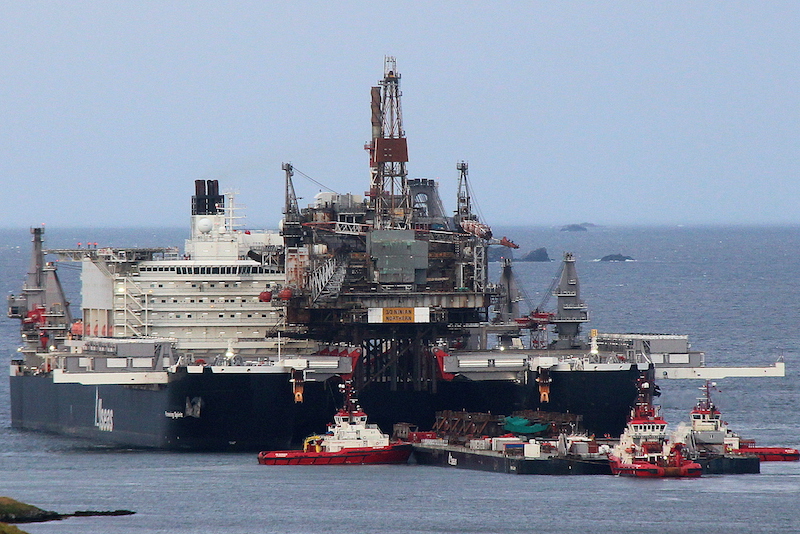
The Nininan North topsides being transferred to the barge Iron Lady from the Pioneering Spirit. Photo Jim Mullay.
An early success was the removal to Ninian North to Dales Voe. The Pioneering Spirit removed it from the jacket and transferred it to an Allseas barge from which it was transferred to the shore for disposal. In addition the Pentagone Buchan Alpha, which had once been Drillmaster, was towed into the voe where it dismantled itself using its own crane.
Well, this is yet another amazing aspect of the North Sea oil story, but is it the right way of dealing with the problem? No-one is suggesting today that anything other than onshore disposal is the appropriate means of getting rid of the old platforms, but even if there is not much of a case for the disposal of topsides in the sea, surely the jackets, just collections of tubes and spars, already covered in crustaceans could be toppled to lie on the seabed as reefs. They would be joining the extensive numbers of shipwrecks and World War One and Two debris, already providing safe havens for fish of all sorts, in a way memorials to man’s courage and ingenuity in the search for survival and security.

Buchan Alpha being towed into Dales Voe. Photo Paul Moar.