

Those of us who used to live in Aberdeen during the great days of the oil business are distressed by the rumours that the city is a mere shadow of its former self. It was, some will say, a brief period of prosperity for a few, now causing us all to be living in a world which has burst into flames.

Ships tied up at the bottom of Market Street, Aberdeen. A stone's throw from the town centre. Photo Victor Gibson 2026.
At this point people outside the business may be visualising those nodding donkeys out in the boondocks, pumping petroleum up to the surface. They are probably the international symbol of oil production. A small gold mine in everybody’s back yard. Of course it was never like that out in the North Sea. Up on the drill floor of the oil rigs we would be hoping that the pressure in the reservoir would ensure that the stuff would come bubbling up all on its own. And if anything there lies a skill. The drillers have to be able to determine when and how the product will arrive on the surface. If uncontrolled the result can be devastating; on the Deepwater Horizon in the Gulf of Mexico back in 2010 lives were lost and the whole coastline was polluted when the well got away. We would not like anything of that sort to occur here in the United Kingdom.
The way such disasters are avoided is by having a skilled workforce which operates under an umbrella of well understood rules, overseen by a proper disciplined authority which has detailed knowledge of the problems and the reasons for any success.
But where was I? I was going to write something about Aberdeen today. Union Street, maybe one of the most famous streets in Scotland after Princes Street in Edinburgh, is currently in disarray, being resurfaced in a decorative manner, or at least that is the idea. It has turned out that the immediate substrata is full of cast iron pipes of indeterminate origin, which must be identified and if possible cut off, as long as no-one is using them. This has made the refurbishment more of a permanent situation, with the locals grumbling that it is awful. At the eastern end of the street is the majestic Town House, which contains the registry office where weddings take place. It is a memorable venue. More or less opposite is the magistrate’s court with its adjacent pubs, the Old Blackfriar and the Tilted Wig. In the middle of Union Street is The Grill, a fabled whiskey pub where nips can cost as much as £200. The Grill was a men only pub until the introduction of the Sex Discrimination Act of 1975, and did not have a ladies lavatory until 1998. Indeed, the centre of the city is redolent with attractive watering holes including Ma Cameron’s, The Globe and Under the Hammer the pub beneath the Aberdeen auction house.
 Ma Cameron's one of Aberdeen's attractive pubs just off union Street. Photo Victor Gibson 2026.
Despite the reduction in offshore activity the port is still fairly busy, and it may be one of the few marine environments in the world were people can sit on the top of the low cliffs to the south of the channel and watch the ships going in and out. Vessels on the way in steam serenely up the channel into the Tidal Basin. On their right is Pocra Quay which houses the siloes of cement used variously in well construction and behind the quay are the bijou cottages of Fittie, a barrio to which the fisherfolk were sent in the eighteenth century before the houses even had roofs on. The locals still remember the event. From the Tidal Basin the incoming ships will either go up the River Dee or into the Inner Dock. They can still berth at the end of Regent Quay, only a stone’s throw from the centre of town and within sight of the panoramic windows of the Maritime Museum.
At the top of Belmont Street is the Aberdeen Art Gallery, which since my last visit has gained an extension to what used to be the roof, which houses an exhibition space and a cafe. The cafe even has an external area where you can brave the cool breezes and the beady eyes of the seagulls which are waiting for you to be inattentive to your sandwich. On the ground floor the ceilings are supported by pillars, the granite for which has been sourced from all round Scotland and Norway. There are small plaques attached to the bases to show us where they came from.
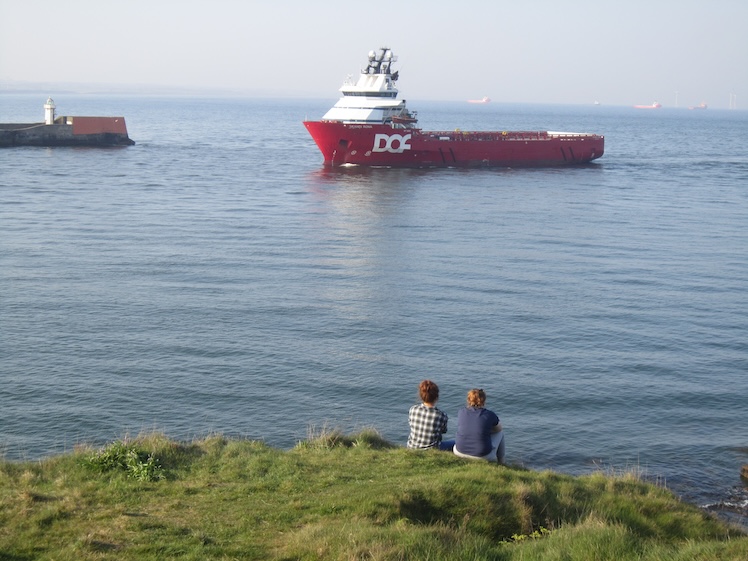
It is still possible to watch ships entering the port of Aberdeen from the cliffs to the south of the harbour. Photo 2019 by Victor Gibson.
After years of wrangling, during which a bridge over the harbour was considered, there is a bypass to allow through traffic to avoid the town altogether. You leave the A90 just outside Stonehaven and track into the interior coming out far to the north on the A96. The change has turned a visit to the town centre by car from a nightmare to a pleasant outing. Like all towns on the coast the suburbs are limited because you have the sea on one side, which increases traffic density at the beginning and end of the day.
But going back to the skill required to ensure the safety of the drilling industry, and the involvement of the regulatory authorities. After Piper Alpha the HSE ( The Heath and Safety Executive) opened up its own special offshore office to oversee the North Sea offshore oil industry. It was called Lord Cullen House, but as the years have passed budgetary constraints have resulted in the department being subsumed into another larger organisation, and in the view of many has had its teeth removed. Now the British Government is having to decide whether to allow further drilling to take place in what is a shrinking resource anyway. But they will have to get on with it. If after all the shilly-shallying the Burnham boys decide to allow oil exploration to resume there may be no-one left to do the job, or a regulatory authority able to determine what is safe and what is not.
And Aberdeen? It has proved itself capable of withstanding change. Many of its most impressive houses were built in Victorian times when it was a centre of industry and thrived as a fishing town. Today they are mostly luxury hotels. The fishing was adversely affected by the EU and the quotas, and moved north to Peterhead anyway and, even when the oil business was the source of its wealth, there were downturns which it had to overcome.
Today if the oil industry finally leaves for alternative, and less difficult environments Aberdeen will survive, even if it has to reinvent itself as a tourist hot spot. It is, after all, the granite city.