

The Labour Party’s move to shut down North Sea oil has been making the news as the America - Iran war enters yet a new phase and free movement of oil through the Straites of Hormuz continues to be the top of all our wish lists. I have a view, so here is an article composed of some of the final chapter of my book ‘North Sea Oil. A History’.
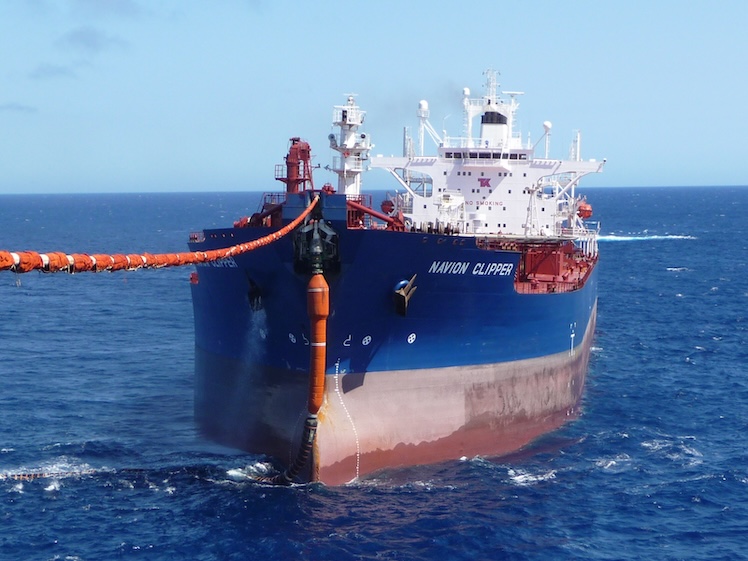
This is an offtake tanker loading from n FPSO. Probly about 100,000 tons. Quite a small ship compared with those trying to get out of the Gulf. Photo Erik Azevedo.
Oil is magic stuff. The top ends, naptha, only just a liquid, is used in the production of chemicals,. Aviation fuels, petrol and marine diesel, convert from a liquid into a gas at relatively low temperatures and, as a vapour, can be explosively ignited to drive our internal combustion engines. It can be loaded and carried as a liquid, even in small motor cars, and then converted. Even if we somehow manage to remove it from our land transport, surely it will still be required to power ships and aircraft. There is work being done to find alternative ship power sources. Tugs, offshore ships and ferries are being equipped with batteries which will assist in the reduction of the burning of hydrocarbons. In Norway there is an electric ferry which is recharged overnight using hydro power. Surely the ultimate transport process. But at sea there are an uncounted number of ships churning back and forth full of products which we want to make our lives easy. Typically there are more than 600 enormous car carriers, used to move these four wheeled vehicles, 4000 at a time, from their places of construction to the places where they will be retailed at the maximum profit. The actual cost of carriage, per car, is virtually nothing. Indeed surely in a world where very large ships contribute a significant amount of pollutants in the atmosphere, we should be looking at the price of the transport of the goods we purchase, jeans sewn together in Pakistan and Vietnam, many types of electrical and electronic product made in China, and dare we say it, motor cars produced in the United Kingdom. Somehow the cost of the products should include a cost to the environment, if we follow the court ruling on Horse Hill, near Gatwick.
A lady called Sarah Finch has been campaigning against the Horse Hill oil field since 2012, supported by Friends of the Earth. The case has made its way through the courts, until in 2024 the UK Supreme Court ruled that the planning permission should have taken into consideration the cost to the planet of burning the product from the field and therefore it should be shut down.
In the UK parliament, central to everything taking place in 2024 in relation to oil production, is the Rosebank project. We might remember that it was at Rosebank that the Bourbon Dolphin sank with distressing consequences, but now in a shiny new approach by Equinor, the Norwegian company, it is to be revived. The field is situated in very deep water out in the Atlantic, at the margin of what might be possible. Hence Equinor got permission from the Conservative government to carry out the project, drilling the wells over the next year or so and then installing an FPSO to recover, process and dispatch the oil by tanker.
Back in 2023 Caroline Lucas, the Green Party MP for Eastbourne, managed to get a debate tabled on the subject of Rosebank, where she was able to ask the Secretary of State why? The environmentalists seem to have managed to get onto a new topic relating to the possibility of the product being recovered being burnt, due to the Horse Hill ruling. In this case Caroline Lucas stated that, if burnt, the product from Rosebank would produce over 200 million tons of carbon dioxide, ‘more than the combined emissions from all the 28 low income countries in the world’. The debate gave a number of other MPs the opportunity of agreeing with her, and the opportunity for the Minister for Energy and Net Zero to reply that the necessary permissions were in the hands of the regulators. Since then, in 2024, after the landslide victory of the Labour party, the Prime Minster hinted that the future of Rosebank was in doubt.
The new government might choose to review a report by a House of Commons Committee headed ‘Accelerating the Transition from Fossil Fuels and Securing Energy Supplies’ published in January 2023. It is, in many ways, distressing as it indicates that at the current trajectory the planet is unlikely to meet the target maximum increase in average temperatures which is a rise limited to 1.5 degrees C.
At the same time the report suggests that the best way of reducing the consumption of hydrocarbons would be to stop using them, highlighting the facts that projects to insulate British housing and the installation of heat pumps lag well behind historic objectives. They also suggest that the cheapest alternative provision of electricity, on shore wind farms, are virtually at a standstill, indeed a radio commentator was heard to say that a windmill can be installed in one day, but planning permission takes ten years. The new Labour Government has promised to change this situation.
Also on the government’s to do list is the possibility of commissioning tidal energy projects, all of which have so far been rejected on the basis of cost, although some experimental tidal energy generators have been installed in the north of Scotland. One of the problems is that where very strong currents might provide energy, the same currents prevent the actual installation of the systems.
The UK is a net importer of hydrocarbons despite the existence of 277 fields out there in the UK sector, a situation which has been extant since 2004, and it seems that the chances of making a meaningful reduction in the use of gas before 2030 is unlikely. Indeed the report takes previous governments to task for not actually focusing on transport as a means of reducing consumption. Apart from legislating that no new ICE cars will be sold after 2030, little has been done in this area.
The NGOs who were interviewed for the report suggested that all the government’s plans including the resolutions at COP26 in Glasgow in 2021, were inadequate in dealing with the current climate change situation, and that really the oil companies had just been allowed to carry on as they had been before. There is some justification for this view. The Norwegians had banned the flaring off of gas in 1971, but there are still flares out there in the British sector. The committee recommended that casual flaring be banned immediately, and that the government should set a clear date for ceasing offshore licensing rounds, bearing in mind the changes to the labour market which would result in the reduction on offshore activity.
The two fields closest to development Rosebank, for Equinor, and Jackdaw for Shell underwent challenges in the Scottish courts towards the end of the year, and initially the Labour government said it would not contest any of the outcomes, although there were government representatives in the court to listen to the people from Greenpeace and Equinor making their case. After the presentations had been made, the judge retired to come up with his conclusions. It is necessary to take just a brief look forward into 2025, since on 30th January the judge determined that the giving of the original permissions had been inappropriate and that, while the oil companies could continue with their development processes, no oil or gas could be produced until further investigation had been carried out and, taking the Horse Hill judgement into account, a new approval considered. Oil exploration is incredibly expensive, and the preliminary activities relating to development cost even more, so what if in the end the projects are terminated?
It seems likely that if Rosebank and Jackdaw are shut down by a revised review of their environmental impact after all the preliminary work has been done, the oil companies will just move on to places where the regulatory environment is more friendly. In apparently having regard for the future of the planet, the government has neglected one aspect of the future of its national energy situation that of ‘energy security’. If Rosebank, in particular, does not go ahead we would appear to be reliant on Norwegian imports, and the loss of the Langeled pipeline would leave the British shivering in the winter cold. And, of course, if permission to produce hydrocarbons is not given to Equinor and Shell, further exploration and development in the UK sector of the North Sea would be unlikely. The mobile units would be towed away to work elsewhere or go to the breakers and the platforms gradually dismantled. The British offshore oil industry would, in time, be no more.
Elsewhere, as if indicating in some way the end of an era, Shell closed its brutalist architectural headquarters at Tullos in Aberdeen. One assumes that since they are still out there doing stuff, even after the departure of the Brent Field, they don’t need so many people. Also the former Labour MP John Prescott, a man who always had a lot to say about how the job was being done out there, died on 21 November.
In addition, late in 2024, a musical To Save the Sea about the Greenpeace occupation of Brent Spar has been aired in Edinburgh and other Scottish cities. So even today the events out there are becoming history. Like all history what is presented is a view of the writer, and the Brent Spar musical is no different. But to quote one of the reviewers of the show, ‘The audience enter the auditorium and takes their seats to the sound of ocean waves and howling winds’. Perhaps this is a fitting reminder of the conditions faced by those working out in the North Sea over the sixty odd years of offshore oil. It is an epic tale deserving more than a musical, no matter how entertaining, as its sole memorial.
This was written in 2024. Time has passed and no further exploration wells have been drilled in the Uk sector, while many have been drilling in Norwegian waters. Despite the bumbling responses from Britain’s prime minister relating to the need to sponsor renewable energy which will free us from the manacles of hydrocarbons, few of us have been convinced. As this article has laid out, if there were problems with the Norway to Uk pipeline, say due to sabotage by an enemy, whoever they may be, the Brits would be shivering.