

Confession. The Day of the Seafarer was so poorly promulgated this year (2022) that I missed it so I am recycling last years rant.
The photograph is of the P&O cargo ship “Ballarat” which together with a sister ship, “Bendigo” ran from UK to Australia during the 1960s. As was the case with all conventional cargo ships in those days, it would coast around a number of ports in UK, usually starting and finishing in the Royal Docks in London (Now the site of London City Airport) discharging and loading cargo. It would then transit to Australia through the Suez Canal taking about a month to get there.
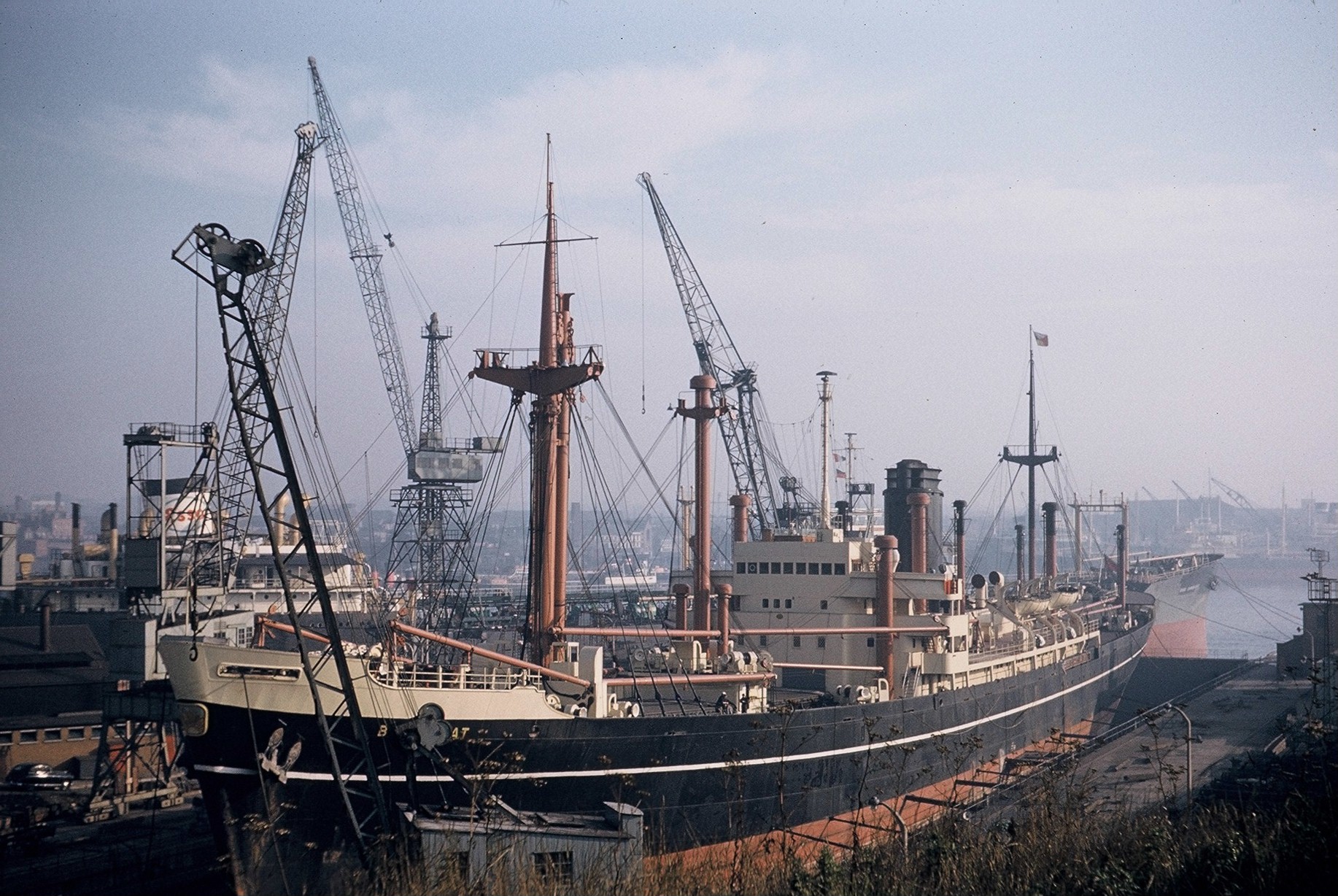
Once on the Australian coast it would spend a week or so in Adelaide, Melbourne, Sydney, Newcastle and Brisbane before setting out for UK again. This ship had over 100 crews members when I sailed on it, requiring us to carry a doctor. All the officers, which included six apprentices, were British. The deck crew came from Bombay; the engine crew came from Calcutta. They served on the ship for a year and at an agreed time the ship would call at Columbo for crew change. It might almost have been worth going to sea in those days. (Photo John Lupton).
Why have I chosen to post this photo today? Well, it is the annual day of the seafarer, when people round to world are supposed to remember those manning the millions of ships operating on our oceans, and thank them for their service. This is its tenth year, and is now formally recognised as a thing. So how is life different for seafarers today? Many years ago, when I was a Third Mate, the ship I was on called at Philadelphia, and a bunch of do-gooders from the city came on board and gave each of us a little bag of goodies. I thought at the time that surely we had moved on. Seafarers were no longer a bunch of very badly treated people, who needed presents from the charities ashore in order to survive. How wrong I was.
Although life for mariners in the 1960s was tolerable, today things have changed for the worse, with the proliferation of poorly supported and funded flags of convenience and fly-by-night owners. This is despite the vast increase in regulations and guidance.
Hence I am encouraged to give a moments thought to where today’s seafarers are now. Well, let’s start with an event which focused the media of the world on the carriage of goods by sea. It was the grounding of the enormous container ship “Ever Given” in the Suez Canal under circumstances which are still being chewed over on mariner’s websites everywhere. The media focused on the commodities which had been locked in on the ship; these included sex aides and garden gnomes. Now, several months on, the “Ever Given” has been forgotten, but it is still at anchor in the Bitter Lakes in the middle of the canal, while the shipowners, the insurers and the Suez Canal Authority negotiate about the level of compensation due to the authority. We should not forget that there are 25 Indian seafarers on board, and the captain has been threatened with arrest.
Meanwhile another container ship, the X-Press Pearl, offshore Sri Lanka has burnt out and the captain has been arrested. I think the crew were rescued and all being well might have been sent home, although news reports did not discuss their fate, preferring to deal with the deaths of marine life due to the weck. How did this happen? It was due to a leaking container of nitric acid. In two previous ports the captain had requested that it be unloaded, but permission was refused because the ports claimed they did not have the facilities to deal with it.
Meanwhile there are report of congestion in Chinese ports with delays of up to sixteen days while the backlogs are cleared; as a result the freight rates of standard containers have doubled, so it is said. It would be nice if the crews of these craft would be compensated if the owners are making more money but this is unlikely. Maersk, who own some of the largest container ships in the world, had intended, when the first was brought into service, that they be crewed by 13 people. Could they have got a Safe Manning Certificate for those ships?
A Safe Manning Certificate? Ship owners decide what they believe to be the safe manning level for a ship. What? You say. The owners decide what the safe manning would be. Yes, following these IMO princials:
It must be possible to:
· Maintain safe navigational port engineering and radio watches in accordance with with Reg VIII/2 of the 1978 STCW Convention…
· Moor and unmoor the ship safely
· Manage the safety functions of the ship when employed in a stationary or near stationary mode at sea.
Now, obviously some of this stuff is subjective. Would it, for instance, be suitable to have a two watchkeeper system with each watchkeeper working for half the day. If so we can get rid of a few people. And here we must bear in mind that to accountants people are just a cost, they do not understand the benefit from their presence. At the most basic level, if a large ship has minimal manning on board the crewmembers may only meet at change of watch. Apart from any other pressures, they may suffer from loneliness.
It has become common in all businesses for traditional supervisory levels to be removed, and this can have a detrimental effect on ships. For instance, only recently, an AB died because the investigators found that he was working on the afterdeck of a ship which was being moved in port, with inadequate supervision. So he was not warned when a rope was caught in the propeller and snapped. He was struck by the backlash and died. The ship, Damsterdijk, has “mistakenly” (quotation marks from the Nautilus Telegraph) been issued with a safe manning certificate which allowed for a manning level of six seafarers. When the accident occurred there were eight on board, one of them a cadet, but the mooring plan required a manning level of nine.
But I’m going on a bit about ships which are manned, and their seafarers are getting paid. This is at least something. There are frequent cases today of seafarers being abandoned on ships from which the owners have walked away when things have got a bit difficult. Sometimes they cannot leave due to lack of funds or are prevented from leaving by the local port authorities, and even when they can leave they may opt to stay in an attempt to get their unpaid salaries. Even in this case, they may be eventually forced to leave so that they can earn a wage again.
Unfortunately there are many ports in the world where seafarers are not allowed ashore, or if they are allowed there will be the cost of transport through the container base where the ship in moored. Indeed that are some owners who rule that, regardless of what is happening and what permissions are, or are not required in the port where the ship is moored, the crew are still not allowed ashore.
Seafarers are reliant on the owners for the facilities available on board. There are ships which require their crews to live in four or six berth cabins, effectively dormitories, even if there is space to do better. There are cabins which do not have any portholes, because it is cheaper to leave them out. Indeed some owners seem to regard their whole crews as a sort of underclass, unworthy of humane treatment.
Finally we live in a world of on-line communication where we can use our mobile phones for basic communication and send and receive emails or whatsaps. But there are not many owners who are prepared to pay for the available satellite comms which would allow their crews to have this sort of facility, although they will be sure to have a phone link with the captain so that they can tell him what to do. It is said that in some cases of groundings with, finally, the loss of the ships, the watcheepers have been coasting too close to the shore in their efforts to get a phone signal.
So on the day of the seafarer thanks may be due to the local people who have supported crews abandoned by their owners in the ports of the world, and to the various seafarer’s charities who provide facilities for the crews to relax, and communicate with their loved ones. Otherwise it seems to be back to the days of the Onedin Line!