

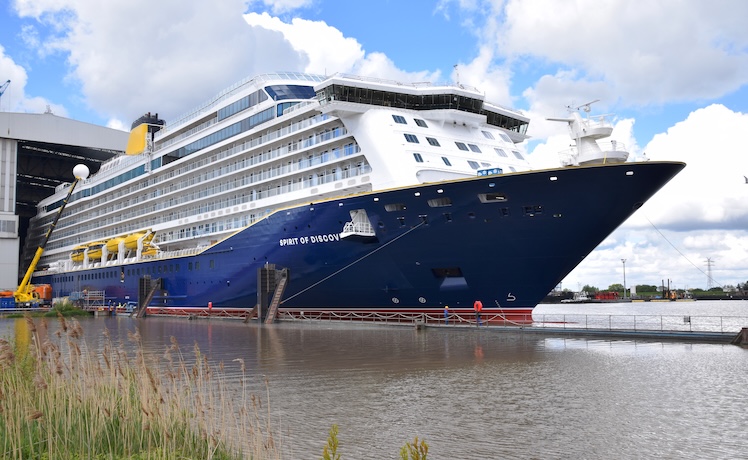
On 4 November 2023 the Saga passenger vessel Spirit of Discovery suffered engine failure while attempting to cross the Bay of Biscay in atrocious weather conditions. This resulted in extreme rolling during which the mainly very elderly passengers were thrown about, and suffered from impact with the sliding furniture. One man suffered a spinal injury which resulted in him dying on hospital four days after the ship had docked in Portsmouth.
As a result of the injuries to the passengers the UK Marine Accident Investigation Branch carried out an extensive investigation into the affair and submitted their report in March 2026. The report describes the event as a very serious marine casualty, but had there been no injuries nothing would have been done at all to identify the glaring errors in the operation and software installation on the ship. This short article just skims over the surface, but the full report is available on the MAIB site.
The Spirit of Discovery is, by modern passenger ship standards , a small ship, authorised to carry only 999 passengers (Cannes bans ships carrying more than 1000 passengers) and 503 crew. But the passengers are all over 50. Indeed the youngest passenger on board during the voyage was 50 and the oldest was 96, giving an average age of 78. There were 943 of them on board at the time. It was a Saga cruise, which was intended to start off from UK go to the Canary Islands and then call at ports on the Iberian peninsula on its way home.
The ship had been built in 2019 and its marine management was carried out by V Ships. It was 237 metres long and was powered by two azimuthing pods with fixed pitch propellers. It had stabilisers and two bow thrusters.
While in the Canary Islands the ship received information that heavy weather was to be expected during the return to the UK and so the itinerary was altered to, it was hoped, avoid the worst of it. An intended call to visit Las Palmas was cancelled with the intent that the ship would get to A Coruňa on 4 November where it would shelter from the worst of the weather, and after the storm had passed continue to its point of termination, Portsmouth.
During 2 November the captain held a risk assessment with his senior staff which covered weather routing, port closures, the possibility of injuries and the need to ensure the availability of propulsion. The staff captain briefed the watch standers of the need to get approval from the engineer on duty before acknowledging alarms of the propulsion system. All departments were then required to complete their heavy weather checklists.
Still on passage from the Canaries the captain discussed other possible ports of refuge with the Saga onshore team, including Vigo and Ferrol. both discounted due to the direction of the swell.
Now on 3 November as the ship sailed north the captain was informed that A Coruňa was closed due to the potential wave heights exceeding those acceptable for pilot boarding, so in consultation with Saga it was decided that a direct passage back to Portsmouth was the only option. There did not seem to be any suitable shelter available for the ship, and a possible visit to Lisbon suggested by one of the passengers was vetoed due to a rumoured industrial dispute in the port, which they thought could have held it alongside. Instead it was intended that the ship strike out for Ushant with the wind and swell on the port quarter which, according to the heavy weather chart provided by the builders, would be within its capabilities.
At midday on 4 November the ship was making 16 knots over the ground, pitching and rolling violently despite the fact that the stabilisers were out, seemingly belying the guidance available on the builders chart.
At 1230 the port propulsion pod ‘water leakage stop’ (WLS) sequence alarm activated. The engineer on watch said it could be acknowledged, since the actual stop could only be activated by pressing the ‘stop’ button, so they thought. Very shortly afterwards the port propulsion overspeed alarm went off. The port propulsion then automatically shut down, applied its shaft brake and then rotated so that it was at ninety degrees to the ship’s head.Then once the propeller had stopped turning inflated it shaft seal.
One of the watch officers controlled the heading of the ship using the remaining propulsion pod and the captain was called, who when he arrived took over the control of the propulsion and maintained the heading using the bow thrusters. Once the bow thrusters were stared up the stabilisers housed themselves. At 1236 the starboard pod went through an identical process to the port pod, over sped and shut down, and now virtually out of control the ship rolled violently. At 1240 multiple injuries amongst the passengers were reported and the medical team got to work.
After the affair the passengers were universally complimentary about that actions and attitudes of the crew, and much is said about the medical approach to the disaster. They had a plan which it seemed was too difficult for them to action properly.
After about 1245 the engineers managed to get the propulsion back to work, and used a portable pump to pump out the pod’s bilges. The captain by now seems to have been personally operating the pods and the bow thrusters to control the direction and speed of the ship, now effectively hove to and the stabilisers were in operation again, the system being overridden. The passengers were advised to stay in their cabins and during the afternoon the weather worsened to hurricane force 12. The propulsion shut down intermittently during the whole period but only once did both pods shut down at once. The engineers developed their skill at restarting them, generally managing to do the job within ten minutes.
On 5 November the weather had improved sufficiently for the voyage to be continued and at 0500 on 6 Nov the ship rounded Ushant and began to make its way up the channel, berthing at Portsmouth at 2100 on that day. A number of passengers were transferred to hospital and one who had spinal injuries was to die a few days later.
Then the investigation. According to the makers, the propulsion pods would be operational at angles of roll of 22.5 deg and pitch of 7 deg, and that the bilge system would automatically pump the pod’s bilges. However if water was sensed by the level sensors then the Water Leakage Stop alarm would be initiated. Then, unknown to the crew, when the PCS (Propulsion Control System) next stopped the pod, without further intervention the WLS would be activated, and once in progress the process could not be stopped.
The investigators found that there was a 1986 page operating manual for the pods which said (their italics):
At this stage no automatic sequence WLS will be initiated by the event of water leakage! Only if the operator follows the WATER LEAK STOP REQUEST by using the STOP PROP pushbutton with pending WATER LEAKAGE STOP REQUEST, the following sequence will be initiated. [sic]
The ship was being given guidance by a couple of weather routing companies. both of which had advised that the voyage across the Bay of Biscay should not take place before the storm had passed. The Weather Routing Incorporated (WRI) forecast stated:
Updated forecast is on the basis Master’s intentions to proceed direct to Portsmouth. Please note that the vessel will encounter unavoidable dangerous and very heavy conditions of 10-13m swells on the 04th and into the 05th/ AM. If able, we would recommend the vessel seek shelter along coastal Portugal no further north than 40N latitude until 05th/12z before continuing onto Portsmouth. [sic]
It could hardly have been stated more clearly, but for some reason it was not received by the captain and the Saga email accounts were not being monitored at the time. Hence neither of the dire warnings issued by the weather routing companies reached the captain.
There were a lot of recommendations. But for want of a better description one can only say that things were looked at ‘very optimistically’ on board the ship and in the Saga office, although there was no indication, according to the investigators, that there was pressure on the captain to fulfil the voyage requirement.
If we don’t look at the misleading information about the safe operating limits for the propulsion system and just get back to the basics, it was actually intended that the ship head off into possible hurricane force conditions with over 900 old people on board. Against the advice of the weather routing companies, and - honestly - with inadequate systems in place to tie down the furniture. An activity had taken place to identify what items on board could move in heavy weather which I think the Americans would call a ‘pencil whipping’ exercise. What were they thinking?
I can only say that if you have survived an event involving force 12 winds and apocalyptic swells you won’t want to challenge them again. On my first trip through the Bay of Biscay, the cargo ship I was on rolled violently, once to 40 degrees, releasing a bulldozer in one of the tween decks, which demolished all the motor vehicles close to it and punched several holes in the engine room casing. The lesson I learnt then was never to challenge the weather, you have to try to work with it, and in this case, given that they should not have been starting north on 4 November, they should have done something else. Undoubtedly they were faced with difficulties, but it seems to me that the alternatives to continuing north were too easily discarded. They just accepted that it was not possible to enter A Coruňa because the pilot could not board. They discarded the possibility of going into Ferrol because of possible swells, and maybe they could have gone into Lisbon, braving the possibility of a strike. Even if the dock workers withdrew their labour there is no certainty that the ship would have been affected. At worst they could have been faced with negotiation, as an alternative to being faced with a hurricane.
And just as an aside, I noticed that when the captain arrived on the bridge he took over at the controls, the steering and the bow thrusters, and before his arrival the steering had been carried out by one of the OOWs. This is the world we are in now. Helmsmen have been virtually discarded to be replaced by the autopilot, particularly with this podded propulsion which seems to have its own quirks, encouraging computer control. We do not know whether the ship was provided with a joystick or any form of DP system, either of which might have helped when it was in trouble. But finally, in this emergency, was being on the controls the best place for the captain, effectively leaving the management of the emergency in the hands of the staff captain? As I have been saying for years Captain Kirk did not drive the Enterprise!