

The latest Tale from the Riverbank - Edna T Gattle at the Atchafalaya Railway Bridge
I have in the past sometimes written about misfortunes which have occurred on the American waterways, mainly because the whole process of carrying cargo on the river systems is so interesting. These articles have been lost in the archives, and you would have trouble finding them, so I am starting a new feature, specifically dealing with these misfortunes.
The American waterways are more extensive than we Europeans can possibly imagine. As a seafarer I have been up some rivers in different continents including the Mississippi but only as far as Baton Rouge, the Orinoco and the Rhone and the inland waterway as far as Duluth in Lake Superior and they had seemed like quite long transits. Elsewhere there are barges traversing the European inland waterways, usually just one large hull with its own power. This we can understand. But a single tug pushing large numbers of barges is a complex business, and only possible due to width and depth of the waterways, and only viable because they are so lengthy. The river systems extend for thousands of miles, the Mississippi from New Orleans, north through Mephis, St Louis, Mineappolis and further, with the Ohio River extending to the east and the Missouris to the northwest almost as far as the Canadian border. The Missouri is 2500 miles long.
This river system allows the transportation of millions of tons of cargo to take place annually and so it is not surprising that there are incidents, often causing the closing of bridges and the actual loss of barges.
Over time I have had the opportunity of reading about misfortunes on these waterways, sometimes with amusement and always with some surprise that there seems to be no limitation to the number of barges which can be pushed along by a tug, or exactly what rules the tug will follow, particularly how it will be manned. So there follows some narratives sourced from the various reports in America about tug and barge accidents.
THE EDNA T GATTLE AT THE ATCHAFALAYA RAILWAY BRIDGE
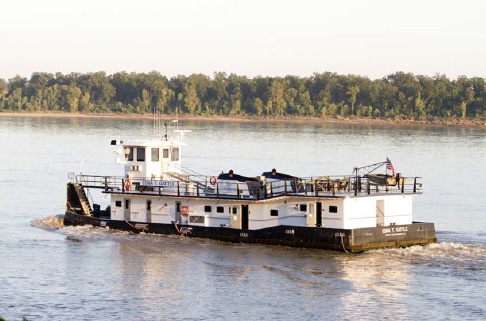
The Edna T Gattle from the NTSB report.
There are a some essential facts which relate to this misfortune.
The first might be the Atachafalaya River itself, which has it source in the Mississippi and runs parrallel to it in Louisiana, later discharging into the Gulf of Mexico beyond Morgan City. It can be fast flowing and it seems on the day of the accident that it was flowing at between four and five knots. Perhaps the captains of the pusher tugs on the American inland waterways are familiar with this effect, but for most to be in charge of a vessel which is required to be doing about 10 knots over the ground to achieve steerage is a frightening experience. Then we come to the Union Pacific Railway bridge at Krotz Springs, about a mile down river from the US 190 highway bridge. This bridge has an air draft of about 25 feet. Beyond that the captain of a tug proceeding down river, which has an object on deck exceeding this air draft has to call up the bridge; the bridge operator then has to call his supervisor and if he gets permission he can open the span of the bridge which allows vessels with an increased air draft to pass through. The investigation into the accident was to determine that about 18 minutes is required from the time fo the first call to get the bridge open.
Then we turn to the Edna T Gattle, a pusher tug built in 2006 for Terral River Services. With 3000 bhp available, which has a retractable pilot house, reducing its air draft from about 37 feet to very little. It left the company yard on April 24 2019 and picked up a barge at Summesport on the Atachafalaya with an excavator on the deck. This gave an air draft of 45 feet. From there they started off down river with the intention of delivering the tow to Ameila, beyond Morgan City.
So as soon as the tug started down river the captain was aware that the bridge would have to be opened, which was done by means of the span rotating through 90 degrees around a central pier, creating two channels. At 2307 while the tug and tow were tramping along at about 12 knots, the captain called the bridge, but reported that reception had been poor. He was about five miles away, so would arrive in about 20 minutes at the bridge. He called again at mile 38, said according to the report to be 3.3 miles from the bridge. Not more than 15 minutes away. The bridge operator called his superior and waited for over three minutes for him to answer. He is said to have answered at 2317.
The captain felt that he could stop the tug at the location of the road bridge, and on arrival there according to the report he “throttled back”. So he was still doing about five knots. The captain told the investigators “Krotz Springs is a swift area”.
Still waiting for the bridge to open, the tug was going astern against the current with a modicum of success but without sufficent control of its position on the river, so when the bridge was finally opened it was close to the “right descending bank” and had to approach at an angle, maybe still without sufficient steerage, due to the potential speed over the ground required to do this.
At 2348 the starboard quarter of the barge hit one of the piers resulting in the excavator hitting the bridge span and damaging the operating mechanism, causing $500 thousand worth of damage,. The briudge had to be closed for temorary repairs and trains rerouted.
This was not the first time the bridge had been hit. Another vessel of the same class had hit the bridge on a previous occasion and indeed this was the second time the Edna T. Gattle had hit it. In 2010 the Lil Al Cenac, pushing a crane barge had to back up in similar circumstances and subsequently the crane had become entangled in the brdge spans, sinking the tug, fortunately with no loss of life.
The NTSB determined that decision points should account for delayed operation of lift and swing bridges. Scary stuff!
THE MARSEILLES DAM INCIDENT.

The illustration is the Joseph L. Heller from the NSTB Report.
This accident occurred on 18th April 2013, when the Dale A Heller pushing a raft of 14 barges, was on its way down the Illinois River, a waterway which rises in Lake Michigan, and terminates on its confluence with the Mississippi, 333 miles later. The tug with its barges was approaching the Marseilles Dam on 17th April but difficult condition in the river, due to recent heavy rain, made the approach to the Marseilles Canal difficult and so the Dale A Heller found a place to hold up, 0.75 miles above the dam. Another tug/barge combination, the Loyd Murphy made fast alongside the Dale A Heller as conditions in the river became more difficult. Later a mooring was found for the Loyd Murphy, but no suitable safe location was found for the Dale A Heller, and so it was decided that the only course of action was to take the tug and its barges into the calmer waters of the canal.
First it is necessary to describe the set-up at Marseilles. Traditionally when our forebears were first using rivers as a means of transport they found that there were deep bits and shallow bits, and in order to deepen the waterways they dammed them and then provided short canals and locks alongside the dams. The ultimate manifestation of this process must be the Welland Canal which allows the vessels navigating in the Great Lakes to avoid Niagara. At Marseilles a vessel going downstream would pass the five concrete piles protecting the dam on its starboard side, and the cross current deflecting the vessel towards the dam would depend on the levels of water in the river, and hence the number of gates in the dam which were open.
The dam was provided with eight gates. If all gates were closed there would be no water flow towards the dam, and so any vessel approaching the canal would be able to do so with ease, however this would increase the possibility of the town of Marseilles being flooded if there was a lot of water in the river. But if all gates were fully open it would be extremely difficult for any vessel on its way down river to successfully make its way into the canal. The gates in the dam were controlled by the US Army Corps of Engineers, and each could be raised to a maximum of nine feet above base. Hence if one gate was fully open, it would be described as "9 feet of gate open" and if all gates were fully open there would be 72 feet of gate open.
So, on 18th April, with the Dale A Heller and its 14 barges finding it more and more difficult to hold station in the rising waters of the river, a conference call was held between the "River Industry Action Committee" and the "Illinois River Carriers Association", and it was decided that since no safe haven could be found for the tow they would move it into the canal. Their decision was in part determined by the weather forecast which indicated that even more heavy rain was due to fall in the next 24 hours.
But they remained concerned that the current caused by the open gates would prevent the tug/barge combination from getting past the concrete bollards protecting the dam. Hence they decided that the Loyd Murphy and two Army Corps towing vessels would assist with the move. At this time the lockmaster had 66 feet of gate open, near the maximum, but he indicated that during the time that the Dale A Heller and its barges were being manoeuvred towards the canal he would close 16 feet of gate, which would mean that there would then be 50 feet of gate open.
The report states that a number of the parties involved in the conference call misunderstood the lockmaster, and thought that he had indicated that there would be 16 feet of gate open, a misunderstanding which was to have considerable bearing on subsequent events.
At about 1700 the Dale A Heller began pushing its raft of barges which were three abreast in the direction of the canal, with two of the other tugs positioned on the starboard side to push the whole setup to port, and one tug attached at the bow of the group. As indicated, the lockmaster closed 16 feet of gate, and kept his eye on the water level in case the town was to be flooded.
At 1718, as the groups was approaching the canal, an Army Corps supervisor on one of the tugs noticed that the water level might overcome the levee, and communicated this to the lockmaster who said he would open a further 8 feet of gate, but instead of following this agreement he opened the gates to their original 66 feet open.
At 1733, as the head of the tow was entering the canal, the crosscurrent began to pull the barges towards the dam. The Army Corps supervisor communicated with the lockmaster, who agreed to close the gates, despite the possible danger to the town, but it was too late.
At about 1734 the leading barges contacted the concrete wall on Bells Island, and several of the barges broke loose. One of them allided with the concrete plies protecting the dam, and eventually the Dale A Heller lost all 14 barges, with seven of them ending up against the dam and four of them sinking in that position. The remaining barges were rescued and moved into the canal.
The damage to the barges was estimated to have a cost of nearly four million dollars and the damage to the dam to have a cost of between 40 and 50 million dollars. Wow!!