

I was slightly depressed yesterday, but initially was unable to say precisely why. Then I realised that I had received a copy of the Telegraph in the post, and my emotions had been driven by what I read in the magazine. Perhaps I should explain that ‘The Telegraph” is not the Daily Telegraph, but the magazine of Nautilus International, the union for those serving as officers in the British Merchant Navy, the same service in the Netherlands and the world of the super yacht.
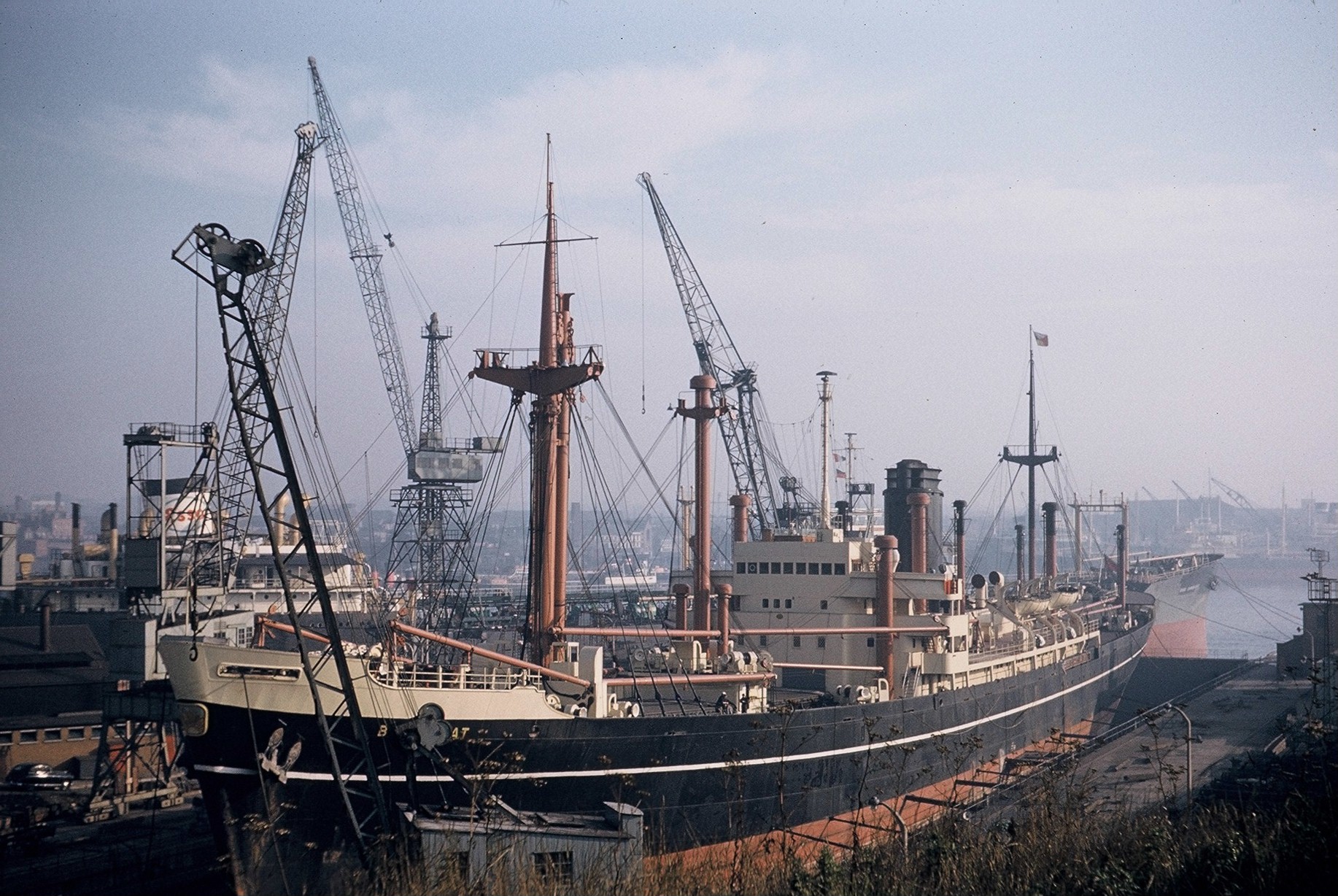
My first ship the P&O cargo ship Ballarat, in drydock. Photo John Lupton. (Small photo The Oil Mariner, one of the small ships I had commanded)
I have to hand it to them they try to keep going although the world which it describes is completely different from that with which I used to be familiar. I was always a member of the union and used to get a monthly copy of the Telegraph, which was presented in a sort of newspaper form, and won prizes. Today it is a quarterly magazine of some thickness which I receive because I am still contributing a small sum annually to the union so that they can monitor the activities of my pension provider.
One of the things which depresses me is the union name for the activity of going to sea. They call it being involved in ‘maritime’. What the hell does that mean? Well, it sort of concealing the fact that there is little left of the former proud British merchant fleet which once dominated the world. Back when I went to sea there were three major nautical colleges, Conway, Worcester and Pangbourne, all three providing British shipping companies with apprentices who would join at the age of seventeen and make their way through the ranks to eventually become ship captains, although even then it was determined that only one in ten new starts would achieve command, the rest mostly going on to more worthwhile activities, daunted by the sheer unpleasantness of being at sea.
One of the things which put people off was the 1894 Merchant Shipping Act, the most pertinent section being that which determined the ratio between work and leave. The standard was 90 days in each calendar year, of which the employer had the choice of liquidating 30 days for a cash payment. While this might not have deterred single men, when love took a hand it was natural that even seafarers would want to spend more than 90 days per year in the company of their wives and families. It was possible for seafarers to get jobs in associated professions ashore. When I qualified as a master mariner at the youthful age of about twenty-seven I got a job working for the stevedoring industry in Southampton as a superintendent. I joined a small group of master mariners who had the job of managing the shipboard activities relating to the loading and discharge of ships in the port. If there was a downside, the pay was terrible, the industry taking advantage of the desperation of seafarers to get a job ashore at virtually any cost.
I was to return to seafaring in the offshore industry which offered equal time at work and on leave, a more reasonable relationship. By that time we were in the age of Thatcher economics which changed the rules so that any ship no matter where registered, would be welcome in UK waters, and even if the ships were registered in the United kingdom they could be crewed by absolutely anyone, as long as their qualifications appeared to be suitable. Well, it turned out that the only thing keeping shipowners honest was the 1894 Act. The traditional companies which had been managed by former seafarers whose focus had seemed to be more on keeping the brass shiny than making money, succumbed one by one, trampled underfoot by investment organisations who bought them for their inherited wealth, their investments and their property portfolios. The headquarters of the P&O, for instance, which had contained a courtyard with a turntable in it for turning the chairman’s Rolls Royce around, has now been replaced by a 225 metre skyscraper known as “The Cheese Grater”.
In this different marine world Nautilus struggles on. This issue of the Telegraph features an investigation into why no-one is interested in the maritime industry, and why no-one goes to sea any more. The question is really, why would they. When I went to sea, now more than 60 years ago, it was a pretty doubtful job, even though in those days I was one of 48,000 deck officers. The British public thought of us as a sort of sub-order of humanity.
In the mid 1970s I was travelling south from Aberdeen on an all night bus and took the only spare seat which was next to an attractive lady who told me that she was returning to Dundee after visiting her daughter at Aberdeen Uni, and that her husband was a university lecturer. What did I do? she asked. I told her I was captain of an offshore ship.
‘You know, one of those little ships you can see by looking down from the bridge over the Tay,’ I expanded.
‘Oh, I thought they were all Greeks or something,’ she said.
So this educated lady who lived in one of Scotland’s major seaports, had no idea that it was we British who manned the ships going out there in support of Britain’s search for oil, and that was nearly 50 years ago. So what chance today.
The survey in the Telegraph questioned a cross section of the British public about why they might or might not consider a career at sea. 39% of those who considered a career at sea did so because ‘it will offer exciting life experiences’, and 33% said, ‘it will enable me to travel and explore the world.’ I suppose it was this survey which really depressed me. These people who are considering such a career choice should listen to Dr Johnson who said ‘being on a ship is like being in prison with the added chance of sinking.’
I won’t go into reasons for not going to sea, there are plenty scattered through the pages of this website. But I suppose that I have to admire Nautilus who also know what they are, while at the same time doing their best to improve conditions for seafarers out there, so it is less like being in prison. It is stuff that both they and I know about that depresses me.