

This written in 2017.
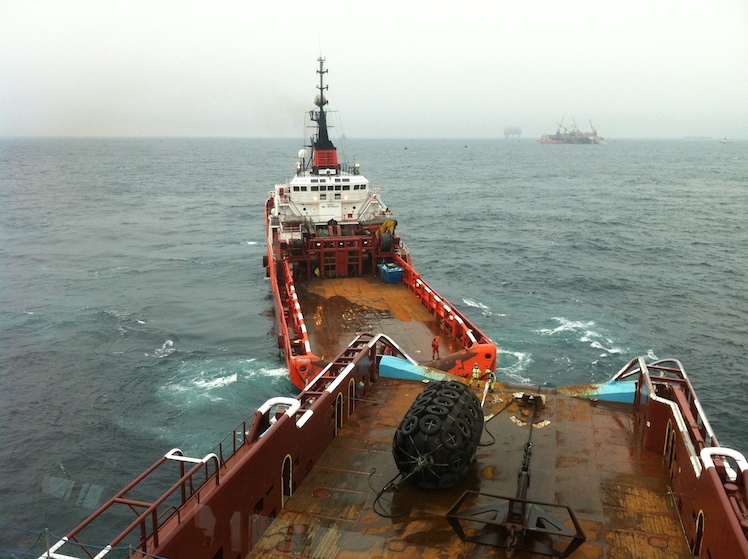
You might be thinking, what the hell, surely there are other ships besides these Maersk things occupying this feature. And the answer is yes there are others but in 1987 that company was on a bit of a run. They had not quite taken over the world, or even Denmark, but obviously they had ambitions, and at the time were building all sorts of ships for many trades, usually at their own shipyards. Even so it is just a bit difficult to see why the Maersk Launcher was featured in the 1988 Reed’s Tug World Annual Digest. And in the text of this feature is a GA of the underdeck and the deck areas of the ship taken from the magazine. I have a bit of sympathy for the journalist who described the ship. He, or she, must have been given the requirement for a requisite number of words, and a list of the ship’s features, which he described in detail without suggesting that any of them were particularly special. But in my view (let me know if I’m wrong), these ships were the first to have the engines moved forward to a point where the bow started to alter the shape of the hull. The designers must have thought that if they moved the engines into the bit of the ship which was virtually useless for cargo that would free up space elsewhere. And it did, and virtually everyone designing ships in Europe took note and moved the machinery spaces forward. In America designers have been less enthusiastic, and even this month I have seen a GA of an American platform ship with the machinery space virtually at the stern. So these medium sized moderately powered anchor-handlers were blazing a trail, and since they are all still out there today, the design must have been successful There were originally four of them The Maersk Lifter, which became the Tschudi Boulder in about 2008 and is now the Hurricane I out in Singapore, and the Launcher became the Bluster and then the Hurricane II. The other two ships have ended up as part of Resolve Marine, a company who are engaged in a variety of anti-pollution and salvage activities, based in Fort Lauderdale, The Logger, one of the three 1987 ships, was purchased by Klyne tugs which gained the contract to provide the UK coast with emergency towing vessels, and became the Anglian Earl, and the whole company was purchased by JP Knight said to be UK’s oldest towing company. When the UK government decided they would just keep their fingers crossed, instead of providing an emergency service in 2013, the UK fleet was sold off. Resolve Marine snapped up the Anglian Earl which became the Resolve Earl and the Blizzard, once the Mearsk Leader (Photographed in Brazilian waters by Andriy Kalov during a buoy transfer) which became the Resolve Blizzard.