

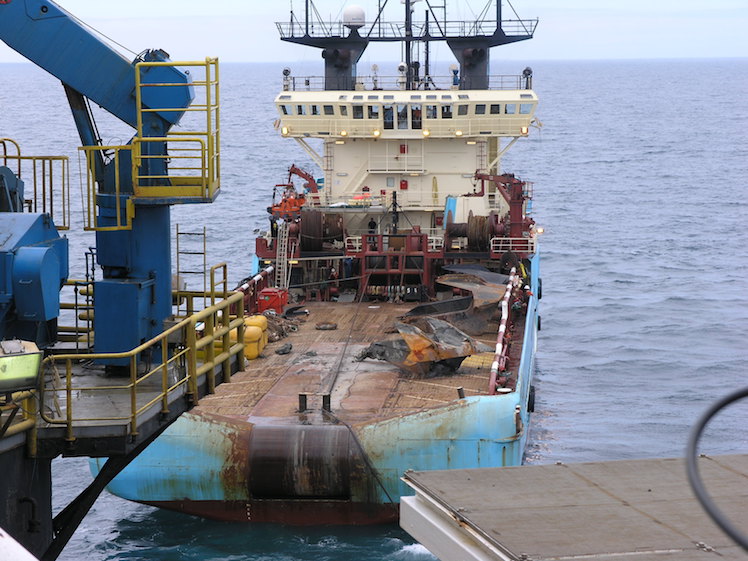
Although the VS 476 is fairly closely related to the VS 469, because of the larger number of the class produced and their longevity in the industry they are worth a mention. Four were built in 1985 and 1986 at the Danish Orskov shipyard all initially owned by Norwegian investors, probably as part of a process, which remained slightly obscure to most of us, known as the KS investment scheme. This was a scheme which gave Norwegian professionals tax breaks if they invested in ships. The first of the four to enter service was the Storfonn, to be followed by the Kongsgaard, the Kingshav and the Challenger III(Photographed as Maersk Challenger by Victor Gibson at a North Sea exploration rig in 2007). But of course 1986 was the year when the oil price fell to $8 a barrel resulting in a difficult time for all offshore vessel owners, and in many cases leaving the ships in the direct ownership of the investors. And as in the world today there were advantages for the more innovative shipowners, particularly those with a bit of money in the bank. This resulted in the British offshore support company Ocean Inchcape (OIL) bareboating the four ships, which became the Oil Chieftain, Oil Challenger, the Oil Champion and the Oil Chancellor. My book “The History of the Supply Ship”, chronicles a spokesman for OIL saying, “we are sure we will soon find contracts in the North Sea because there is still a market for that type of anchor-handler”.
In fact the four ships were often employed as platform supply vessels. They had a deck area of 633 sq.metres and other capabilities included the ability to carry 1400 tons of diesel and 618 tons of mud. Their four B&W Alpha engines delivered 14,400 bhp giving them 160 tons of bollard pull. Later at least one of them had an enhanced winch fitted for deep water work out in Brazil. The four ships were purchased outright by Maersk Supply at the end of the five year OIL bareboat charter and became the Maersk Cs. Maersk had been in the business for some years but on a fairly small scale, and it may be that the purchase of these four ship was the start of their major assault on the offshore support business, and in the following weeks we will see further Maersk ships which were in themselves innovative. The four ships were variously employed in the North Sea, in Brazil and in Canada and today two of them are still owned and operated by Blue Star Line. The Maersk Chancellorwhich has been working in Canada for much of its life departed from Halifax in November 2016 for scrapping in Turkey. The Maersk Champion is still working out in Brazil, apparently defying the Petrobras 15 year rule which has resulted in the departure of many vessels from the area (this written some time ago).