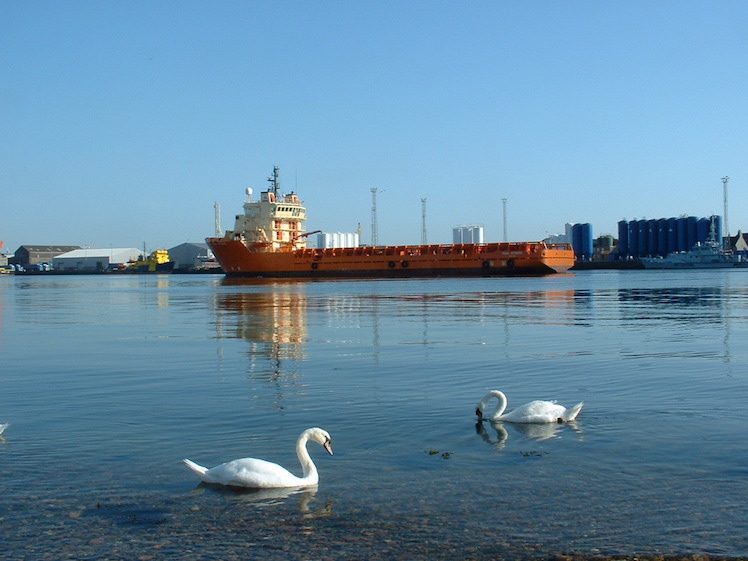
In the dying days of the British shipbuilding industry a couple of UK companies placed orders for a Vik Sandvik design the VS 483 PSV with Clyde shipyards. Actually it has turned out to be the dying days of British offshore ship-owners as well, but back to the ships and their reason for inclusion here. Over the years there have been a number of platform ship designs which offered protection from the weather for the crew working on the deck and the cargo contained therein, by surrounding the cargo space with tanks. Probably the first were the large platform ships owned by OSA which have been described here in earlier presentations, and these were later followed by a number of platform ships built in UK for Star Offshore. But the design had the defect of not offering the crew on the deck anywhere to run if things did not go well as cargo was being landed or lifted, and so the VS 483 design was intended to reduce this risk. The working deck was still surrounded by high sides, but there were no tanks there-in, so the crew could shelter in the protective space provided and actually move along the sides of the ship in the covered area. The first two of the class were built at the Ferguson’s yard on the Clyde for Stirling Shipping; they were the Stirling Forth and the Stirling Clyde and entered service in 1996. A further two of the type, the Stirling Spey and Stirling Tay were built at Kvaener Govan both having entered service by 1999. Sealion, another British company who managed a fleet for Greek ship-owner Gregory Callimanopolous, also built two at Kvaerner Govan in 1998; they were the Toisa Invincible and the Toisa Intrepid (Photographed entering Aberdeen by Victor Gibson in 2001). These two ships had a slightly differently designed deck area but were fundamentally the same. All were moderately powered but had a deck area approaching 1000 m2, and their terrific bulk capacity, made them useful workhorses. The fact that they were slowed down considerably by adverse weather hardly mattered. Stirling Shipping was bought by Seacor in 2001 but the parent company Harrisons (Clyde) retained the Stirling Forth and the Stirling Clyde (Photographed at Brent in 2002 by Derek Mackay), renaming them Inverforth and Inverclyde, and these two ship continued to work for Shell out of Aberdeen for some years. The other two of the class were passed on to Havila who also purchased the Inverforth. The Inverclyde was bought by Rovde AS and became the Ocean Carrier, briefly famous for crashing into a component of the Ekofisk Field in 2005, and was converted into a cable- layer in 2007. In 2016 Havila announced that it had lost the contract for Havila Faith in Brazil but the three VS 483s are still on its fleet list. The two ships which were built by Sealion are apparently still part of the Sealion fleet, although the future of the whole company is currently in doubt. It seems possible that the former Ocean Carrierhas joined a company which supplies power to under resourced areas of the globe but the details are currently difficult to come by, particularly since there is another Ocean Carrier, once the Star Offshore platform ship the Star Arcturus still in service today.