

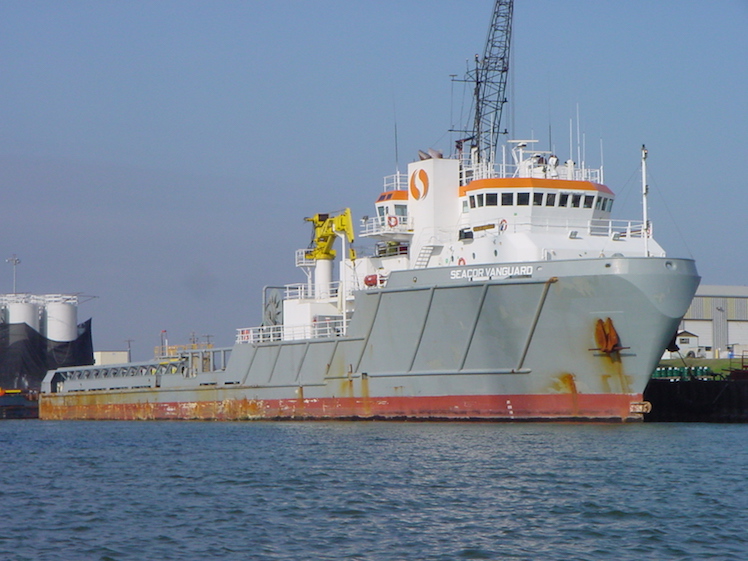
Back in 1999 I gave a paper at an offshore marine support conference in Southampton, but no matter how I try I can’t recall what it was about. However, I do remember that Milton Rose, then the President of Seacor Marine, also gave a paper, in his case about the process of deep water mooring in the Gulf of Mexico. Up to that time we, in Europe, had not heard much about Seacor, who seemed mainly have traded in ships and on occasion bareboated them to people who wanted to operate them. It was therefore a bit of a surprise to those attending the conference when Mr Rose presented details of their latest ships the Seacor Vanguard (photographed by Oddgeir Refvik in 2003) and the Gerard Jordan which had been built at Halter Marine in 1998. They were anchor-handlers designated HLX2225s. What was unique about them was that they were provided with a traction winch and storage capability underdeck capable of housing 4000 metres of 76mm wire (plan showing the position of the traction related wire storage) as well as a work drum with a capacity of 3350 metres of 72mm wire and two storage drums each with a capacity of 4250 metres of 72mm wire. The ships themselves were powered by four EMDs giving them 14,000 bhp and a bollard pull of 160 tons. They had controllable pitch propellers, two 800 bhp tunnel thrusters forward and one aft and all could be contolled by a DP II system. So it appeared that American designs had caught up, or at least one of them had, and there appeared to be a specific reason for it. Essentially Seacor had taken specific steps to address the problem created b the fact that semis were straying further and further from the coast in the Gulf of Mexico, and they had developed a means of anchoring them in deep water, which by 1998 was about 5000 feet or 1500 metres. The massive wire storage (for those days) would allow the ships to install suction anchors at the new location for the rig, possible only requiring a single visit to the shore for further wire, and then the rig would be detached from the moorings at the previous location and connected up at the new one in the minimum of time. For those who might not know about this process it takes advantage of the soft seabed in the gulf, allowing tubulars to be sucked into the seabed using a pump in the top, with the mooring attached. Of course by now the whole business of anchoring in deep water has taken a bit of a back seat as DP has become prevelant and since then Seacor have gone on to build large numbers of anchor-handlers and platform ships and actually have disposed of many of them but today they still have the Seacor Vanguard and the Gerard Jordan as part of their fleet.
