

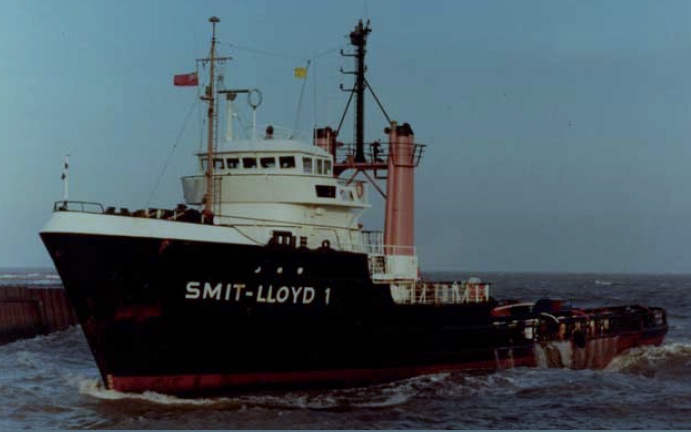
Photo: Paul Gowan.
In the ten years since the Ebb Tide was exposed to the eyes of the marine world very little happened except for the arrival of the first semi-submersible. When it came to mooring it they took a leaf out of the Navy’s book and hung the anchors of the bows of some fairly substantial tugs. In 1965 the first Sedco F triangular semi-sumersible entered service with three legs and nine anchors, generally supported, as the process developed, by supply vessels with Smatco diesel driven winches bolted down on the forward end of the afterdeck and an A-Frame at the stern, and still towed from place to place by conventional tugs. However, one of the directors of the Dutch tug owner Smit & Co visited the United States in 1963 and came back with an idea for a support vessel and from this the company saw an opportunity to extend its operations into the offshore oil industry, so Smit and the Dutch ship-owner Royal Rotterdam Lloyd formed the offshore support vessel company Smit-Lloyd. They could see that the conventional GOM design of supply ship, with its funnels half way down the main deck was limited in its operating capability. To start with it was necessary for vessels towing things to be able to change direction which required the tow wire to run round the quarters, and so the funnels half way down the deck were a problem. In addition the GOM ships were vulnerable to rough weather, and so the new company chose to abandon the conventional design and instead conducted the engine exhausts through two tall but narrow funnels aft of the bridge. The ships were designated as anchor-handlers, and were provided with two engines offering a useful 3000 bhp, giving them a bollard pull of about 35 tons. Each had an open deck of 105 ft x 29 ft (32m x 6.8m) on which could be loaded about 400 tons of cargo, and manoeuvring was assisted by a single tunnel thruster forward. The ships were provided with a winch which was electrically driven and anchor work was carried out on deck with the assistance of pelican hooks and Smit-brackets, used to secure the wires while anchors being worked on. When the first of the fleet, the Smit-Lloyd 1 entered service in 1965 other European ship-owners took a close look at it, although we have to say that the Americans were unimpressed and continued to build slighty larger replicas of the Ebb Tide. But in Denmark Maersk designed two ships along the same lines and by 1967 the Maersk Fighter and Maersk Feeder arrive on the scene, similarly provided with two tall funnels aft of the pilot house. Smit-Lloyd went on to build 17 very similar vessels, which went to work all over the world, setting the standard for everything to follow.
In 2017 a group of enthusiast were trying to preserve the Smit-Lloyd 1 which, unless an initial $250,000 could be raised, was going to the breakers. Does anyone know what happened?
P