

RESPONSIBILITY FOR FERRY OPERATIONS
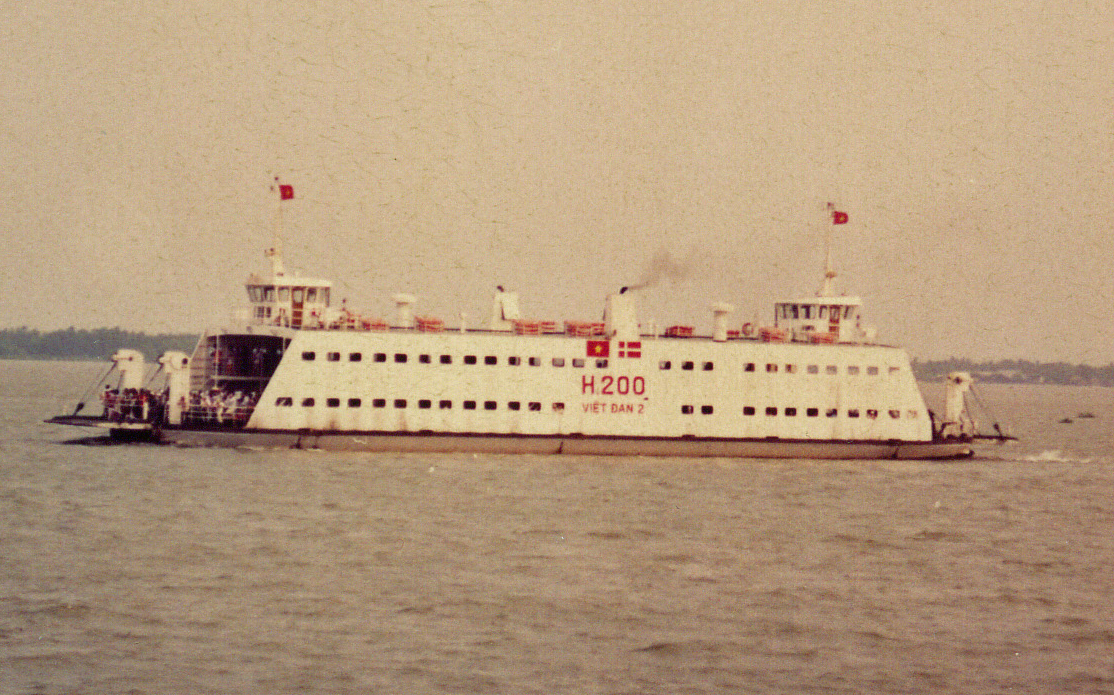
A Vietnamese ferry crossing the Mekong delta: Photo Victor Gibson.
I imagine that all of us have been distressed by the capsize of the South Korean ferry the Sewol and the resulting loss of life. We might also have been angered by the immediate arrest of the Captain and thereafter the whole of the deck department. I wondered how one might approach this delicate situation and so thought I might look at the operation of one of the many ferries on which I have travelled.
The photo shows one of the several ferries which are employed to take passengers and freight (as long as it is on wheels) across the Mekong. You can see the crowds on the fore end of the ship, and the whole of the interior was packed with people, bicycles, small trucks, and trailers full of different sorts of animals. There were no internal divisions within the space, although it was possible for unencumbered foot passengers to stand on a sort of mezzanine deck along the sides. What appear to be windows were actually just air holes. The ferries berthed bow up on one of multiple accesses in a sort of daisy shape, and disembarkation and embarkation took place without the benefit of any moorings. As can be seen the ships have very little freeboard and their construction would pretty well ensure that if there was a grounding or a collision the free surface would guarantee capsize. Looking at the photo it looks as if there are life floats on the roof, but I don’t remember there being any means of access, otherwise I would probably have used it.
If one of these craft sank with considerable loss of life whose fault would it be? It is unlikely that we could blame the Captain. Let’s face it he’s just using the tool he has been given. Could we blame the company that owns it? Probably. But the most likely culprit is the government who should have ensured that the ferries were regulated, and that the regulations were followed. In this case the owners and the government could be one and the same. And lastly do I have some responsibility as an adult with some specialized knowledge, to decide whether I travel or not? Maybe. As usual we do not have the answers.
NERC TO GET A NEW SHIP

An image of the new ship from the press release.
The other day it was announced that the British Antarctic Survey were to get a new ship, and it was pointed out that the others The ’John Clarke Ross’ and the ‘Ernest Shackleton’ were respectively 25 and 20 years old, and that we have to keep up with the times. The ship is being estimated to cost $200 million, that’s today of course. But it pleases me to see that it seems to have offshore genes, if this is what it is going to look like. It looks to me as if you could get a lot of sofas on that triangular bridge.
THE MURZUR

A photo from the internet of the ship on a beach.
The monthly Nautilus Telegraph usually contains an article about some ship abandoned by its owners leaving the crew living in awful condition and not receiving any wages. This month was no exception, containing an article about the Turkish owned and Panama registered Murzur. I googled for a picture, and found one of it stuck on a beach off Teignmouth just north of Torquay.
It was detained during a flag state inspection in Fowey. To quote the inspector: ‘The living conditions were totally unacceptable, with no hot water, poor sanitary system, a communal shower area which is basically a plumbed pipe with no shower head, non functioning washing machine, deckheads hanging down in the cabin and a freezer of uncovered meat in the AB’s cabin.
In addition to the terrible conditions, and by the look of it the risks of being aboard 10 of the crew were paid less than the ILO minimum. An AB on board is paid $400 per month inclusive of overtime and leave. That would be if they were getting any money, because salaries were subject to financial sanctions, and in any case some were owed two or three months wages. The inspector said that there was evidence that some had paid for their positions on board.
It would be good if we could say that this was an isolated incident!!
THE KULLUK ACCIDENT
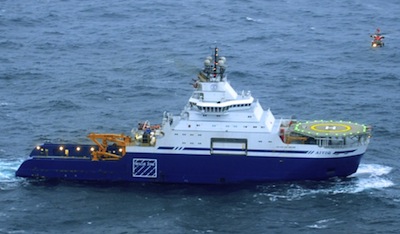
The icebreaking anchor handler Aivig from Edison Chouest publicity.
On 31st December 2012 the mobile drilling unit KULLUK grounded on a beach on Sitkalidak Island, Alaska, with no injuries or loss of life. The event was investigated by the US Coast Guard and their report published in April 2014.It can be found on the USCG ‘Homeport’ website. There is a detailed summary on the Ships and Oil website, We only have space here for the timeline of the accident - so here it is.
21st December: The AIVIQ and the tow leave Captain’s Bay
27th December. The weather deteriorates.
AM. Wind SE 20-25 knots. AIVIQ’s winch control starts generating high tension alarms. More wire is paid out and apparently the vessel slowed, although later investigation was unable to determine that this took place. A video taken by one of the watch keepers at about 0900 shows the tension in the tow wire cycling between 35 tons and 228 tons.
Analysis carried out by Rolls Royce after the event determined that the winch overload alarm occurred on 38 separate occasions.
1135. Loss of tow, due to the failure of the 120 ton shackle connecting the tow line to the monkey’s face. The KULLUK is adrift 52 miles from Sitkalidak Island. The AIVIQ recovers its tow wire. There is no sign of the shackle. The tug GUARDSMAN and the NUNUQ (An AHTS but designated as an oil spill response vessel) notified to get under way. Coast Guard vessel ALEX HALEY instructed to proceed to assist.
1200+. It is decided to reconnect the tow using the emergency system.
1445. AIVIQ successfully reconnects to the emergency tow line. KULLUK towed away from an ‘8 fathom patch’.
2255. The AIVIQ’s No 2 diesel is shut down for oil level checks and refuses to restart. And soon afterwards the engineers note that the injectors are failing on all engines.
28th December
0131. Wind SW 25-30 knots. ALEX HALEY arrives on scene.
0245. All the main engines have shut down, so the AIVIQ is propelled by the 2600 bhp azimuthing thruster and directed by the tunnel thrusters, provided with power by the ship service generators. The ship is able to maintain station ahead of the tow but all are being pulled astern.
ALEX HALEY attempts to take the AIVIQ (and therefore also the KULLUK) in tow. This attempt results in in 800 ft of messenger line and part of the towing hawser being picked up by the Coast Guard ship’s port propeller.
0600. On AIVIQ 5 injectors are replaced on No1 main diesel and it is successfully restarted. However the ship and tow are still being pulled astern.
1115. ALEX HALEY is instructed to depart for Kodiak for repairs.
1329. GUARDSMAN (A 1976 built traditional GOM tug) arrives on the scene.
1538. The GUARDSMAN has the AIVIQ and therefore the KULLUK in tow. But the whole set is still being pulled slowly astern. The GUARDSMAN’s towing system is of course commensurate with its available bollard pull.
2300. Wind SE 35-45 knots. Helicopters arrive on scene to attempt to evacuate the KULLUK, but due to the pitch and heave of the unit and the proximity of the derrick the attempt is abandoned.
29th December
0300-1000. Delivery of 74 new injectors in 12 lifts by Coastguard helicopters to AIVIQ takes place.
0425. Tug ALERT departs from Port Etches near Valdez for the location.
0510. GUARDSMAN tow wire parts.
0630. NANUQ arrives on scene, and after daylight prepares to take the KULLUK under tow, connecting to the rig by using a line throwing apparatus.
1150. NANUQ has the rig under tow using No 8 anchor wire connected to its 64 mm tow wire. AIVIQ is still towing the rig, with its azimuthing thruster.
1235. Evacuation of the 18 rig crew by Coastguard helicopter takes place.
30th December
AM. Winds SSW 40-50 knots.
1315. NANUQ’s tow parts, and shortly thereafter the AIVIQ tow parts at the spliced eye of the emergency tow line. KULLUK adrift approximately 30 miles from land.
1325. Tug ALERT arrives at the scene, and initially is unable to connect to anything due to the clutter in the sea in the vicinity of the rig.
1630. It is decided that the AIVIQ will grapple for the No 8 anchor wire, now trailing on the seabed astern of the drifting rig, together with part of the NANUQ’s tow wire.
31st December
0110. ALERT successfully connects to the emergency towline by recovering the end to the deck and putting a bowline in it, and connecting it to their own towing gear. It starts to tow the rig away from the shore.
0445. AIVIQ successfully grapples the No 8 anchor wire. There is no sign of the NANUQ’s tow wire, or the connecting 150 ton SWL shackle.
0510. AIVIQ and ALERT now have the KULLUK under tow. They are proceeding towards Port Hobron a safe harbour on the Northeast side of Sitkalidak Island on instruction from the Unified Command.
1131. GUARDSMAN is released from the area with gearbox problems.
1336. Wind ESE 50+ knots. A salvage team briefly deployed to the rig.
1530-1600. The master of the ALERT reports that he is required to take evading action several times to avoid collision with the AIVIQ.
1600. The KULLUK begins to pull both vessels backwards towards Sitkalidak Island and so they increase power.
1624. Wind SE 40-50 knots. AIVIQ’s tow parts – at the 76mm weak link. The ALERT is now being pulled astern by the rig. By now the tug is attempting to influence where the rig will go aground. The AIVIQ master considers that there are no other possible means by which the tow can be reconnected.
1815. The ALERT master orders 100% power to influence the speed of drift of the KULLUK, but due to engine alarms has to reduce power to 85%.
2010. The ALERT releases the tow with the KULLUK 3 miles from the shore on instruction from the Unified Command, by spooling the tow wire off its drum..
2040. KULLUK grounds on a stretch of shoreline near Oceans Bay, Sitkalidad Island.
THE CSS OLYMPIA

Some of you might not believe it, but I search resolutely for good news. It may just be that mariners are pessimists, that there is not much. If it hasn’t happened already it’s going to soon.
This could be why the oil industry is not keen on us. They only like good news, and they think that when things go wrong it was just bad luck. Really!
So here is a good news story, probably. I have reservations because this is a completely new design of craft, designated as a ‘Compact Semi-submersible vessel’. It is a ‘swath vessel’ I think. It is only 85 metres long and has a 32 metre beam and has a deadweight of 3900 tonnes. But is can accommodate 500 personnel. This sounds almost too good to be true, and in reality the vessel, is it a ship? Has yet to go to work.
It is currently on its way to Brazil at 10.5 knots, where according to one press release it will be delivered to its new owners ‘Gran Energy’. Once more we are left with questions, since we thought that the vessel was owned by Marine Assets Corporation (MAC).
Before it has been tested in earnest the company (MAC) have two other semis under construction. The CSS Olympia was voted ship of the year by someone the other day!