
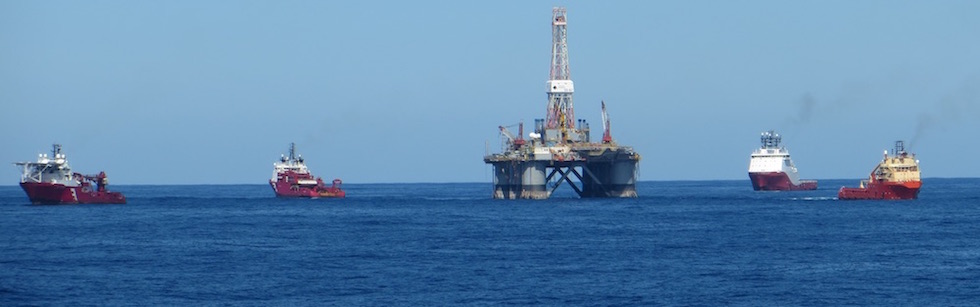

THE RISKS OF LONG DISTANCE MULTIPLE TUG TOWS

Fairmount tugs Towing - From the Fairmount website.
The Tugs and Towing newsletter has recently contained a quite lengthy complaint by a former tug master, and later towmaster about the risks relating to what might be called “high speed towing”, where a large marine object is towed by a number of tugs at a speed intended to get it to its destination in the least possible time. He points out that no proper consideration is given to the possibility of one of the tugs suffering from a blackout, and cites one occasion when he was a tug master and his tug suffered a blackout; his vessel ended up under the bow of the tow, but fortunately was undamaged. On another occasion when he was tow master the centre tug of three suffered a blackout, and was damaged by the tow, which had been travelling at 6 knots. He had recently been tow master on a tow with three tugs travelling at 12 knots, and his question is “what would happen if a tug suffered a blackout at this speed?”
He has several points to make. Firstly even though risk assessments are carried out before the tows none of them consider the possibility of a blackout on one of the towing vessels, secondly even though emergency procedures are written for the possibility of blackout on a towing vessel these procedures cannot work in practice, and even at 6 knots, when there was a blackout on a towing vessel, the emergency procedures did not work. And his third point was that even though the Marine Warranty Surveyors are, in his words, “educated, and know their theory and regulations, when it comes to towing matters… they lack practical knowledge and experience”.
As an experienced facilitator at marine risk assessments I would be really interested to know how the assessments for long distance tows are carried out, and why the emergency procedures are impractical. It sounds like another tick in the box job!
THE AURORA
There is a bit of news about the Aurora which, for those who are not up to speed on the history of Russia, was the vessel which fired the shot which started the assault by the Bolsheviks on the Winter Palace, which was to be the start of the October revolution. In 1947 the ship became a museum ship, and was berthed in Leningrad as a monument to the October revolution, and in 1984 the ship was once more under repair and it wad revealed that some of the plating came from Britain, putting in doubt the claim that the ship was a marvel of Russian engineering.
But now apparently the ship has been docked again, and further improvement work is being carried out, much to the disapproval of at least one columnist of Pravda, who seems to be suggesting that the money which is to be spent could better be assigned to building new warships, and that in the end, there will be nothing left of the original ship. It will have become a replica. This is always a problem with historic vessels. I think I got that right, although I was slightly distracted by the advertisements for contacts with “Beautiful Russian Girls”, but that was before Google had sorted me out and offered me cheap parcel delivery anywhere in UK. Not nearly as exciting.
A GAS EXPLOSION
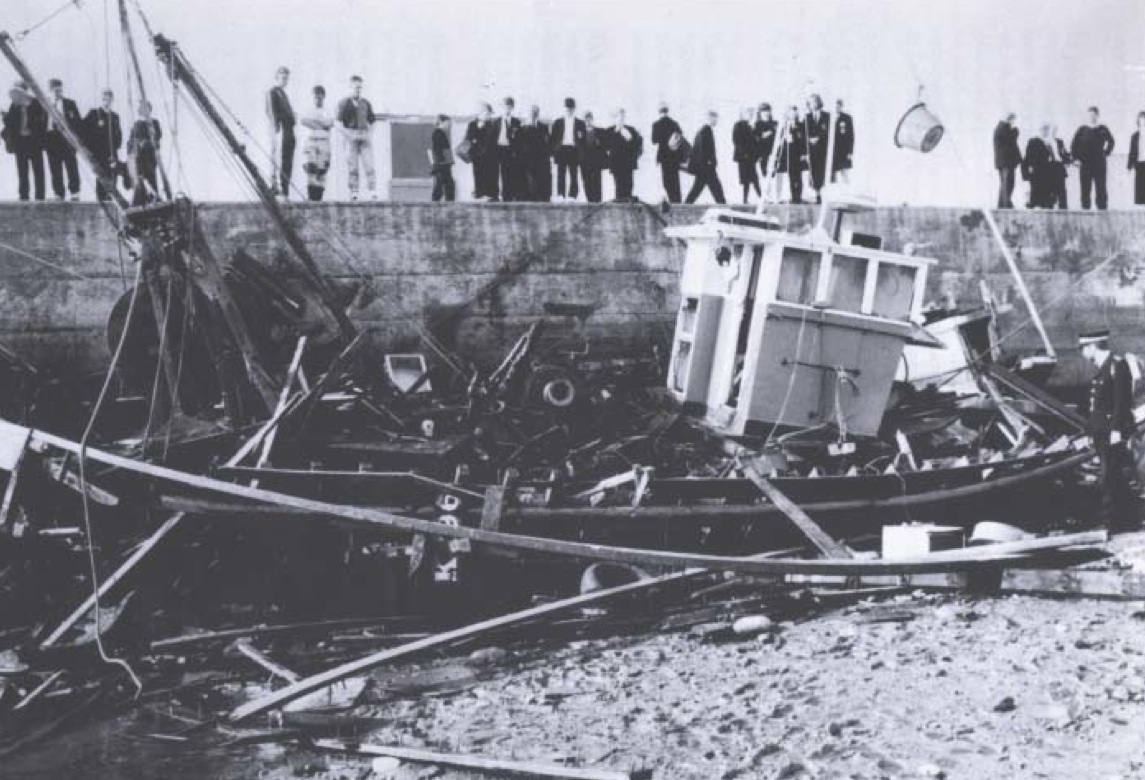
Photo from the MAIB Annual Review
Back in 1992 in the early days of the MAIB they produced their annual review and it featured a photograph of the remains of a fishing vessel. The name of it is not included in the report, or the name of the harbour where it was berthed, but there look like a bunch of school kids on the quayside and a Scottish policeman on the sand close to the stern.
The report says that the vessel was provided with a two ring calor gas stove with gas bottles stowed on deck, with a rigid copper pipe between the bottles and the stove which was situated in the cabin.
The owner of the boat had beached it on a Saturday in order to carry out some minor repairs to the hull, and had last used the stove to make a cup of tea on the previous Friday.
Came the following week, and the owner had commenced working on the hull on Tuesday morning and had stopped for a cup of tea at about 1100. He went to the cabin, opened the gas supply to the cooker, and got out his cigarette lighter. He thumbed the ignite and boom! A violent explosion effectively destroyed the vessel, dropping the owner into the bilges, where he remained until a crane could be brought in to lift the wheelhouse to release him. He suffered shock, severe burns to his hands and minor burns to the face. Lucky man! The accident was caused by corrosion in the copper pipe.
The MAIB directed fishing vessel owners to the DTp 1986 publication:
“Fishermen and Safety” described as “a guide to safe working practices for fishermen”. Others might see the title as an oxymoron.
VLOCs IN PORT

A VLOC berthing at the EMO terminal in Rotterdam
I had to consult the internet to find out what a VLOC was, and it turns out that it is a Very Large Ore Carrier. Today there are ore carriers which can carry about 400,000 tonnes of iron ore, and a number of them are employed to carry the cargo from Brazil to the heavy industrial areas of the world, like Holland and China.
The acronym was brought to my attention by the “Chief Officer’s Column” in Seaways, the magazine of the Nautical institute. And, by the way, it was good to see some really practical content in a periodical which seems to spend most of its time dealing with the more esoteric activities of the marine industry.
And before commenting on the content of the article in the magazine it might be useful for me to relate an experience from my past. Back in the mid 1960s I was Second Mate on a Tate and Lyle geared bulk carrier, whose task was mainly to go to the West Indies and load sugar, destined for the UK. It wasn’t a bad job, with a certain exotic quality, visiting as we did, some unusual West Indian and Mexican ports. We would spend a few days at the Caribbean end, loading sugar from barges with grabs suspended from the ends of union purchases on the derricks. The ship had steam winches so the winch drivers could get a wonderful rhythm going. As the grab reached the point over the hatch when it would crack open and deposit its load, they would fling the Stevenson’s link gear over, and seamlessly start it on its route back to the barge.
There was no work at night, and so we had the opportunity of going ashore with the workers at the end of the day, to be picked p later by the ship’s lifeboat. We visited the Jamaican ports of Savannah La Mar, a tiny town on the edge of a shark infested lagoon, and Salt River, where there were crocodiles and a single corrugated iron shack from which beer was dispensed. We occasionally berthed in Bridgetown, Barbados, La Romana in the Dominican Republic and on one outstanding occasion, Vera Cruz in Mexico, where they loaded the sugar from bags, landing the hoists on the hatch covers, slitting the tops and emptying them in the holds.
We also used to visit Trinidad, and lie offshore close to the coastal town of San Fernando where again we would load from barges. We were young men and therefore were able to take on the prospect of a marathon evening out in Port of Spain, by going ashore with the workers in the evening, travelling in their bus to Port of Spain, spending the evening and then most of the night dining and drinking, and catching the workers’ bus back down to San Fernando in the very early morning. All this sound idyllic and in some ways it was.
But to get to the point of this story. In 1966 the company opened up a bulk loading terminal in Trinidad. This wonderful modern structure turned out to be a single chute on a small jetty sticking out a mile or so from the shore. Aligned with the jetty were a number of buoys to which the ship was to be moored. The ship had been built in the 1950s. In the way of bulk carriers of the time, it had five hatches, two forward of the central accommodation and bridge structure, and three aft of it, the last hatch being just forward of the aft housing which contained the engineers accommodation, the social areas and the funnel casing.
So the ship was made fast with the chute positioned over number 3 hatch, and moorings forward and aft to the buoys. But then an offshore wind began to get up, and soon we found we had to put out extra ropes to the jetty. And then we had to move the ship to load up one of the forward hatches, and we found that aft we had to join mooring ropes together so we remained attached to the most distant buoys. And then we had to move the ropes to the jetty so as to keep the ship alongside. The Third Mate and I spent 36 hours on deck, from the time of arrival to the time of departure. Times had certainly changed, and this brings me to the point of the story.
“The Chief Officer’s Column” in Seaways relates the distressing tale of what life is like on one of these VLOCs working out of the Brazilian port of Ponta de Madeira. The ship will arrive in port and the crew will start to make it fast, initially using the ship’s own moorings which are 44mm steel wire ropes. Once the first 12 moorings are made fast, the mate will prepare for loading, but it will be necessary for further moorings to be added. These will be offered up from the shore and are 64mm ropes. They will keep on adding moorings until there are possibly 42 securing the ship in position. But that’s not the end of the job, because of the tidal range and the rate of loading, which can apparently be 19,000 tonnes per hour (my ship in the West Indies would have been loaded in about 40 minutes), the forward and aft ends of the ship have to be constantly manned so that the 40 odd lines can be adjusted.
The writer, who has had this experience, says that these vast ships have six deck crew available for handling the moorings, and so it has become necessary to recruit the catering and engine room staff to assist with the operation, but of course they can’t be constantly in attendance. They have their own job to do. And so, if it comes to that, does the mate who has to supervise the loading, checking the draught, de-ballasting or ballasting, to minimize the possibility of hogging or sagging and generally taking charge of the whole operation.
Then, after about 30 hours, during which some of the six deck crew have to be given the opportunity of rest, they will start to take the moorings in to prepare for departure, and finally the job will be done and they will go to sea. And they see the time on passage, during which they will have to navigate this vast object across the oceans, as a time of recuperation before the next port visit.
There might be a moral to this story. Professional seafarers are very well trained, loyal and stoical people. They will keep on doing what their employers ask them to do, no matter how difficult – I was tempted to use the word “stupid” here - until events prevent them doing it any more. The reason that such activities cease to be possible is usually because there is an accident which ( forgive me for being cynical) results in a number of seabirds being covered in heavy oil. The legislators will then get on the case, and eventually the shipowner, or the port operator will be prevented by regulation from doing what they have been doing in the past. I mean, how is it reasonable for a ship of 400,000 tonnes deadweight to have a deck crew of six? Why is it reasonable for this deck crew to have to struggle with moorings for endless hours when surely there could be a shore crowd added to them so that they could work reasonable hours in port? Once more, there are answers, but no-one wants to know about them.
QUEEN OF THE LAKES

The Paul R. Tregurtha by Jeff Greg and Amanda Barber
Only a few people, other than those living on the periphery of the Great Lakes will know much about the ships which ply those waters. They used to have the bridge on the bow, and a funnel at the stern, but like nearly all ships today the whole lot can be found perched over the engine room. This is even true of the Paul R Tregurtha, known as “The Queen of the Lakes” because it is the longest ship trading there. The ship is 1013’ long, constructed in two sections, and launched in 1981. So it is now a little over 30 years old. When new it was one of 13 ships more than 1000 ft long trading on the Great Lakes, but one assumes that today it is the only one left.
It has its own page on the “boatnerd” website, where its whole history has been laid out for the interested reader.
The record tells us of the high points of its career when it carried record breaking cargoes of iron ore, around 62,000 tonnes. Also when is was used to rescue a similar vessel, the James R Barker, by tying up alongside it, and then sailing with it lashed alongside to a repair dock.
Possibly lower points in it s career include a moment when it was briefly in the news last month due to having grounded outside Duluth, and hence having required tug assistance. The web page about the ship identified four previous groundings, and two collisions in its lifetime. Not too bad then we might think, considering the extraordinary length of the vessel and the somewhat confined conditions of the Great Lakes navigation systems.