

RESPONSIBILITY FOR THE SEWOL TRAGEDY

The Sewol as it rolled over from the BBC website
Time has passed since the sinking of the Sewol with the loss of about 300 lives. As far as we are aware the Captain and most, if not all, of the deck department have been arrested and are probably in custody. Meanwhile journalists around the world have been beavering away and it has been revealed that the ship had been modified by the addition of accommodation on the upper deck aft. As a result of this modification the maximum cargo the ship was allowed to carry was about 900 tonnes instead of something approaching 4000 tonnes which was actually on board. It looks likely that the 3000 tonne difference was actually supposed to be ballast, so if this ballast was not in place no wonder the thing fell over.
In addition numbers of members of the management of the shipping company have also been arrested, and the South Korean authorities have recently offered a $500,000 reward for information leading to the arrest of Yoo Byung-eun, the patriarch of the shipping company Chonghaejin Marine, owners of the Sewol. They have also offered $100,000 for information leading to the arrest of Yoo Dae-gyun, Yoo Byung-eun’s eldest son. The fact that these gentlemen have gone on the run seems to indicate that they at least believe they know who is responsible for the disaster.
The South Korean Prime Minister also resigned over the disaster, and their coastguard has been disbanded. There has also apparently been a tendency for retired government officials to join the board of commercial organisations, the activities of which they had previously had an oversight, and this cronyism is to be specifically addressed by the new PM. How does the unfortunate master stand in all this? We don’t know what he knew, or even what sort of training he had received for dealing with this sort of major emergency. It is at least fair to assume that the company had not considered such a disaster, or the manner in which passengers would be kept safe. That would be called a risk assessment.
DON'T HEAD STRAIGHT FOR THE PLATFORM
As I seem to keep saying these days, I have spent many years now writing safety stuff, and you can find some of it on the Ships and Oil website. I have written and spoken formally and informally on safety matters, and one point I have always made to those operating offshore support vessels is ‘DON’T HEAD STRAIGHT FOR THE PLATFORM!’ Then if something goes wrong, or you forget what you are supposed to be doing (yes it happens) the ship will just steam on, and the worst thing that will happen to you is getting a bit red in the face. But the Nautilus Telegraph has reported that an unnamed ERRV was heading for a platform the other day to go on close standby, when a change of watch took taking place – the Mate to the Captain. As the ship was approaching the platform the Captain attempted to change direction by steering with the aziprops but nothing happened. He increased speed to improve control (Is this beginning to sound familiar?) but nothing happened. So in a close quarters situation he stopped one of the aziprops and the ship turned, missing the platform by three metres. The Mate had not told the Captain that he had the ship in autopilot. This failure to notice that the autopilot is engaged has resulted in several collisions, but if they had just steered a few degrees off from the direct course towards the platform it would not have mattered.
THE SHIP OF GOLD

The Central America being wrecked. Borrowed from the National Maritime Museum.
The BBC website reports that a deep sea exploration company has recovered 1000 oz of gold from the wreck of the Central America.
The ship sank back in 1857 with the loss of 425 lives and also 21 tonnes of gold, when it was caught in a hurricane 160 miles off the South Carolina coast. The gold was intended to prop up the banking system in New York, and its loss resulted in financial panic.
Since the recent recovery all activity has stopped amidst a blizzard of writs and counter claims, reflecting the earlier legal activity after a previous treasure hunting venture.
This was led by a man called Thomas G Thompson who developed the means of recovering the valuables from the wreck during the 1980s and with financial backing from a number of investors, ventured out there and started to do the job.
In 1987 his company recovered a quantity of gold and other valuables, but in 1990 the insurers of the cargo filed suit to claim the rights to the cargo, but lost. They appealed and in 1992 the court ruled in their favour. A further trial in 1993 produced yet another result, and in the end Thompson’s company and the insurers agreed to split the rewards.
Thompson sold some or all of the gold in 2000, but his investors received nothing, because, appar-ently all the proceeds had been used to pay for the court cases. They have sued him And when he failed to turn up for a hearing an arrest warrant was issued. His current where-abouts are unknown. The gold remaining in the wreck may be worth as much as $97 million. More on this story later!
THE LOSS OF THE OCEAN RANGER
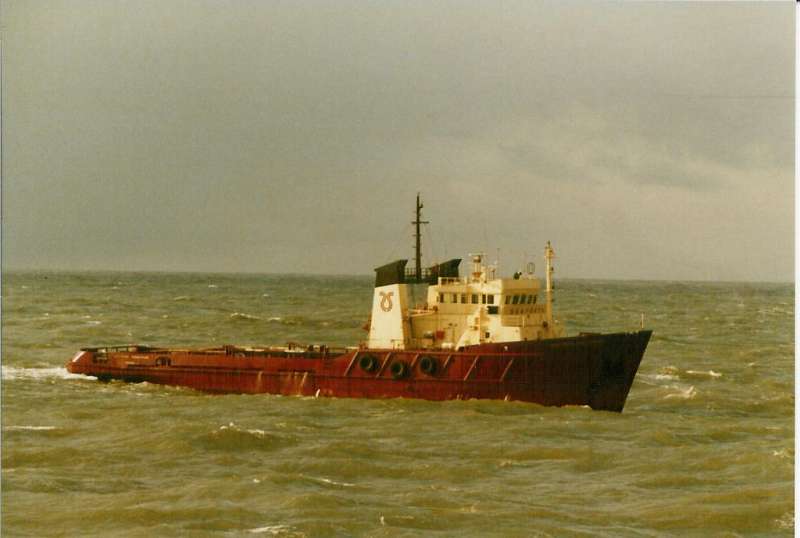
The Seaforth Highlander from Shipspotting.
I find that, despite the fact that, on many occasions, I have used the Ocean Ranger accident as an example of how a minor incident can turn into a catastrophe, during my 20 odd years and a safety consultant, I have not included a description of it on the website. To rectify this omission this is an extract from my book ‘Supply Ship Operations.’ A fuller description can be found on the Ships and Oil website.
The Ocean Ranger was an extremely large and relatively well-found semi-submersible which, in the spring of 1982, was drilling for Mobil on the Grand Banks off the coast of Newfoundland. It had eight columns. Key to the events which followed, the Ballast Control Room was situated in the aftermost intermediate column on the starboard side, below the level of the main deck.
No ships at all were involved in the disaster prior to its occurrence, but it was a marine event, caused by a combination of poor design, bad practice and lack of knowledge. One of the many failings detailed by the enquiry was the curious diversity of responsibility for the rig. During the enquiry a number of former masters of the Ocean Ranger were interviewed and they testified that they had responsibility for marine matters without the authority to properly discharge their duties. The masters had no crew directly under their control and even the ballast control operators took their orders from the tool-pusher, the senior drilling person on the unit. The report on the sinking stated that “He had no knowledge of the ballasting system or the principles of stability. And yet the ultimate authority and responsibility for the safety of the rig and its crew rested in his hands”.
The initiating event in the disaster was the weather, which turned from unpleasant to apocalyptic over the days up to 15th February 1982. On the previous evening the wind speed was about 70 knots and the rig was heaving alarmingly. Other rigs in the area, the Sedco 706 and the Zapata Ugland were both hit by large waves.
On the Ocean Ranger a large wave broke the port glass and flooded the Ballast Control Room, dousing the ballast control board. For those unfamiliar with the function of this equipment, the board is used to electronically control the valves and pumps which operate the ballast system on semi-submersibles.
The problem for the Ocean Ranger, was that when the control board was doused in water, valves in the pontoons started to open and close randomly, to the distress of the control room operators. They knew that they had a problem they did not know how to solve it. Like many ballast control systems, the one on the Ocean Ranger was provided with solenoids which changed the electrical power into hydraulic power. A switch on the board would activate the solenoid which would open or close to allow hydraulic pressure to be exerted on the valve actuator, or to be removed, usually allowing the valve to close. Realising that they had to do something, someone inserted a set of brass rods into the solenoids, apparently thinking that the valves would be closed, but instead the valves were opened. This allowed water to flow freely between the tanks, and since the ballast tanks in the rig were distributed along the lengths of the pontoons all the water ran from aft to forward. The rig gradually trimmed by the head until the chain lockers filled up, and then in the dark at three in the morning on 16th February the rig disappeared from the radar screens of the ships in the area.
There were two OSA ships, the Boltentor and the Nordertor standing by the Sedco 706 and the Zapata Ugland, and the Seaforth Highlander was standing by the Ocean Ranger. At five past one on the day of the disaster, only two hours before the sinking, the Mobil foreman requested that the Seaforth Highlander come to close standby, and a few minutes later the other rigs dispatched their standby vessels towards the distress. In 60-foot waves one should remember that any movement of a ship in a specific direction, rather than just maintaining a heading to reduce the possibility of structural damage, is something of a feat.
The report states that during the approach to the rig the Seaforth Highlander made ready the equipment it had available which might assist in the rescue. This, pathetically, consisted of a cargo net, a grappling hook, a boat hook, two heaving lines and two lifebuoys fitted with lines. The Master of the Seaforth Highlander saw a flare at about 2.14 as the ship was approaching the rig, and that this flare had been fired from a lifeboat.
The ship approached the lifeboat and the Master decided to place the ship stern to wind with the lifeboat astern of the ship. In this way he would be able to maintain the heading, and would not be at risk of running the lifeboat down. The witnesses said that the lifeboat was also head to wind apparently under power. The Seaforth Highlander now stern to the seas was manoeuvred closer to the craft and the seas breaking over the after deck were freezing instantly and making it difficult for the crew to do anything useful in their less than adequate protective clothing.
Just after 2.30 the Seaforth Highlander reported that the lifeboat was alongside. The crew on the deck managed to throw lines which the survivors in the lifeboat managed to attach, and at this time a number of men emerged onto the port side. It seems reasonable to assume that others had undone their safety belts, and had stood up, and obviously the bailing activities which had been going on now ceased. These changes probably contributed to a loss of stability and as a result the lifeboat rolled slowly over, throwing a number of men into the sea. The deck crew made valiant attempts to recover them, with some considerable risk to themselves since the seas were still breaking over the deck.
Meanwhile the other ships arrived. The Boltentor was asked to assist in the recovery of the lifeboat, and the Nordertor was sent to monitor the rig itself, the Nordertor reporting the loss of the radar echo of the rig at three o’clock. Then all three vessels took up the task of searching for survivors or bodies in the sea, but the report of the enquiry notes that “sea conditions and inadequate retrieval equipment frustrated all efforts to recover bodies”.
During the final but unsuccessful attempts to recover the lifeboat, the Captain of the Nordertor observed that there were about twenty bodies inside. Several floated out through a hole in the bow, and one was washed onto the deck of the ship. Over the following days the search continued for bodies, the fleet now enhanced by a number of other vessels, and by 20th February a total of 22 bodies had been recovered. Not one person, of the 83 man crew, was saved..
THE SPANISH UT722s

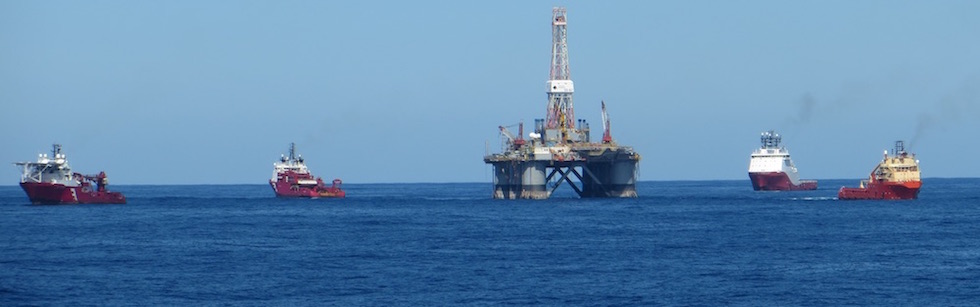
One of the splendid Spanish UT722s waiting for something exciting to do. Photo Victor Gibson
Back in 1993 the Liberian registered tanker the Braer ran aground at the southernmost point of the Shetland Islands and broke up. No lives were lost, and there was limited damage to the environment due to the fact that the ship was carrying Norwegian light crude oil. However an enquiry headed by Lord Donaldson determined that the British government should station emergency towing vessels (ETVs) around the coast of the UK in order the limit the possibility of further events of this sort.
For a while a number of vessels were stationed around the Uk coast, and the tug operator JPKnight made a business of it, operating a number of UT719s. Although these ships did some work, they never intervened in a disaster similar to the Braer, and this has led the UK government to discard the process. This is a gamble!! And it may or may not come off.
The photo is of one of the many well found vessels operated by the Spanish emergency services, which include two UT 722s. Other governments operate ETVs, including the French, the Germans and the Dutch. I am not alone in thinking that the UK government should take responsibility for the safeguarding of the coastline and those at sea around it.