

PASSENGER SHIP PROBLEMS

The Marco Polo which made the news in February when a wave broke some windows, resulting in the death of a passenger in his eighties
Hardly a month goes by without a news item about some sort of misfortune involving a cruise ship. You might not think this surprising since there are many cruise ships wending their way around the oceans and they cover a multitude of possibilities from objects as big as the Costa Concordia to ones as small as the Hebridean Princess. The ship which made the news on 14th February was the Marco Polo when a large wave broke into the restaurant and felled a couple of passengers. One , an 85 year old man, died before they could get him to an emergency helicopter and the other, a lady, was airlifted ashore for treatment.
What can we say. If you have a look at the history of the Marco Polo you can see that it was built fifty odd years ago in East Germany, and was converted into a ‘modern’ cruise ship in Greece. And of course the ship was hit by a freak wave which broke the windows, while it was making its way towards Tilbury up the channel – in February. There are quite a few key words in this paragraph which might cause one to anticipate disaster, but regardless of all else there is the probability that the ship was attempting to maintain its schedule to get back to the terminal port in time to disembark the current passenger list and take on a new one.
It is always fun to read the critiques by cruise people on the internet, and the Marco Polo gets a pretty good roasting. But there is a serious message there. It is important if you are going on a cruise to choose a modern well run ship, and the older you are the more modern your ship of choice should be.
WINDFARM WORRIES
There is much correspondence in the pages of the Nautilus paper ’The Telegraph’ about the activities of the maintenance vessels used in the windfarms offshore UK. Correspondents claim that they are often required to work in weather conditions in excess of even their own guidance. In addition there were three windfarm vessel accidents during January this year, in one case requiring the crew to abandon it before it sank. The Nautilus general secretary has written to the UK shipping minister expressing concern. However, the response was according to the paper, ‘underwhelming’.
Those of us who have been involved in the offshore oil industry have been surprised at the apparent lack of regulation extant in the renewables business. One assumes that there will have to be a serious accident before anyone grasps the nettle.
ESNAAD 715
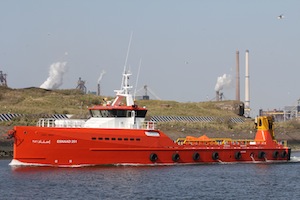
Here is the Esnaad 251 a sistership to the 715. Photo Jan Plug
Back near the beginning of the month I was watching the news here is Spain when I saw a somewhat garbled news item which included video of crewmembers being lifted from…yes, a supply boat, to a rescue helicopter.
It turned out that the ship in trouble was the Esnaad 715 one of Damen Axebow crewboats which was on a delivery voyage from Holland to the Middle East. Apart from cribbing the design name from Ulstein these look like splendid little craft and so it was distressing that one might be lost at sea without even turning a propeller in anger.
But as it turned out the five crewmembers were saved, and afterwards the ship was towed into Coruna, so up to a point all is well.
The modern concept of having ships dive through the waves which seemed to have been started with the XBow, has been extended by a number of designers and the Axebow, with no flare effectively fulfils the same purpose. If there is a downside it would appear than more of the hull is used for the bow, thereby reducing the cargo carrying space, but one assumes that the passengers can go in that bit, and since the ship will pierce the waves rather than riding over them one assumes that the ride will be more comfortable.
The whole concept might have been initiated when ships started having watertight doors at deck level rather than wooden ones. Wooden doors!!! What were they thinking??
AN ACCIDENT IN THE GULF OF MEXICO
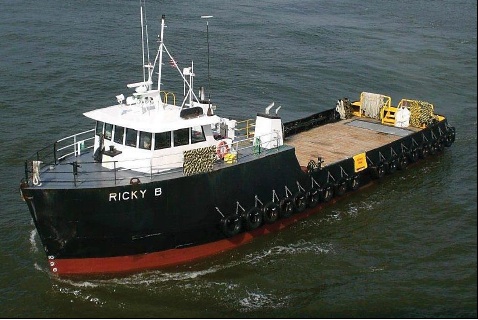
The Ricky B from the Investigation report
We don’t often hear what goes on offshore in the Gulf of Mexico so it was revealing to receive an accident report from the American National Transport Safety Board the other day. The accident involved the small platform ship the Ricky B, pictured here. It was built in 1981, was 110 feet long and was power by two Detroit diesels of about 500 bhp each. It had a crew of three.
On May 30th 2013 at 0702 the Ricky B sank about 245 miles south of Marsh Island Louisiana while being towed. The three crewmembers had abandoned ship and were transferred from another vessel to a manned oil platform.
In the days leading up to the sinking the Ricky B had been conducting supply runs to various oil production platforms located 30-40 miles from the Louisiana coast. Two days before the sinking on May 28th 2013 at about 2100 a high bilge alarm activated on board the vessel. The mate entered the engine room where he noted that the starboard shaft seal packing was damaged and leaking. The mate woke the master to inform him of the situation and both returned to the engine room to assess the leak. According to the master a piece of the packing material was found in the bilge under the starboard shaft seal system and in his opinion water was ‘coming in too hard’ to attempt to repack the system. The crew disengaged the starboard engine and using the port engine maneuvered the Ricky B to a nearby platform where they tied off the vessel to attempt a repair. The crew managed to tighten the four nuts that secured the packing gland faceplate to the through-hull penetration, and this action slowed the ingress of water to a rate that was reported to be within the capacity of the vessel’s bilge pump.
After the field repair was completed the crew proceeded with the Ricky B’s intended supply run to another platform 16 miles to the north using only the port engine. The master told the investigators that the starboard shaft seal system continued to leak throughout the night and into the early morning in May 29th, but the vessel’s bilge pump was able to ‘keep the water below the deck plates’ in the engine room. About 1030, with the master on watch, the vessel departed the platform for its home port of Dulac, Louisiana, still using only the port engine. The master stated that he was making rounds in the engine room every 30 minutes to monitor the flooding situation. About 1045 the mate relieved the master of the watch, and sometime later for unknown reasons decided to engage the starboard engine at clutch speed. Clutch speed is the slowest speed at which the engine will rotate the propeller shaft.
About 1130 the mate noticed that the bilge pump was no longer keeping up with the ingress of water. He then aligned the appropriate piping in the ballast manifold and started the ballast pump to assist the bilge pump in dewatering the engine room. However this action was unsuccessful and about 1230 the ballast pump ceased to operate due to the rising water level in the engine room. The mate woke the master and then radioed a distress call which was received by the US Coast Guard Sector New Orleans. Shortly thereafter the crew shut down both main engines, but the generator and the bilge pump were left running and continued to operate until the water level reached a point where these systems failed.
The crew of a nearby vessel, Miss Monica, responded to the Ricky B’s distress call. The crew of the Miss Monica supplied a compressed air driven dewatering pump, which the crew of the Ricky B activated to attempt to dewater. However that effort was unsuccessful. The crew of the Ricky B also tried to activate a gasoline powered dewatering pump that had been airdropped by a Coastguard C-130 aircraft responding from Mobile Alabama. That too was unsuccessful because the watertight seal on the airdrop case containing the pump had failed and allowed water into the case, which had rendered the pump non operational. At 1400 the master deployed the Ricky B’s anchor, sealed the access to the engine room, activated the vessel’s emergency position indicating radio beacon and then joined the mate and the deckhand who had already abandoned the vessel to the Miss Monica. The crew of the Miss Monica transferred al three crewmembers to a nearby manned platform.
Early the following day, about 0215 on May 30th the towing vessel Delta Force arrived at the location of the anchored Ricky B which was still partially afloat. The crew of the Delta Force began towing the Ricky B towards the shore. However at 0702 the Ricky B completely submerged and sank in about 50 feet of water some 24 miles from Marsh Island.
About 2.5 weeks later on June 17th the Ricky B was lifted to the surface by a contracted salvage team for dewatering. On entering the engine room the salvage supervisor discovered that three of the four nuts that secured the packing gland faceplate to the shaft sealing system were loose and the plate was offset 3-4 inches allowing water to flow freely into the vessel. The salvage supervisor removed the packing gland faceplate, installed new packing material and then reinstalled the packing gland faceplate, effectively making the gland watertight. The vessel was dewatered and then towed to a shipyard in Morgan City to be examined and repaired or scrapped.
Post sinking toxicological testing was performed on all three crew members, and the mate’s specimen tested positive for cocaine. The mate’s use of this illegal drug may have contributed to the sinking because of his decision to engage the starboard propulsion shaft even though he knew it had been shut down due to the severe seal leak. In addition, although the crew members stated that they had tightened the bolts that secured the starboard shaft packing gland faceplate, this was not the condition in which the salvage team found the starboard shaft seal when the vessel was examined immediately after refloating.
The above report is reproduced more or less complete, and would raise a few questions for European mariners. It is difficult, for instance to imagine a ship with only three crew venturing out into the oilfield, even allowing for the generally more benign weather conditions in the Gulf of Mexico and the small size of the ship. Indeed one wonders whether a ship manned in this way should be out there overnight anyway. Perhaps it was not really meant to be more than what might be called a day boat. Who knows, certainly not the investigators whose sole conclusion was that the crew had failed to assess the seriousness of the leak.
HELICOPTER SAFETY

A Helicopter on an offshore helideck. Photo Tim McCleod
The UK CAA and the Norwegian air authorities have recently issued new rules for the carriage of personnel in helicopters flying to offshore installations of all sorts. This is after there have been five helicopter accidents in recent years, some with major losses of life.
According to the report in the Scotsman on 21st February helicopters are to be banned from taking off in severe weather and, pending further improvements, oil rig workers will only be allowed to fly if they are seated next to an emergency window exit.
From April 1st 2015 the regulatory authority has also called for a limit to the ‘size’ of offshore workers allowed to fly by helicopter. This limitation has yet to be specified, but some commentators have suggested that they will be required to be able to exit through an emergency escape window, which seems sort of logical. There is more, and doubtless it will all rumble on.
Some will remember that the larger crewmembers always seem to get onto the helicopter first, leaving the smaller personnel only able to get one cheek of their backsides onto the seat. So at least that will change.