


Uncategorised
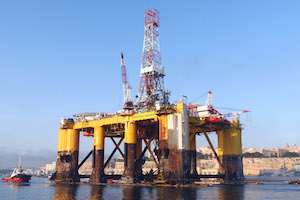
Here is the Transocean Amirante in 2015 in Malta. This is a very old semi-submersible which was constructed in about 1977 and has been moderately undated since. Back in the early years of this century, after a minor downturn, the oil price went mad, and there seemed to be hardly any capable offshore drilling units out there to take up the challenge. Hence all this old stuff was dragged out of retirement and fixed up. This rig shows the typical upgrade, in this case to give the rig more variable deck load. This usually has involved the addition of buoyancy on the corner columns and blisters on the pontoons. This rig has, I think, been taken to the breakers but fortunately I've got the photos.
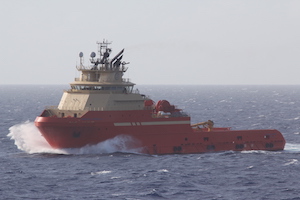
Another of our fairly frequent visits to Brazilian waters, where the Bram Force can be seen rushing across the seascape. It is one of a class of Edison Chouest anchor-handlers built out in Brazil in about 2015, powered by four Cats developing 27,000 bhp. In accord with what seems to be the current design of anchor-handlers they are great big things, maybe larger than they need be, requiring much of the power available just to maintain station because of the windage.
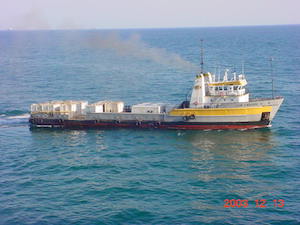
Searching through my archives I found the Don Enrique II, which was built in 1980. It is obviously (to some) a Halter Marine 180 footer, originally the Marsea Six. According to the internet it is still out there in Mexican waters. One of the interesting statistics when you have a look at this class of ship is the gross tonnage, in this case 282 tons. Of course gross tonnage is a measurement of space, not weights originating as "tuns" - barrels. This type of ship have large plates bolted to the inner sides of the accommodation, and are measured with the plates removed. If under 500 GRT they do not have to conform with SOLAS requirements and some US manning standards.