


Uncategorised

Not for the first, or the last time I am writing about a Maersk design, and on this occasion it is particularly unusual. Back in the 1970s in the North Sea, and probably everywhere in the world, semi-submersibles had a great deal of difficulty deballasting from operating to transit draught and the other way, and so it was necessary for the ships on the job to take all the cargo off the working deck into port prior to a rig move, then get out there and move the rig (we should remember that at that time virtually all the ships working on the UKCS were anchor-handlers). After the move they would go back to the base port pick up all the cargo, which was mostly drill pipe, and take it out again. As a result of this activity it seemed to some-one to be a good idea to develop a ship with an open deck forward on which the drill pipe, and containers could be stowed for the move and a clear, but shorter, afterdeck which would allow the efficient operation of the anchor handling activity. While it is not possible to be definitive as to whether this was the source of the design of the Maersk Ms it seems likely, although by the time they appeared in 1986 things had changed. By then most of the semi-submersibles out there had been modified with the addition of extra buoyancy to allow the transitions to take place without the deck load having to be removed. And in any case whoever had worked on the idea for Maersk had changed the open deck forward into a hatch. As an aside, the ships were fitted with a large central propeller and two smaller azimuthing thrusters aft. This was on the basis, one assumes, that it is still more efficient to conduct the power through a single large propeller rather than two smaller ones side by side. The two ships were provided with enormous winches, having two workdrums each capable of storing 3300 metres of 77 mm wire and two tow drums each capable of stowing 1900 metres of 77mm wire. These capacities and a 160 ton bollard pull made them desirable for the deeper water rig moves which were beginning to take place. The forward hatches were always something of a problem. Shell used the ships for a while, fitted with a TV camera based DP system, which allowed them to use the hatches, and in an early exploration project out in the Falkland Islands the ships were used to take cargo out there underdeck. At some point the Maersk Master was fitted with rail round the hatch, allowing containers to be stowed on top of it. The Maersk Mariner (Photo by Cesar Neves in 2009) was sent to the breakers in January 2015, and an interesting photograph of it being put ashore was posted on Instagram, with one comment from a viewer saying “If you ever worked on the Mariner you’d be glad to see it up the beach. In fact you’d probably want to grab a gas axe and get stuck in”. The Maersk Master was sold to a Nigerian company in 2013 and also made it the the Alang breaker’s beach in August 2015.
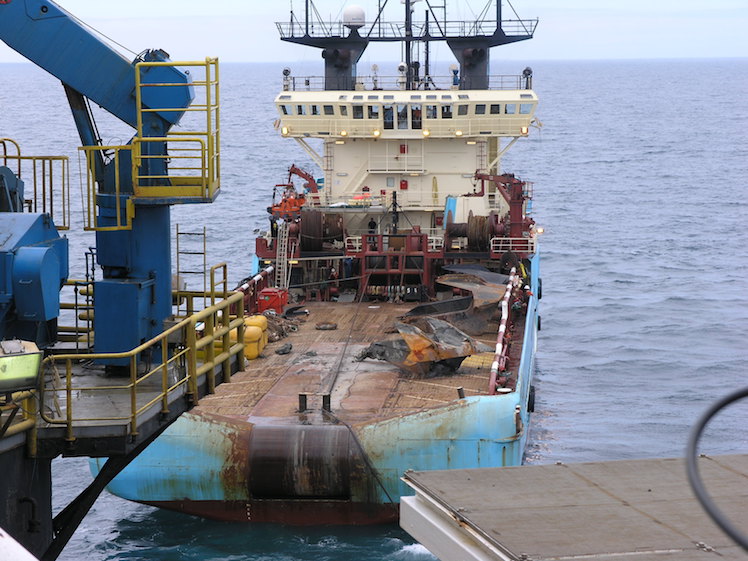
Although the VS 476 is fairly closely related to the VS 469, because of the larger number of the class produced and their longevity in the industry they are worth a mention. Four were built in 1985 and 1986 at the Danish Orskov shipyard all initially owned by Norwegian investors, probably as part of a process, which remained slightly obscure to most of us, known as the KS investment scheme. This was a scheme which gave Norwegian professionals tax breaks if they invested in ships. The first of the four to enter service was the Storfonn, to be followed by the Kongsgaard, the Kingshav and the Challenger III(Photographed as Maersk Challenger by Victor Gibson at a North Sea exploration rig in 2007). But of course 1986 was the year when the oil price fell to $8 a barrel resulting in a difficult time for all offshore vessel owners, and in many cases leaving the ships in the direct ownership of the investors. And as in the world today there were advantages for the more innovative shipowners, particularly those with a bit of money in the bank. This resulted in the British offshore support company Ocean Inchcape (OIL) bareboating the four ships, which became the Oil Chieftain, Oil Challenger, the Oil Champion and the Oil Chancellor. My book “The History of the Supply Ship”, chronicles a spokesman for OIL saying, “we are sure we will soon find contracts in the North Sea because there is still a market for that type of anchor-handler”.
In fact the four ships were often employed as platform supply vessels. They had a deck area of 633 sq.metres and other capabilities included the ability to carry 1400 tons of diesel and 618 tons of mud. Their four B&W Alpha engines delivered 14,400 bhp giving them 160 tons of bollard pull. Later at least one of them had an enhanced winch fitted for deep water work out in Brazil. The four ships were purchased outright by Maersk Supply at the end of the five year OIL bareboat charter and became the Maersk Cs. Maersk had been in the business for some years but on a fairly small scale, and it may be that the purchase of these four ship was the start of their major assault on the offshore support business, and in the following weeks we will see further Maersk ships which were in themselves innovative. The four ships were variously employed in the North Sea, in Brazil and in Canada and today two of them are still owned and operated by Blue Star Line. The Maersk Chancellorwhich has been working in Canada for much of its life departed from Halifax in November 2016 for scrapping in Turkey. The Maersk Champion is still working out in Brazil, apparently defying the Petrobras 15 year rule which has resulted in the departure of many vessels from the area (this written some time ago).

For some reason I have previously failed to record the Viking Queen anywhere as being of historic interest to ship enthusiasts, and this is even though I was standing on the quayside at the Total berth in Torry, Aberdeen when it sailed into the Tidal Basin for the first time. It was 1984. Blimey, I thought, can these ships get any bigger. At the time I was captain of a modified UT704 of which more later. But the Viking Queen was 75 metres long and 16 metres wide, and was 3200 tons deadweight. I was later to find out that it was powered by four Wichmann engines delivering 12,390 bhp and giving it a bollard pull of 142 tons. It also had 3000 bhp of thruster power available to propel it sideways, as opposed to what was available on my brand new ship which was 500 bhp, plus whatever I could get by manipulation of the main engines and the rudders. This became a bit of a talking point between me and my owners. The Viking Queen was a VS469 and was the first offshore vessel designed by the Vik Sandvik design house located then in Fitjar on the Norwegian island of Stord. This organisation continued to produce innovative vessels and more of their ships will appear in this feature. It was purchased by Wartsila in 2009. VS have also had a long relationship with Eidesvik then the owners of the Viking Queen. If the ship had a weakness it was the winch which had two drums, the work drum being capable of storing 1500 metres of 70mm wire and the tow drum 1400 metres of wire of similar dimensions. It appears that the winch might have been replaced when the ship became the Ocean King, this being based on a photograph of the ship in Bergen in 2007 and later information provided by Atlantic Offshore. The new winch, if that it what it was, had two work drums each with a capacity of 1400 metres of 70m wire, and a tow drum with a capacity of 1100 metres. In 2016 it was reported that the ship’s contract with Statoil had been terminated where it had been continuously employed since 1986 both under the ownership of Eidesvik and Atlantic Offshore. There was one sister ship, the Viking Troll which was also purchased by Atlantic Offshore and became Ocean Troll. It was converted into an ERRV (Emergency Response and Rescue Vessel) in 2013 and was chartered by Nexen on the UKCS. It appears to be still out there. That Viking Troll is not to be confused with a later vessel of the same name built in 2000 as the Stirling Iona, also a VS design.
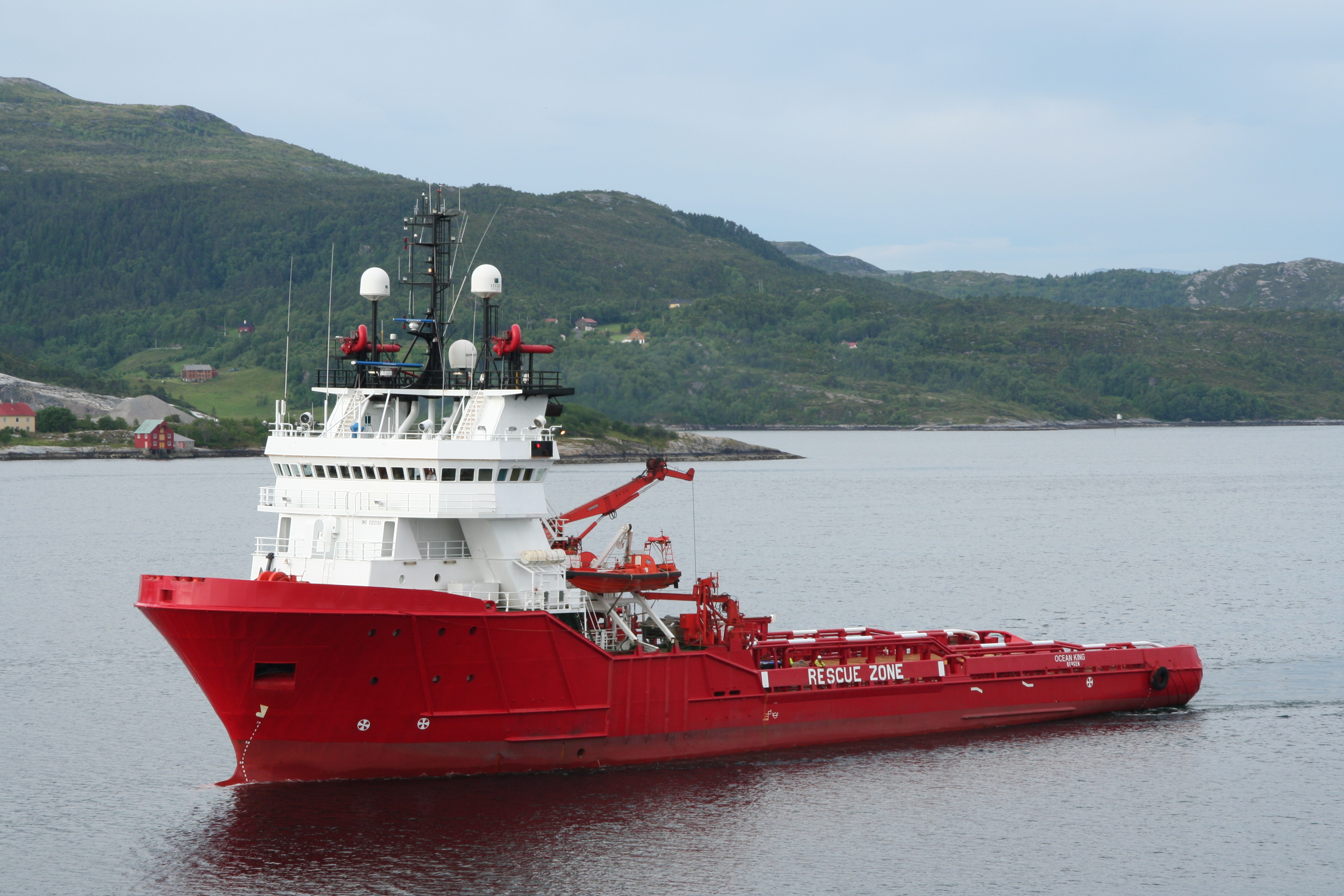
Photographs: Viking Queen in Bergen at the time of its purchase by Atlantic Offshore by Victor Gibson and Ocean King in Atlantic Offshore livery in 2007 by Jan Plug.