


Uncategorised
THE QUEEN'S DIAMOND JUBILEE
The latest celebration of our queen’s lengthy reign was an impressive four day event mainly in London, but probably all of us who have experienced previous jubilees looked back to them. In a similar manner to the events of 2012, back in 1977 the queen visited different parts of the United Kingdom allowing her devoted subjects to line the streets and wave small union jacks at her.
Back in 1977, the year of the silver jubilee, I was master of the seismic survey ship Oil Hunter, which was a converted Norwegian stern trawler. It was engaged at the time in carrying out a survey line completely encircling the United Kingdom on behalf of the UK government (Don’t ask me why). At the time when the queen was visiting Northern Ireland , our ship was lying alongside in the Limerick port of Foynes in the Irish Republic. As part of the delightful hospitality shown to us by the locals the Mate and I were invited to the Foynes yacht club where we attempted to maintain the nautical reputation for alcoholic consumption with limited success. “Don’t worry boys,” said one of our hosts late in the evening. “we’ll make sure nothing happens to you”. And typically, in the way of mariners everywhere, we had never thought that anything was going to happen to us anyway – up until that moment.
The following day then, I was less than totally surprised when two very large suited gentlemen, elbowed their way into my cabin without any introduction. “We’re the Irish Special Branch,” they said, “and it seems that your ship is the only British registered vessel in Ireland at the moment, and so you could be a target. We’d like you to take your ship out and anchor it in the river.” I gave their suggestion a bit of thought before answering. “But that would mean that if there was a bomb planted we couldn’t get off” I replied, “so I think we’ll stay here.” And we did. I try to limit my reminiscences but could not resist this one.
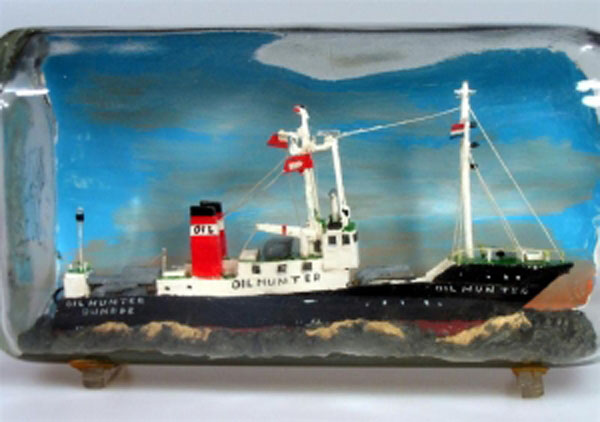
This is the Oil Hunter in a bottle (downloaded from an internet auction site!) The leading hand on the ship when I was captain used to make them, back in 1977.
THE ELGIN GAS LEAK
Good news then for Total and everyone involved with the Elgin Platform. If I had delayed my newsletter until 17thMay I could have reported that the well had been killed using, according the “The Scotsman” 1000 tonnes of oil based mud. Since then, apparently, personnel have been returning during daylight hours to work on the platform, and finally it was reported a couple of days ago that most of the platform crew are now back at work, although it may take towards the end of the year before the platform is producing again. It appears that the only people who are distressed by this news are the greens who have ben unable to find any evidence of pollution of the environment.
THE ITS CONFERENCE
It would seem churlish today not to mention the ITS Conference which took place in Barcelona at the end of last month.
This is a biennial event organized by the ABR Company, and provides a fun week for the movers and shakers in the tug business, in some major city of the world. Last time it was in Vancouver and the next one in 2014 is in Panama. There is a conference, where pertinent papers are presented, and a load of stands promoting everything from shipyards to steering gear.
The magazine published by the same company is now called International Tug & OSV, showing that the organization has taken on the relationship between oil industry vessels and the tug and salvage business.
However, when it came to it the speakers stuck pretty resolutely the subjects they knew about, salvaging, towing and building and operating tugs. Cross over points might have been the papers about ETVs – Emergency Towing Vessels – many of which were, or are, types of anchor-handler.
Some people were in favour of ETVs, but the traditional salvage spokesmen, headed by Andreas Tsavliris, of Tsavliris Salvage and Towage were in favour of the commercial approach, and he felt that the involvement of offshore ships in the salvage business was inappropriate. This old record has been playing since 1975, and I was amazed he is still at it.
There’s more, and I might get down to writing a proper review later in the month.
HEADING FOR THE RIG

The Big Orange XVIII Photo Scott Boulter
I though I would continue for another newsletter with a narrative about a marine accident, and with a second one following the theme of uninten-tionally running into things.
This accident occurred on 8th June 2009, and the principle player was the well stimulation vessel Big Orange XVIII. Yes, if you were wondering, the Big Orange XVIII used to be orange, together with Big Oranges I to XIX all of which used to be well stimulation vessels. The Big Orange XVIII was a modern ship capable of DP operations while connected up to a rig or platform, pumping thousands of gallons of noxious fluids down the wells , to well, stimulate them. Pertinent to this event it was powered by two azimuthing propellers which had to be rotated to go astern.
The other main player in this event was Ekofisk, and it may be worth remembering that back in 2005 The Ocean Carrier had run into a bridge between two of the Ekofisk platforms, resulting in an enhancement of the procedures and systems in order to prevent such a thing happening again. Ekofisk is a complex field with a whole range of different types of platform connected by bridges, and at all times provided with jack-ups carrying out various activities at some of the platforms.
So, the BO XVIII had spent some time at the end of the previous month stimulating wells at Ekofisk, and hence there was some familiarity between the ship and the field, but the ship had returned to Montrose (the location of the photo) for a crew change, and had then returned to the field to stand by. On the day in question the ship was called in a t 0340 in the morning to carry out the stimulation of well X16. The Second Mate was on watch. It was his first trip on the BO XVIII.
The master was called to the bridge and at 0400 he asked for permission to enter the 500 metre zone, and changed the steering mode from auto to manual. The communications took place with “Ekofisk Radar”.
Subsequent to this communication, from the viewpoint of the platform the Big Orange XVIII continued to approach the facility at reduced speed, and then unaccountably increased speed considerably and with some difficulty avoided hitting one of the platforms and, steadily increasing in speed, passed under a connecting bridge. It just avoided the jack-up COSL Rigmar and then veered off to starboard, running into the water injection platform Ekofisk 2/4-W at 0417, at a speed approaching ten knots. The damage to the platform was considerable, both above and below the waterline, and the ship suffered a loss of all items protruding above the bridge and a two metre dent in the bow. No-one was injured.
On board the ship one can only say that the master failed to understand what was going on, and that the Second Mate was unlikely to have been of much help since he was a new arrival, although the investigation did not say what other offshore experience he had, if any. Of course, had they not been heading straight for the complex then there would have been no problem.
We have already said that the master took over at 0400. Shortly afterwards he went to the radio room to take a short phone-call, and then returned to the pilot house. Approaching the point where he was going to stop and test the systems he put the helm over but nothing happened, the ship ploughed on. He then increased speed because sometimes the ship failed to respond to the steering at low speed. Nothing. He then turned the controls for the propulsion through 180 degrees for full astern, and increased the power to maximum. The speed of the ship increased.
The Captain resorted to steering with the bow thruster, managing to avoid some of the fixed structures, and passing under the connecting bridge. By now, in desperation, he pressed the emergency stops for the engines, which, although it is not expressly stated, probably also cut off the power to the thrusters. So the ship hammered into the platform and came to a halt. There was a flurry of communications between the various personnel and ships involved, and the Big Orange XVIII started up the engines again, and backed off straight into the Northern Crusader, after which it limped off to await further instructions.
Oh – and why did all this happen? The Captain went to answer the phone. Because the second Mate was inexperienced he re-engaged the autopilot before he went. When he returned to the pilot house he forgot to put it back into hand steering!!
AFRICAN PIRACY
The Russian site, Maritime Bulletin is currently running a campaign to in some way raise the consciousness of the international community against piracy in places other than the Horn of Africa.
They are attempting to raise the awareness of anyone who can read to the possible misfortunes that can occur to seafarers in African ports.
And we all agree, and I’m please that I am sitting here at my comfortable desk, rather than commanding a ship attempting to survive in places where there is no way that the ISPS Code has any place. The people you are dealing with are in uniform and carrying guns, but they are also asking for money, and anything else worthwhile you might have.
And then there are the ones who will be deterred by sandbags. In the end they are the ones who we might prefer to deal with.
BP SHIPPING - WHAT COMES AROUND
Back in the 1970s BP operated a small fleet of offshore vessels ranging from platform ships to an advanced standby vessel, which launched its FRCs in all weather up to a force 9. Then they sold the ships and closed down. Actually it was not quite like that. Both the management and the ships were taken over by Gulf Offshore, then a very small player in the North Sea. There-after they placed management of the “jigsaw” ships, one in the photo, with Vector Offshore. But now BP Shipping are are building four new platform ships in Korea, and in a somewhat complex arrangement, if reports are correct, will bareboat them to BP Exploration. This process is apparently consistent with BP’s strategy, “That promotes vessel ownership where long term life of field can be demonstrated.”
THE ELGIN GAS-LEAK UPDATE
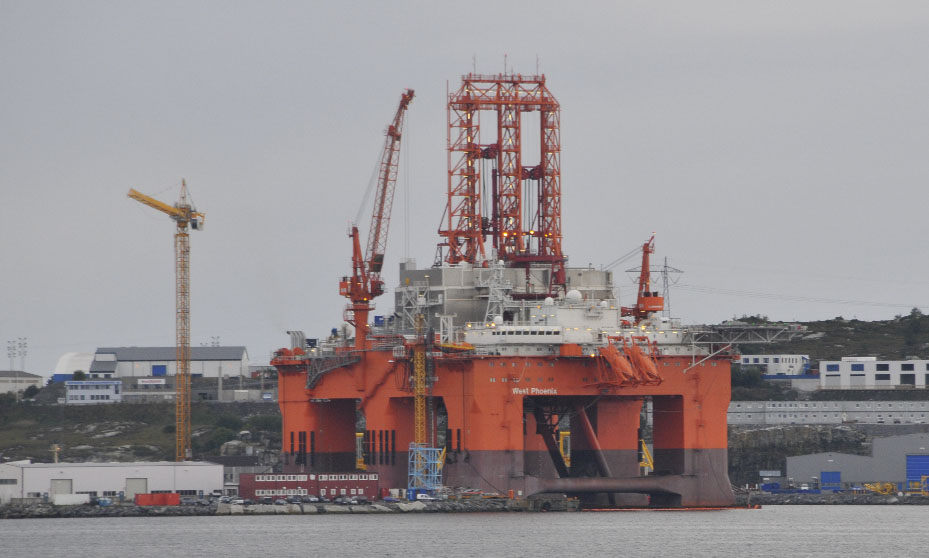
The Seadrill West Phoenix. Photo Robbie Norman
Remember 25th March, the day we learnt that the Elgin Platform had suffered a gas leak and that the complex had been, for want of a better word, abandoned. After the initial excitement created by the flare, which was still burning, and might, if things had gone particularly badly, served as an ignition source for the accumulated gas, we all went back to our normal lives. And when the flare went out on 31st March even the news teams who had been accumulating with their satellite broadcasting vans on Greyhope Road, went on their way in pursuit of more exciting events.
But of course it has not been fun and games for Total who have mustered all their forces in an effort to bring the leak under control. These have included the Transocean moored semi, the Sedco 714, now a veteran of many years campaigning in the North Sea, the modern jack-up Rowan Gorilla V replaced at the Elgin WHP by the Rowan Viking, which if course is still in position, shut down and unmanned, and the DP semi-submersible Seadrill West Phoenix, a recent addition to the Total chartered fleet.
The latest news, on 15th May, is that the West Phoenix is in a position to commence killing the well with heavy mud via a temporarily installed flexible pipeline. This is known as a “dynamic well kill” for which permission was granted by the Department of Energy and Climate Change, on 4th May. If this job goes according to plan the well should be back under control in a day or two, and for those who are unfamiliar with these processes, the work is quite different from the attempt to kill the Macondo well in the Gulf of Mexico back in 2010. They are going to make, or maybe have already made, a connection to existing pipework on the deck of the Wellhead platform, as opposed to trying to stuff a pipe down end of a broken riser on the seabed several thousand feet down.
THE CRUISE SHIP AND THE CASTAWAYS
It would be a nightmare for any shipmaster to find out that he had ignored seafarers in distress, and that there had been deaths as a consequence. So it must be for the Captain of the Star Princess which steamed unknowingly past a small boat containing three distressed fishermen, in the Pacific near the Galapagos. Apparently a number of birdwatching passengers saw the boat, and the waving men on board it, and told crew members on the ship. But the officer of the watch was never informed. The fishing boat was adrift for 16 days before they saw the ship, and the one survivor was rescued after a further 14 days, his two friends having died of thirst.
MASSIVE TIDE IN AUSTRALIA
While undertaking my regular activity of updating the “Fleet Information” I came across the Massive Tide, and thought I might try to see if it had had any previous names. There is actually a comprehensive list of all the UT 704s on the website but for some reason the Massive Tide does not appear. So, I googled the name and accidentally came up with an Australian Government accident report.

The Massive Tide. Photo Kenny Polson
The accident was minor. There were no injuries except for a few red faces, and very limited damage to the ship. But as usual there are lessons to be learnt.
Over the years I have campaigned – unsuccessfully – for a change in attitude of deck officers serving on offshore support vessels. I have suggested that they should stop setting course directly for oil rigs, so that if they become inattentive, or for some reason go below, forgetting why they were on the bridge, or fall asleep, they will not be brought back to reality by the grinding of metal as their craft embeds itself in some completely innocent offshore structure. But the Massive Tide accident did not involve an oil rig, it involved an island.
The summary of the accident investigation states that at 0445 in the morning the while travelling at 9.8 knots the ship grounded on a shoal on the western coast of Rosemary Island, in the approaches to Dampier Western Australia.. The weather was fine and the visibility was about eight miles.
The ship left Dampier at 1400 on 28th August 2006, and arrived at the Ensco 106 at 1950. For the duration of the passage the Second Mate had been on watch, and when the ship arrived at the rig he called the Master and remained on the bridge to operate the bulk system. The report says that the Master took over the watch. But one of the problems with the old UT 704, and maybe other Norwegian built support vessels is that the bulk operating system is situated on the bridge and is normally operated by one of the deck officers. This is as an alternative to it being in the engine room and operated by the engine men.
So, the Second Mate took the watch to get out to the rig, and remained up there for the transfer of the bulk cargo at the rig which was completed at 2315. At that time the Master suggested that he go down until midnight, but since he was due back at that time he elected to carry on. Hence the Master suggested that he call the Mate before 0400 which was his planned hand-over.
At 0100 the ship was released by the rig with the Second Mate and the lookout on the bridge. The Second Mare set the course at 129 degrees, and recorded a GPS position in the log book at 0200 and 0400, and since the ship was to arrive at the Dampier Sea Buoy before 0500 he decided to leave the Mate in bed. But at 0445 the ship ground to a halt on the shoal.
The nub of the problem was that the second Mate had read a course 129 degrees off the GPS which was the one directly to the last waypoint at the berth, rather than the 119 degrees required get the ship to the fairway buoy. And rather than plotting the position on the chart at 0200 and 0400, which would have instantly identified the error, he chose just to write the position in the log book. Surely this would be the equivalent to making a small cross in the log and appending the statement “you are here”. The report does not really tell us why the Second Mate failed to identify the light on Rosemary Island, but it did suggest that the ship’s management of its watch periods was less than efficient.
The reason for the rather curious watch periods was that the Master and the Mate both had driving experience, while the Second Mate was still learning, so he was to do the transits and the other to do the port and rig times. Why then did he remain on the bridge to look after the bulk discharge? Could the lookout have done the job? Might the Captain have done a bit of transit watchkeeping?
Within the detail of the report is the fact that the Second Mate was unfamiliar with the radar, and had set it up, so he thought to enhance possible targets, but there was a lot of clutter. When the Master adjusted the radar after the collision the clutter turned out to be Rosemary Island. You could not make it up! And it may be that the lesson to be learnt is to manage ones watchkeeping time efficiently to limit the possibility of fatigue.
EXPERT COMMENTS
The correspondence pages of the Nautical Institute magazine usually contain a number of exchanges of views, a slow motion activity since the magazine only comes out monthly.
Two months ago I wrote a letter to the NI suggesting that they sort themselves out and be prepared to make expert comment, rather than hiding behind investigation reports. The main thrust of my argument is that many accidents take place without any form of investigation being carried out due to inertia or inability on the part of the country in which the ship is registered.
Now that I have this newletter I do not need to respond to Hong Kong based Captain Alan Loynd in the magazine, and therefore extend the correspondence over yet another month.
I had used an example of the failures of Costa Cruises to support their senior staff, by not carrying out proper training. My example was that of a 19 year old female dancer who had been put in charge of an evacuation station.
Captain Loynd had suggested that maybe she was not in charge, or that she was actually well qualified to be in charge. Here is a typical example of how assumptions can be made, and readers of the NI magazine who have forgotten the content of my letter will be thinking he had a point.
No he did not!! The girl was interviewed on a BBC investigative report into the Costa Concordia accident. I heard her speak. If she was not in charge she did not understand that. Or if she was qualified she did not understand that she was!
OFFSHORE WIND

The photo looks north from the south side of Nigg Bay towards Balmedie, the place where Donald Trump has now stopped building his billion dollar golf course, apparently in protest that they are going to put some windmills offshore there. He, Donald, is resorting to hurling insults at Alex Salmond, but to no effect.
When his plan was first proposed Aberdeen the council decided to move the windfarm to Aberdeen Bay, here just to the North of Girdleness, the lighthouse, but this would have prevented ships from anchoring out there, and the energy used in steaming up and down woukld probably have far exceeded any wind power generation.
The next anchorage is in Fraserburgh Bay about 40 miles away. Ships have to anchor where the seabed is composed of either mud or sand, otherwise they are vulnerable in high winds, rather like Donald Trump’s hair.
THE WRECK OF THE SAMTAMPA
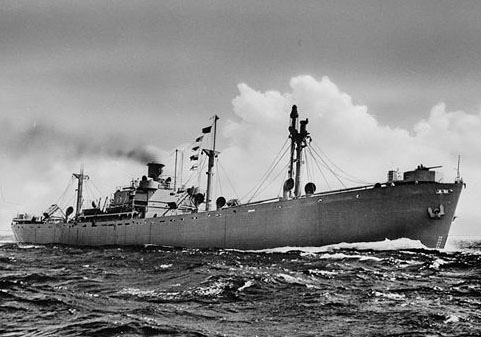
Some of us remember that most of the Uk shipping industry was sunk during the Second World War, and that after the war, British ship-owners started to trade again using Liberty ships and Victory ships. These ships were built in America for one trip, but never the less traded well into the 1960s. One of these was the Samtampa, built in 1943 and operated after the war by Houlder Brothers. BBC Wales recently commemorated its loss, which took place on 23rd April 1947. The ship anchored in heavy weather in the Bristol Channel, but the anchor dragged and it was driven ashore and broke up almost immediately. The Porthcawl lifeboat was launched, but was also lost. The thirty nine crew of the ship died as well as the eight volunteers on the lifeboat. All a few hundred metres from the beach.
THE ELGIN GAS LEAK

The Elgin Platform with the Rowan Gorilla V alongside. Photo by the Island Pride Crew
We all found it difficult to believe that the Elgin Platform and the drilling rig Rowan Viking had been abandoned on 25th March. Well, not quite. Nineteen people were left on board, but overnight on the same night they also were airlifted off. So there it was completely unmanned in the middle of the North Sea, with an unknown volume of gas leaking from the pipework of an abandoned well at the WHP, the wellheads platform. As far as I can tell the last time a platform was abandoned intact was the Hewett A in 1967.
To add to the excitement the flare was still burning, so there was some holding of breath as we waited to see if the lower explosive limit might be exceeded in the area of the flame. One imagined that things must have been pretty tense in the boardroom of Total – the owners of the installation. But on the 31st March the flame went out, and the news teams who had been ranged along Greyhope Road in Aberdeen, so as to provide a backdrop of the harbour for their pieces to camera, packed up and went home.
It is important to note that the evacuation procedures initiated by the Company were totally successful. Everyone was evacuated without injury, the first helicopter to reach the scene being a rescue aircraft from Norway. Additionally despite efforts on the part of Greenpeace, pollution has been minimal.
The latest press release from Total indicates that they have sent people from “Wild Well Control” together with some of their own experts out to the rig, and they have reported back that things are looking good. Meanwhile they are in the process of positioning the Rowan Gorilla V (seen in the photo at the Elgin WHP) to drill a relief well and are also bringing in the Sedco 714. The BBC have also reported that the Skandi Acergy may be involved in the possible well kill.
THE ICEBERG 1
On 29th March 2010 pirates hijacked the small ro/ro Iceberg I, which was crewed by 8 Yeminis, 6 Indians, 4 Ghanaians, 2 Sudanese, 2 Pakistanis and 1 Filipino. It was incorrectly reported that they had been released late last year, so except for one crew member who committed suicide, they remain in captivity. They are all locked in the hold, and have been there for nine months. Their owners have gone out of business. What next for them??
AMY JONES AND THE DEEP OCEAN CLARION
A number of offshore and marine media sources have reported on the suing of Ensco Offshore by Amy Jones a graduate of the Maine Marine Academy who was hired as an engineer by Pride and assigned to the Deep Ocean Clarion in 2010.
Her problem was that she was assigned to a cabin with male engineers, a situation which she found unacceptable, and this even though she had volunteered to share with other female employees.
Because of the disagreement her employment was terminated, and hence she is suing Ensco, now the owners of the vessel, renamed Ensco DS-4, for $3.3 million.
The basis of her claim is that “this assignment was dangerous, discriminatory and against the plaintiff’s religious and moral values”, and that sharing quarters with unmarried men would also have “exposed her to attack, even death in certain countries” through whose territories the vessel could have passed.
Honestly one has some sympathy for her. In civilized parts of the world we have become used to having our own little space, no matter how small, and sharing sleeping quarters comes hard, even without the male/female problem. But $3.3 million, and exposed to attack, even death!!
We should also bear in mind that this brand new drill ship is apparently provided with at least some three and four berth cabins. It is unlikely that this accommodation would be acceptable to the regulators in North West Europe.
THE MIGHTY DELIVERER AND A TURTLE
In the March/April edition of “Tug and OSV” magazine a lawyer has written a short article about the problems of knock for knock clauses in the TOWCON contract. Although he did not name names it rang a bell, and so I did a bit of research

The case he cited was that of the Might Deliverer and the oil rig “A Turtle” formerly the Petrobras XXI, and before that something in the North Sea. Back in the spring of 2006 the Mighty Deliverer was contracted to tow A Turtle from Brazil to Singapore. On the way, things went wrong, reported at the time as loss of tow due to bad weather, and the rig disappeared into the mist apparently never to be seen again. Then later in the year some of the inhabitants of Tristan de Cunha were on a search for some cattle in a remote part of the island, when they were surprised to see an oil rig aground about 250 metres from the beach. This resulted in a salvage, actually more of a demolition operation, which took 50 days, resulted in the rig being floated off into the ocean, and sunk in deep water, at a cost $20,000,000.
Of course some-one had to pay the bill, and it turned out to be the insurers of the rig who had to do it, but they took the owners of the Mighty Deliverer to court to get a contribution. They were unsuccessful because of the knock for knock clause in Towcon, although they did not have to pay nearly all of the contract price for the tow, because the rig had not been delivered.
In the court it was revealed that the reason the tow had been released was because the tug was running out of fuel. Various problems were presented one of which being that progress was impeded by the level of marine growth on the rig after its layup, and therefore the possible speed of the tug and tow had been miscalculated, and in the end they only managed an average speed of 1.7 knots.
Incidentally the Mighty Deliverer was previously part of a tug and barge setup. The bow was supposed to fit into the notch on the back of the barge. It is therefore really a pusher tug, not a puller. They say that the engine power was 15200 bhp, which allowed Noble Denton to calculate the bollard pull at 180 tonnes, or in other reports 152 tonnes, but whichever it was it was a rule of thumb estimate. However, the fuel consumption was said to be 3.5 tonnes per day, making one wonder how much of the 15000 bhp was actually being used. And even at that daily consumption it was evident that they were not even going to get to Capetown.
The calculation of the bhp by Noble Denton was part of the towing approval, and it was this that was relied on by the owners of the rig as an assurance of suitability of the ship to carry out the task. This seems to raise an interesting point regarding the suitability of vessels for the task they are being requested to carry out, and who might have the responsibility of ensuring it. This is particularly relevant today where, after an accident, flag states may choose to prosecute the charterer rather than the vessel owners no matter what has gone wrong.
Looking at the photograph of the Mighty Deliverer, it appears that the tow wire is stowed on that reel on the afterdeck, which would indicate that it was secured in some other way – quite possible – but not common, and of course towing approval probably does not specify what sort of floating objects can be towed.
So in the end one can only ask a question. Would we hire a pusher tug, recently re-activated after a long layup and classified with the Russian register, fitted with what appears to be temporary towing equipment, to tow a rig half way across the world? This without even thinking about whether it would be likely to run out of fuel or not.
The answer seems to lie with the costs. A Turtle was purchased for $5,000,000 and the lump sum fee for the tow was $2,000,000, and there was no-one on board the rig. But it still seems odd. Any one of the many UT 704s still in service could have done it.
BLACK FISH
Black fish are not a species with dark scales. The term is used in UK to describe fish landed illegally in excess of the EU quotas set for the species.
I had meant to catch this bit of news from February earlier, but so much has been going on that I did not get round to it. Anyway, thirteen Shetland fishermen, and a number of Peterhead skippers have been in court and have been fined as part of a roll up of a scandal that has been going on for years.
Also involved have been a number of fish processing plants in both Lerwick and Peterhead. The full extent of the scam had a value of £62.8 million. One of the processers, Shetland Catch, pleaded guilty to landing £47.5 million of fish.
Apparently a variety of techniques were used. The least sophisticated seems to have been a hidden pipe in a Peterhead plant, allowing part of the catch to be diverted into an unmonitored tank. Other processors had weighing systems which showed an incorrect weight.
The skippers have had to repay a total of £2.9 million, and have been fined as well. It was big money!
SHELL'S LEAKS

After Macondo every time there is a bit of an oil leak everyone goes mad, and hence there has been some distress in the GoM when Shell reported a bit of an oil sheen close to two of its platforms. This follows a revelation earlier this year that after the 2011 Gannet incident which resulted in more that 1300 bbls of oil leaking into the sea. The subsequent investigation found that the Company had failed to do quite a lot of administration, in relation to pipeline emergencies. Unhappily for Shell they had also had a pipeline problem in Nigeria at their Bonga field which resulted in the loss of 40,000 bbls of oil to the environment. Doubtless the legal consequences were less in that part of the world than in UK, or the Gulf of Mexico.