


Uncategorised
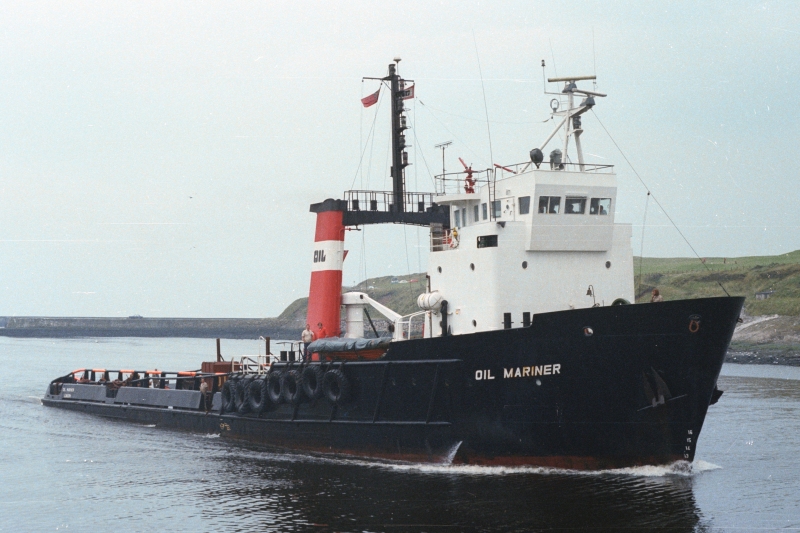
I have chosen to use the Oil Mariner as an example of the typical Ysselwerf design of which about a dozen were built for UK shipowners between 1972 and 1976. This Dutch shipyard took on the task of producing ships for the increasingly large British offshore sector, when British yards did not seem to be capable of responding with either designs or actual construction as fast as the owners required. Where were the Norwegians you might ask, well believe it or not they were still feeling their way, although by now Tidewater had placed an order for two anchor-handlers with Ulsteins of which more later. And in the early 1970s Wilhelmsen Offshore were operating half a dozen ships built in America at the Mangone Shipyard, but although designated as anchor-handlers they were unable to deck the anchors then used by North Sea semi-submersibles. The designers at Ysselwerf had trouble sourcing engines of sufficient power which would fit into the engine rooms of these small vessels. Their solution was to use the prime movers originally designed for diesel locomotives and so some of these ships were powered by two Dormans, collectively producing 5600 bhp and later models with two English Electic engines producing about 3000 bhp each. They had fixed pitch propellers and it took a heart stopping ten seconds to get from ahead to stop and another ten from stop to astern, resulting in a technique of always running one engine ahead and one astern when snatching at an offshore installation. They also had a Gill Jet forward, which was capable of providing thrust through 360 degrees, but which took an age to move from one of the fixed positions to another. It was possible to neutralise the sideways movement with the rudders and the water stream from the ahead engine, if that was necessary (further explanation of the technique in my book “Supply Ship Operations”). The ships were fitted with twin drum waterfall winches controlled from a small house built above the main deck where the unfortunate engineer in charge would operate a large wheel to change direction and a lever to operate the motors. To get an anchor from the seabed to the deck in 200 metres of water took about 45 extremely boring minutes. A feature of this class of vessel was the large stern roller and wide gate over which they could haul the 30,000lb LWT anchors and which would be secured on deck by using pelican hooks. This since after experimenting with a variety of wire securing means, the industry had settled on the pelican hook, traditionally used by the military to release anchors on old warships. Its main advantage was that it could be operated remotely from behind the crash barrier, by pulling a string. When changing from anchor-handling to towing it was necessary to close a gate over the roller, and then to loop the tow wire over it so that, on releasing the pelican hook, it would end up free to move around the stern.
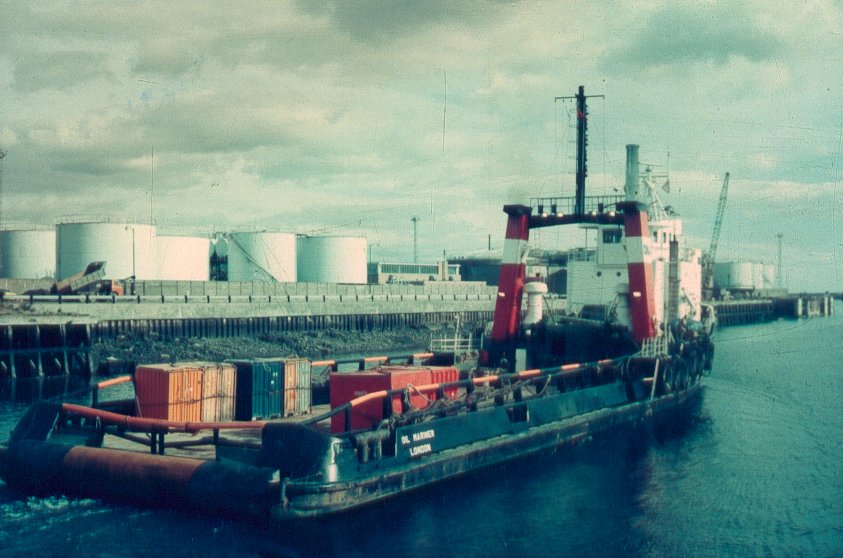
Photographs: Oil Mariner on its way into Aberdeen by Gary Markham, and on its way down the River Dee by Victor Gibson.
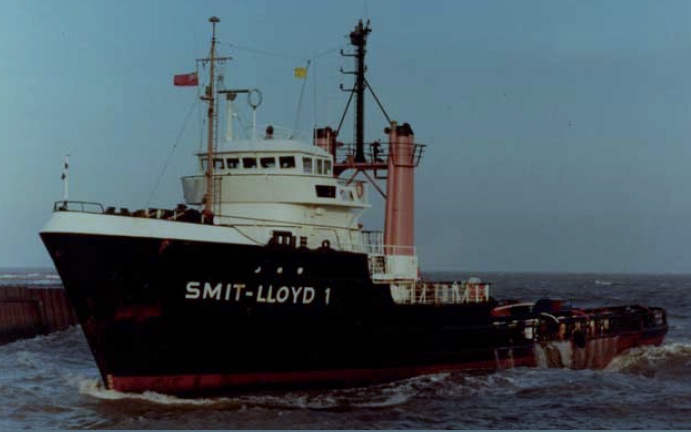
Photo: Paul Gowan.
In the ten years since the Ebb Tide was exposed to the eyes of the marine world very little happened except for the arrival of the first semi-submersible. When it came to mooring it they took a leaf out of the Navy’s book and hung the anchors of the bows of some fairly substantial tugs. In 1965 the first Sedco F triangular semi-sumersible entered service with three legs and nine anchors, generally supported, as the process developed, by supply vessels with Smatco diesel driven winches bolted down on the forward end of the afterdeck and an A-Frame at the stern, and still towed from place to place by conventional tugs. However, one of the directors of the Dutch tug owner Smit & Co visited the United States in 1963 and came back with an idea for a support vessel and from this the company saw an opportunity to extend its operations into the offshore oil industry, so Smit and the Dutch ship-owner Royal Rotterdam Lloyd formed the offshore support vessel company Smit-Lloyd. They could see that the conventional GOM design of supply ship, with its funnels half way down the main deck was limited in its operating capability. To start with it was necessary for vessels towing things to be able to change direction which required the tow wire to run round the quarters, and so the funnels half way down the deck were a problem. In addition the GOM ships were vulnerable to rough weather, and so the new company chose to abandon the conventional design and instead conducted the engine exhausts through two tall but narrow funnels aft of the bridge. The ships were designated as anchor-handlers, and were provided with two engines offering a useful 3000 bhp, giving them a bollard pull of about 35 tons. Each had an open deck of 105 ft x 29 ft (32m x 6.8m) on which could be loaded about 400 tons of cargo, and manoeuvring was assisted by a single tunnel thruster forward. The ships were provided with a winch which was electrically driven and anchor work was carried out on deck with the assistance of pelican hooks and Smit-brackets, used to secure the wires while anchors being worked on. When the first of the fleet, the Smit-Lloyd 1 entered service in 1965 other European ship-owners took a close look at it, although we have to say that the Americans were unimpressed and continued to build slighty larger replicas of the Ebb Tide. But in Denmark Maersk designed two ships along the same lines and by 1967 the Maersk Fighter and Maersk Feeder arrive on the scene, similarly provided with two tall funnels aft of the pilot house. Smit-Lloyd went on to build 17 very similar vessels, which went to work all over the world, setting the standard for everything to follow.
In 2017 a group of enthusiast were trying to preserve the Smit-Lloyd 1 which, unless an initial $250,000 could be raised, was going to the breakers. Does anyone know what happened?
P
Here is the Bokalift 1 again. It was once a submersible heavy lift ship, but like one or two others has been fitted with a DP system and in this case a 3000 ton crane. So now it no longer submerges but is capable of maintaining station in the close proximity to a structure or a position allowing it to dismantle old platforms, install new ones, or in this case, position bits of wind farm structures. In August it was captured leaving Ijmuiden with a bit of a wind farm on the deck. This, since these craft are used more and more for wind farm jobs. There are a lot of them (Both the wind farms and the ships).