


Uncategorised

For this historic ship type I admit to venturing into unknown territory. It is informally known as the Halter Marine 180 footer although it seems to have been built by a number of different shipyards in the Gulf. From the various bits of information available to me I have found one constructed by the Quality Shipyard in 1979 which was the Gulf Fleet 36. It could have been the first, on the other hand it might not be a type at all, just a design controlled by the requirement to keep the gross tonnage under 200 tons, and by the need to provide what the Americans called “North Sea stacks”. I have direct experience of the possible ship type as master of the Pike for some months in 1994 out in Saudi Arabia. This ship was built in 1982 by Halter Marine as Petromar Norseman, one of five constructed for Petromar Offshore and advertised as being “Ready for the North Sea”. The exhausts still came out of the deck half way down the sides and were then directed forward until they could turn to the vertical and come out of the funnels. The gross tonnage was kept low to fit in with US manning requirements by having the cabins fitted with enormous plates on the inboard bulkheads which would be removed during the tonnage measurement (for non mariners who might be reading this, gross tonnage is a measurement of space not of weight). It was powered by two EMDs offering 3900 bhp and giving it 40 tons bollard pull, and virtually all its other systems were powered by identical GM V8s. These included the pumping systems, the bowthruster and the winch so in an emergency any of these engines could be moved to somewhere else. The Gulf Fleet 36 was sold to an Egyptian company in 2005 and may now have been scrapped, and the Pike was sold by Seacor to a Mexican company in 1999 and became the Isla Coronado, to be passed on again in 2009. But there are many other very similar vessels probably still in service somewhere. Although there is a tendency for European mariners to look down on these simple craft they were, and maybe still are, ideal for the task of moving small jack-ups in benign environments, a long way from technical support. Indeed, during my three months in command, if there was a rig shift to be done, we were assigned to it, a source of some pride for our Filipino crew. While they were probably unsuitable for doing anything with semi-submersibles in European waters several Halter 180 footers were imported into the UK during the first decade of the new century and were rebuilt and operated successfully as standby vessels.
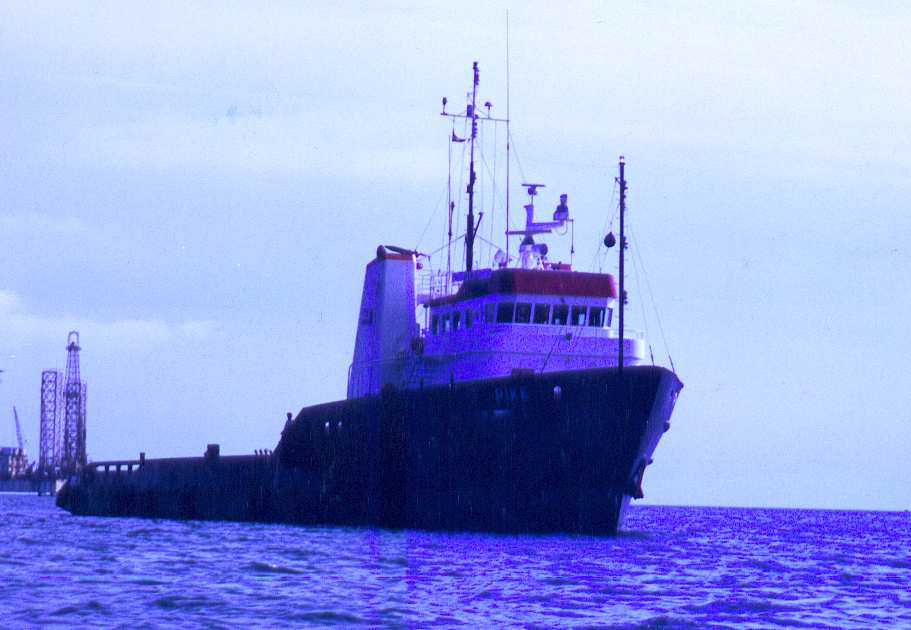
Photographs: The Gulf Fleet 36 photographed back in 2002 by Oddgeir Refvik in the Gulf of Mexico, and the Pikephotographed in West Africa by Fergus Mack in 1999.
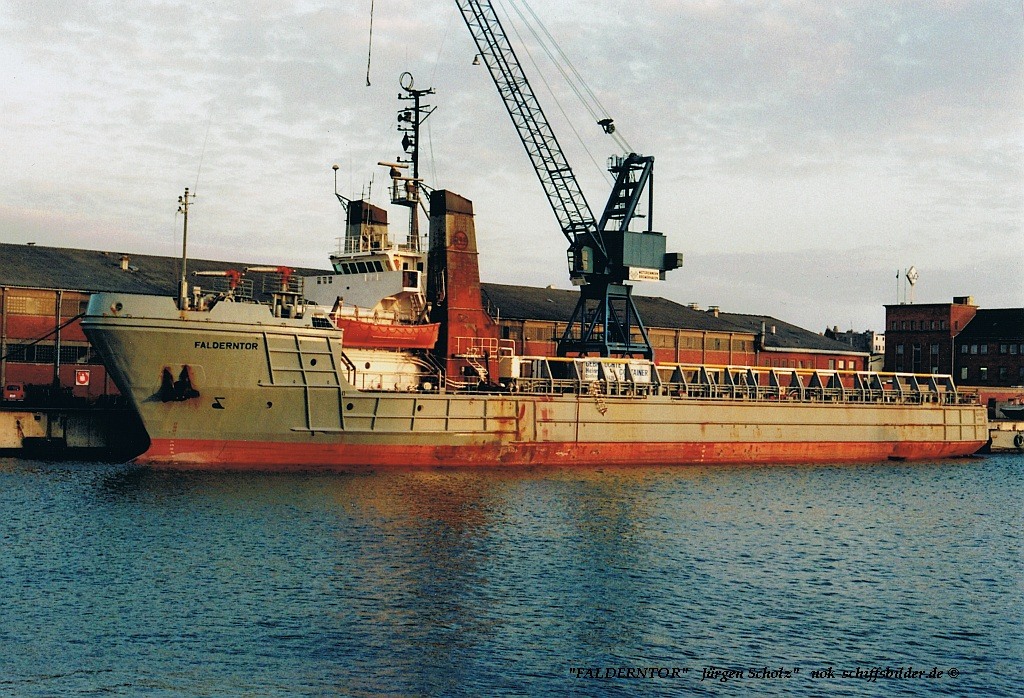
When it comes to ground breaking craft some names will keep cropping up, and one of those in the early days was OSA (the Offshore Supply Association) who really put money into their designs. We have already been amazed at their manifestation of an anchor-handler and in 1977 the industry was equally set back on its heels when the OP7000, appeared in the form of the Falderntor, the Huntetor, the Kaubturm and the Kreusturm. These ships, in a similar manner to the anchor-handlers, took into consideration the windage created by substantial accommodation blocks and the effect of waves breaking over the bows when under way and so the accommodation was low, and the bridge set well back behind the high bow. Also like the anchor-handlers the funnels were positioned on either side of the bridge so that the driver would have an unimpeded view of everything aft when he was at the controls. They had probably been designed as “three length” pipe carriers, and incidentally the company had already commissioned numerous “two length” pipe carriers, but by the time they appeared in 1977 they immediately became platform supply ships. They were almost 80 metres long but were slim in the beam, being just over 15 metres wide. This gave them a deck area of 580 m2. Their two engines developed 6000 bhp and they were provided with two 600 bhp bow thrusters and two 300 bhp stern thrusters. They were also very early vessels with the “bathtub” main deck, so that the cargo and the people working on it were protected by tanks on the port and starboard side and the stern. Later in their lives they had the bathtub decked in, so that tanks of various sorts could be installed underneath, and the freeboard was now such that the cargo and the people working on the deck were above the waves anyway. The four ships have had numerous owners, possiby the Falderntor having the most exciting history, since after a serious fire it re-entered service as the Gulf offshore’s North Prince and would go on to be owned by Nomis and then by Vroon where it became the VOS Prince. In 2011 it was sold to the French navy and renamed VN Partisan, and appears to be still serving as a submarine support vessel of some sort, with a load of accommodation modules on the deck and a helideck at the aft end. The Kreuzturm eventually became the Sable Sea owned and operated by the Canadian shipowner Secunda Marine Services mostly in the North Sea. It appears to have been broken up in Portugal in 2013, and the Kaubturm and the Huntetor have remained with the OSA fleet owners, firstly OIL and then Tidewater, and both might still be afloat somewhere, in a creek, bayou or sheltered Carribean bay.

PHOTOGRAPHS: The Falderntor in 1988 (apparently shortly after its fire) by Jurgen Scholz and the Sable Sealeaving Aberdeen in 2001 by Victor Gibson.
Some years ago I attended a Nautical Institute annual conference which was held in Aberdeen, what transpired got me thinking and this article was the result.
There were a number of interesting presentations dealing with such things as BRM and HELM. By now we all know about Bridge Resource Management is, since it is usually flagged up by accident reports, but HELM was new to me and is Human Element Leadership and Management, and apparently it requires training.