


Uncategorised
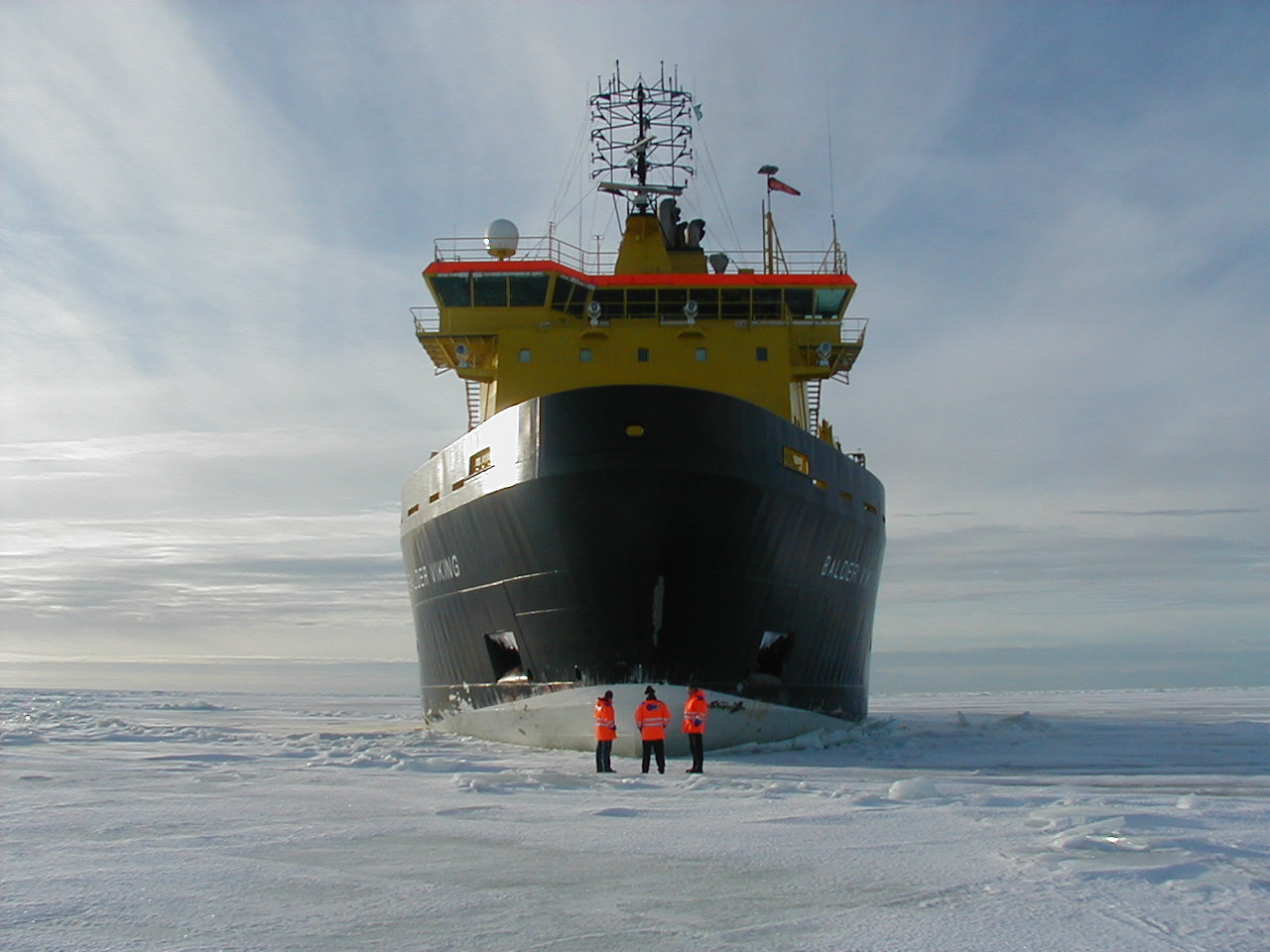
Back in the 1970s a Norwegian company known more for its colour scheme than anything else was Viking Supply Ships, whose craft were painted in black and yellow diagonal stripes. One, the Edith Viking featured on the first rig shift I ever went on in about 1977 and I was struck by its paint job. Later another of the company ships, the Ben Viking, was hired by a film company to take part in the movie “North Sea Hijack” which featured, in addition to the delightfully painted ship, the British actor Roger Moore (who died last Tuesday). If this was a film blog I would say more. Like many OSV companies Viking have had their ups and downs and in their lifetime have had other names, and for a while we thought that the striped ships were toast, so we were cheered when the Tor Viking II and the Balder Viking (Photographed in the ice by Bart Trondsen in 2004) arrived in Aberdeen in 2000. They were KMAR 808s, and only recently I reviewed the KMAR 404 probably as different from the 808 as chalk from cheese. They were designed in the marine architects house owned by Kvaerner, which had been Maritime Engineering and actually was to become Moss Maritime…but more of that company later. The first two 808s were followed in 2001 by the Vidar Viking. They were all constructed at Kvearner Leirvik and were intended to double as commercial anchor-handlers during the summer, and if requested, as Baltic ice-breakers during the winter, and in their icebreaker role they would be fitted with a V shaped extension at the stern, and a helideck in the middle of the main deck. The V shape would enable them to pull commercial vessels close up to their sterns, and then they would steam ahead breaking the ice and dragging the cargo ship behind them. As anchor-handlers they were provided with four MAK engines providing them with 18,300 bhp and 200 tons bollard pull and for the purposes of keeping them free of ice they were provided with pumping systems and wing tanks which could create a 10 degree list in 20 seconds. From the start they proved popular with operators and for all three to be together at any time proved to be a rare occurance (although captured on film by the author in Aberdeen in 2001). As well as working in the North Sea and the Baltic they have been out to Sakhalin and also to Alaska in support of potentially icebound exploration drilling. Today, in what might be described as an extremely competitive offshore environment they are still proving popular, the Tor Viking II and the Balder Viking currently being engaged in a North Sea rig shift, although the Vidar Viking is laid up, and may only be reactivated at the end of the year, one assumes in time to engage in icebreaking activities.


We might be wondering by now what Maersk have been up to since one of their vessels was last described in this feature, which was the Maersk Fighter which entered service in 1992. They had actually been building a number of anchor-handlers derived from the ME 303, designated the ME 606 and then the ME 909, mostly known as the Maersk B Class. These designs were to culminate in what was known as the Maersk A Class, starting with the Maersk Assister in 2000 (Photographed entering Aberdeen in 2001 by George Craigen). The class was larger and more powerful than anything Maersk had so far produced and were briefly the most powerful and probably the largest anchor-handlers afloat at 90 metres long; they contained nine decks between the main deck and the bridge but no elevator. The four MAK engines produced 23,500 bhp, giving them a bollard pull of 278 tons and the multiple forward and aft thrusters were capable of providing 6000 bhp sideways. All these systems could be controlled by a DP2 system provided by Kongsberg. The winch which was electrically powered, a Maersk innovation while everyone else was still putting their faith in low pressure hydraulics, was capable of a pull of 625 tons, leading the manufacturers of fabricated anchors to issue guidance as to how much force should be used to get them over the roller, this after the ships had bent a few. In addition, when they came out, a workdrum capacity of 12000m x 84mm wire, and a capacity of 2600m x 84mm wire, was claimed for each of the two tow drums, although I have noticed that ship-owners are tending not to tell us about drum capacity these days. However, I have been on board the Maersk Assister and can confirm that the winch is very large indeed. In typical Maersk style the whole thing is housed in a great big hanger and is viewed from the bridge on CCTV. The problems of paying out the wires under tension, which had made previous attempts to power winches electrically impractical, has apparently been overcome by using electrical resistance and dissipating the heat through vents on either side of the winch space. The Assister was followed into service by the Maersk Achiever, the Maersk Asserter and the Maersk Advancer in 2003 and the Maersk Winner in 2004, all of them being constructed at the Volkswerft yard in Germany. In order to make them suitable for multiple activities the ships have accommodation for 60 people and several have subsequently fitted with large cranes for the field maintenance activities. The Winner in particular was fitted with a 200 tonne crane capable of working at depths of 2000 metres when it entered service and has accommmodation for 86 people.


A previous design featured in this series was the ME 303 developed by Maritime Engineering in Norway. This company was taken over Kvearner in the late 1990s and their first offering under the KMAR designation was the KMAR 404, several of them being constructed in 1998 at the company yard at Leirvik and a further three at their Kleven facility. The ships were not really ground-breaking and are noteworthy more for their early distribution and their history than for their capabilities. They were powered by two Wartsila diesels offering 15,000 bhp giving them a bollard pull of about 180 tons, and with two thrusters forward and one aft, they had adequate manoeuvrability. But in an age which was beginning to require winches with massive wire storage, with their rather moderate capacity of 2000 metres of 76mm wire on each of their two drums, they were hampered. The first to enter service were originally owned by Sanko and Maersk but they were to pass rapidly from company to company, starting with Tidewater, who had collected six from the original owners. Typically the Leopard Bay was to become the William R Croyle, and the Maersk Dispatcher was to become the Ray J Hope (Fantastically photographed by James McLellan at work in the South Atlantic). So by now, as we are coming to understand, Tidewater were updating their fleet with second hand European tonnage. However they were not standing still, and in 2004 a new company, set up in Norway by former executives from Viking Supply, managed to purchase all six of the Tidewater 404s. In addition they bought one which had been owned by Bourbon; this last vessel had started out as the Havila Charisma (Photographed entering Aberdeen by the author in 2002) and had become the Bourbon Charisma. In addition to the vessels which had become the whole of the Deep Sea fleet two of the type were built at Kvaerner Kleven for District Offshore, as the Skandi Stord and the Skandi MØgster, and one which was to become the Lady Sandra was also built at the same yard. Despite the fact that the KMAR 404s were in no way super ships the Deep Sea Supply timing of their purchase seemed to be just right and there is little doubt that the vessels made a fortune for them during what we now recognise was an oil boom. During that time it seemed that operators were prepared to pay anything for anchor-handlers for what always appeared to be urgent rig moves. Back in 2007 I acted as a towmaster for a rig shift which employed three ships at a combined cost of £250,000 a day, and so the 404s made good money. Today they seem to have mostly migrated to the South Atlantic except for the Lady Sandra assigned by Farstad to it subsidiary IOS in Australia. In late 2016 this ship was sold to an undisclosed client, but the relevant internet sites indicate that the name has not changed, although it is now registered in India.
