

FERRY TRANSPORT

I have just returned from holiday spent at the northernmost point of the island of Sardinia where a ferry operation connects the small town of Palau with the island of Maddellena. There are a number of small car ferries operated by two or three companies, and we chose a company randomly and stepped onto the ferry together with the foot passengers ahead of the vehicles which were then loaded.
We had bought our tickets at a tobacco kiosk on the shore, but it seemed that the vehicles were loaded, and then during the passage across to the island the vehicle occupants bought their tickets in the saloon. Later, as we are leaving the ferry I noticed large packs of lifejackets encapsulate in transparent plastic inside a large locker, the door of which had been left open. And I was then prompted to have a look at the accesses to the interior of the ship, which might have included the engine room. All the accesses were open.
You can see where I am going with this, and actually the possibilities of the ferry sinking were probably pretty low. The only vessels of similar size in the area are other ferries, although there are large numbers of superyachts crossing their route. And actually the time on passage is about 20 minutes. But what if… In the event of a collision which put the edge of the car deck under water it seems possible that the free surface would have a major effect on stability, and if an access was submerged it could be glug, glug, glug. We would not know how many passenger were on board because they would still be buying tickets, and if the plastic wrapped lifejackets were to total required to be carried how could they be distributed?
So really should I have been travelling on this ferry having conducted my personal risk assessment and found the results unsatisfactory? It is a question I have asked before, and have not answered.
THE FOCOMAR ACCIDENT
A marine misfortune not really followed by even the marine press was the abandonment of the bulk carrier Focomar. The 2011 built bulk carrier left Djibouti on July 27th on its way to Singapore, but within a very short time suffered a breakdown, which resulted in the crew abandoning the vessel in a lifeboat, and sailing a small island off Socotra. Socotra itself is not really a very friendly place and its adjacent island was even less hospitable, consisting of little more than a rock standing out of the Indian Ocean. The crew were able to send a distress message, and were provided with food and water by an Italian warship which was a component of the EU anti-pirate force. Apparently they were subsequently rescued by a tug sent out from Djibouti by the ship’s owners. There are those of us who might think that it would be up to the first ship on the scene to rescue shipwrecked sailors – but in today’s world apparently not.
THE MV MISSISSIPPI

Readers of this newsletter will by now be aware that I enjoy reading and recording activities which take place, and have taken place, on the inland waterways of the United States, and it was therefore with some pleasure that I read a report reproduced in the Tugs and Towing Newsletter about the US Army Corps of Engineers flagship the Mississippi .
Its reason for being included was a reproduction of an article which originally appeared in the Tennessean about a visit to the city of Nashville by the craft. The reason for the visit was that it was transporting the “Mississippi River Commission” on a voyage of inspection of the work carried out by the Army Corps of Engineers on the river. The Commission, a presidentially appointed body, also hold meetings with the public.
The Commission had boarded the ship at Chattanooga, after which it made its way through, it seems, a very complex waterway system ending in the Cumberland River on which it made its way to Nashville. If you look at a map and try to trace the waterways connecting these two cities you can get an idea of how extensive the American inland waterways system really is.
In the article there was also a picture of the Captain at the controls, and it appears that like many river tugs it has three engines and three propellers, in this case each of 2100 bhp. Other interesting statistics are the facts that the vessel has a dining saloon which can seat 85 people and a conference room capable of seating 115.
The task in which the ship is engaged when not carrying the Commission is the moving of barges carrying materials intended to stabilise the banks of the lower Mississipp
THE GROUNDING AND SALVAGE OF THE APL PANAMA
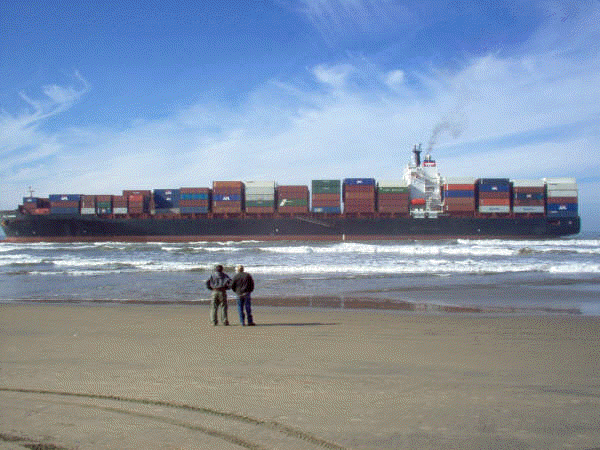
While thumbing through the pages of the Nautical Institute Seaways the other day I found myself reading, and rereading the report of a talk given to the Hong Kong branch regarding the salvage of the container ship APL Panama, and on googling the name found out what an extraordinary event this had been, particularly since the ship was eventually refloated undamaged after two and a half months.
The course of the event starts maybe with a west coast longshoreman’s strike which was taking place during the winter of 2005, and this resulted , probably, in the container trade using the port of Ensenada in Mexico, just a few miles to the south of San Diego. From there they were able to transport the landed containers by road into the USA. So it has always been. Cargo owners will always find some way of circumventing the limitations caused by industrial action.
Ensenada is a holiday destination as well as being a substantial port, with pristine beaches extending towards the south from the town, which itself is fronted by the harbour. Since the harbour entrance itself is also on the south side, the approach to the port will probably be from a southerly direction.
So enter the APL Panama which was making its way towards the port on the afternoon of December 25th 2005. The vessel was crewed by Croatian officers and crew from Myanmar. And as ship was approaching the pilot station, the Mate called the Captain, who according to all accounts, was tardy in reaching the Bridge. In some accounts there is a reproduction of the exchanges between the Chief Officer and the Captain as the former tried to point out to the latter the location of the Pilot Boat and the buoyage system in the approach to the port. The Captain seems to have failed to register this information and this resulted in an attempt to make a turn away from the channel to make a new approach. But there turned out to be insufficient sea room and the vessel grounded at high tide just off the main beach of the town.
It seems that the master immediately attempted to deballast the vessel to get it back into the water, but this was unsuccessful, and rather than the ship being refloated it was pushed further up the beach by the waves, and immediately a bank of sand began to build up on the seaward side.
Two days after the grounding the salvors arrived to take stock of the situation and their team included the person who gave the lecture to the Hong Kong branch whose job it was to be to deal with the legal implications. However their presence did not allow work to commence immediately due to adverse weather, and it was to be three weeks before anything could be done. By this time the ship was 450 metres from deep water, and as the photos on the internet revealed not far from the beach which would, later in the year, be redolant with bikini clad lovelies sunbathing on the sand.
A variety of possibilities were considered including pumps on the deck – too high, a dredger to seaward – too expensive, and tugs washing away the sand with their propellers – too dangerous, and so finally they reluctantly had to settle on discharging the bunkers and then the containers.
First it was necessary to find a way of getting the fuel off, and the salvors judged that they would not receive permission to build access from the beach to the side of the ship for the road tankers, and so waited until a holiday weekend was taking place and then laid a road, connected up the ship to the road tankers with a long flexible and in this way discharged 3500 tonnes of fuel oil. Once this had been done a further attempt to refloat the ship using tugs was made. It was unsuccessful but the bow of the ship was moved thirty degrees further to seaward.
Thereafter it was decided to attempt to unload the containers using a sky crane – another word for a large Russian helicopter, and so one was employed and succeeded in discharging 1900 tonnes of containers. However the Mexicans refused to allow the equipment required to keep the aircraft in the sky into the country and so it had to return to US terrotory every night. They also attempted to charge import duty on the helicopter every time it entered the country, which seemed to have required the Hong Kong speaker, Mike Mallin, to exercise the full extent of his negotiating powers.
A futher extention of this plan was for the employment of a “puller barge” sourced in Alaska which provided an additional 800 tonnes of bollard pull. At this time observers who live in the city of Ensenada were commenting on a variety of internet sites, letting the world know what was going on. They were also suggesting a number of innovative means of fulfilling the salvors requirement, which was we should remember, to get the ship back into the sea.
Finally the local authorities allowed the salvors to build a proper road to the ship’s side from the beach, which allowed them to put a large mobile crane alongside, which set too to discharge the containers onto road transport. And once a sufficent area of the deck had been cleared, two crawler cranes were put up there to move containers within reach of the big crane on the shore. Meanwhile, possibly following a suggestion from one of the inhabitants of Ensenada, the salvors had decided to drill holes in the double bottoms and fit an air blowing system in order to blow sand away from the bottom of the ship.
Once all the cargo had been discharged, and the bunkers removed, and the sand blown away from the immediate vicinity of the hull, the ship was pulled back into the sea. It was two and a half months after it had grounded, leaving only a deep depression in the sand – for which the salvors were later fined by the Mexican authorities.
WELL STIMULATION

During last month the marine media reported on the sale of the veteran former pipe carrier Skandi Fjord, and since I have managed not to address any offshore matters, despite the low oil price and the shipowners in crisis, I can say a few words about an offshore activity.
The Skandi Fjord has been chartered for many years by Halliburton and has had all sorts of tanks welded to its decks since it has been used as a well stimulation vessel.
Halliburton and others have been marketing well stimulation for many years, as a means of putting new life into old oil wells.
If we think of the area round the end of the production casing as a sort of honeycomb filled with oil it is evident that over time the spaces may become blocked up with solids. When this happens the operators may choose to try to revive the rate of production by having all sorts of noxious fluids pumped down the well at high pressure.
On shore the equipment can be assembled alongside the well. It is also possible offshore for the equipment to be lifted onto the platform or oil rig, but the easiest way is often to get a ship alongside with all the stuff on board, connect up a hose and go to it.