
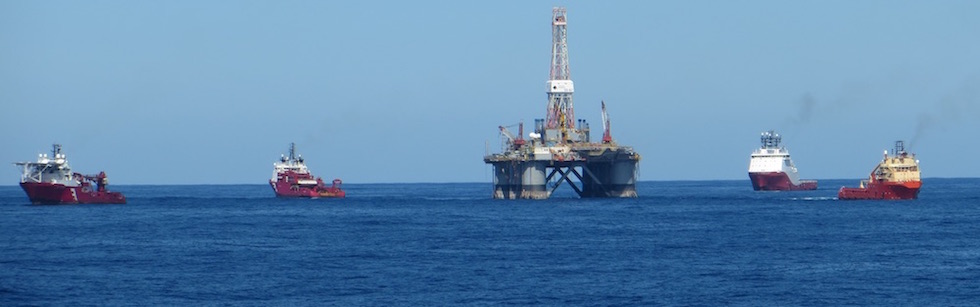

THE A TURTLE INCIDENT
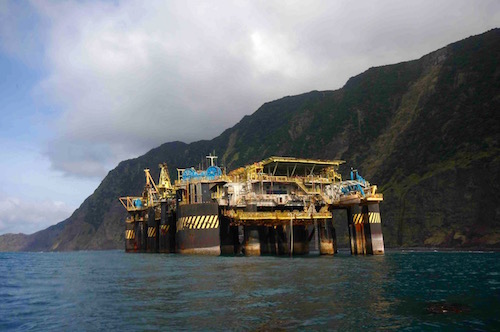
I am now collecting photographs for my book of offshore accidents, and wanting to illustrate failed towing operations I needed a photo of the “A Turtle”, and contacted the Tristan da Cuhna post office, which put me in touch with the compiler of the island’s newsletter. He sent me a number of photographs one of which was this shot of the rig crouching under the cliffs of the island.
A Turtle was once the Petrobras XXI, and before that some sort of North Sea rig, and in 2006 it was being towed from Rio to Capetown by the Mighty Deliverer, when the towing vessel ran short of fuel, and as a consequence released the A Turtle into the wilds of the South Atlantic. Since my book deals with accidents, how they occurred and what the pitfalls might be in the future, I included some details about the towing vessel which despite a reported power of 15,200 bhp and a bollard pull of more than 150 tons apparently only used about 3.5 tons of fuel a day. Anyone who has ever been involved in the operation of oil rig towing will know that there is something wrong here, and if the numbers were true everyone would want one of these ships.
The rig was not seen again for 200 days, that is until some inhabitants of Tristan da Cuhna were looking for some lost cattle when they came across the rig aground at the eastern edge of the island.
A salvage company was employed to remove the wreck, and to do this they needed to remove hundreds of tons of steel from the deck of the unit before eventually towing it away and sinking it in deep water.
THE LEITH MARINE OFFICE
Back in August of this year the Leith Marine Office was closed, and so marked another milestone in the reduction of the British involvement in activity of going down to the sea in ships. A summary of the life of this office was sent to me by a friend who had been Surveyor in Charge back in 2001, and who had ben present at a celebration of its existence at the time of the closure. Marine Offices used to be important because they housed the surveyors of marine craft, and importantly for seafarers the Examiners of Master Mates, and Engineers. For non mariners it is difficult to explain the tension involved when a visit to the local marine office might be required for the “Orals”. British professional mariners are required to attend the Marine Office to spend an hour or so with an examiner being quizzed on their knowledge of the rules and regulations extant at the time of the exam. For Second Mates for instance the examiner would concentrate on the collision regulation, and for the Mate’s exam more likely the carriage of cargo, and for Masters the whole business of keeping people alive in the marine environment. The Leith office had been in operation since 1850, carrying on the tradition started by Samuel Pepyes, who recognised that navigators need to be trained.
THE SEARCH FOR MH370
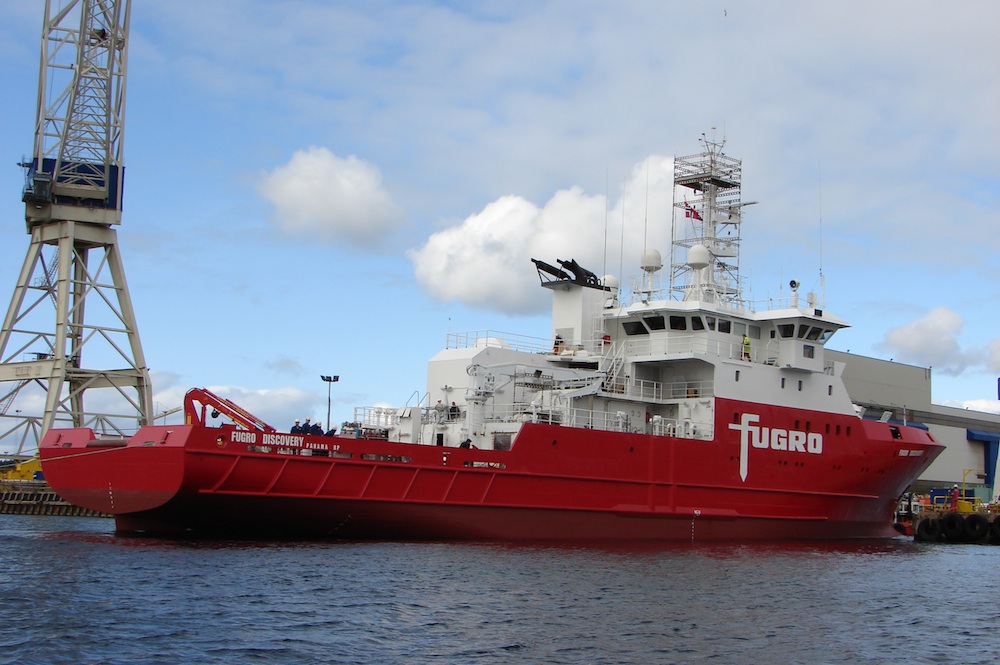
The Fugro Discoverer. Photo jan Plug
An article appeared in the Western Australian earlier this month which reminds us that the search for the Malaysia Airlines Flight MH370 is still going on.
Some ships have been stood down, but two Fugro ships are still engaged in the search. These are the Fugro Discovery and the Fugro Equator. They have been struggling with the winter weather in the South Atlantic but now with the approaching better weather they may be able to use an autonomous underwater vehicle.
The intent of the on-going search is that they will revisit what are known as “classification two contacts”. And the article goes on to explain this part of the search.
Apparently “classification two contacts” are those which according to the newspaper article are “those contacts which are of more interest than classification three contacts but still unlikely to be significant”. And hence they would be of lesser interest than “classification one contacts” which would warrant immediate reinvestigation.
The resurvey will be conducted using the deep tow sonar system at a lower altitude and a higher frequency. And with the improving weather the autonomous vehicle may be deployed, which will swim down all on its own and check out the seabed.
Apparently the first AUV was developed in 1957, despite the fact that they appear to be space age technology. Some were used to search for the crash site of the Air France Flight AF447 in the South Atlantic, and successfully recovered its black box. They were the Remus 6000 three of which were used to search for the remains of the aircraft.
THE CIDADE DE SAO MATEUS ACCIDENT
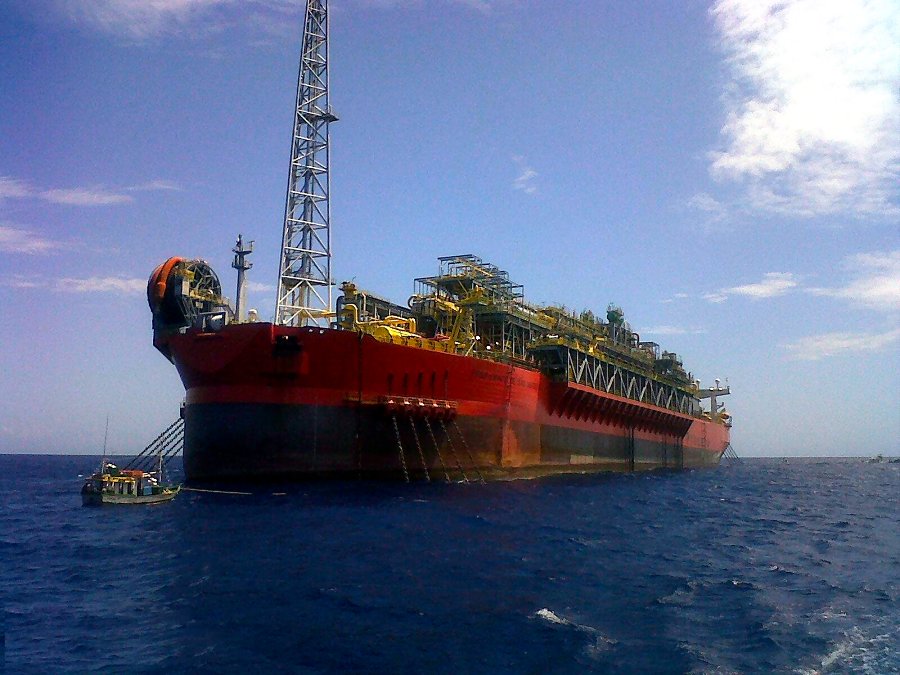
The Cidade de São Mateus on location. It can be seen that it is located by 16 moorings and that the offtake tanker will hang off the bow, probably held at the stern by a tug. This is the most basic FPSO arrangement. Photo borrowed from an FPSO related site.
The other day my attention was caught by an article concerning the status of the FPSO Cidade de São Mateus, which had suffered from an explosion and fire in early February this year. So, back in the summer, three months after the February explosion the unit was still in the field and still waiting for the crude oil in its tanks to be discharged to a tanker. The owners BW had said that a tanker was in the field ready to take on the oil. Despite quite an extensive search on the interweb the actual status of the FPSO today was not in the public domain.
The search on the internet also revealed that the FPSO was once a VLCC , the Maersk Navarin, and that it left Keppel Shipyard Singapore in December 2008, having been converted by the addition of 20,000 tons of processing equipment so that the unit was to be capable of processing a mixture of gas and hydrocarbons. The gas was to be piped directly to the shore, and the liquid hydrocarbons stored in the ship’s tanks until an offtake tanker was in position to uplift the cargo.
This article also featured an internal Petrobras HSE alert which described what had happened on the day, and which identified the accident as a leak of condensate in a Pump Room.
Apparently within the pumping system there was a termination in the pipework which was secured with a blank flange. Plus, under normal circumstances when transferring liquids from one tank to another, or in this case changing the destination of the liquid from one tank to another it would be customary to open the valve in the new destination tank, before closing the valve in the tank currently in use. This would ensure that there would be no unwanted build-up in pressure in the system.
But the valve to the tank in use was closed before the valve to the intended destination was opened. (Elsewhere in the HSE Alert it is stated that somewhere there was a “retention valve”, effectively a check valve which needed to be reversed). But anyway, this naturally resulted in the pressurisation of the line, and in this case the failure of the blank flange which did not have a pressure rating commensurate with the rest of the system. And though we might imagine some guys in boiler suits down there, sweating in the tropical heat as they turned big wheels, actually probably a guy in the Control Room pressed a couple of buttons.
When the valve to the destination tank was closed, with the pump still operating the line was pressurised and there was a condensate leak. While under pressure condensate is liquid, a mixture of various hydrocarbons, but out in the open air it become a vapour or a gas. Hence probably the Pump Room was more or less filled with vapour and gas. There were a number of gas alarms, locating the existence of gas in the Pump Room. At this point some sort of emergency action should have been taken to make the ship safe, but it is probable that those in charge had no idea what to do. And despite these alarms the management of the unit chose to send a group of workers with tools and cleaning materials into the Pump Room, to locate the source of the leak, secure the pipework and to clean up the space.
At this moment readers might be experiencing some sort of déjà vu. But surely we are revisiting the P36 accident they might be thinking, when a low pressure system was accidentally pressurised, and then some people were sent to the space and … yes – unfortunately for the people sent to the space there was an explosion, which in this FPSO resulted in the deaths of nine people and injuries to 26.
The investigation made some recommendations and considered that the what happened was due to the absence of a procedure for this operation, and that even though the risk assessment for the unit had determined that there was a risk of explosion in the Pump Room, there was no procedure in the emergency plan which would guide those on board as to what to do.
There is a lot of noise on the internet about the manner in which personnel are recruited and supplied to FPSOs offshore Brazil, with contributors making claims that anyone can buy certification and that people with no skills at all are sometimes bought certificates and provided with jobs offshore on the basis of personal connections rather than competence and/or experience.
But why don’t we go back to the P36 which some will remember was fitted with a drain system and tankage which, due an unexpected combination of events, resulted in a tank being overpressured and exploding and this resulted in the deaths of eleven people and the eventual loss of the unit. The company carried out an investigation which was informally presented to the world as a PowerPoint presentation and which contained some recommendations. Or since it was the company doing the investigation and making the report, what was presented might have been actions. Their report recommended the initiation of technical training, particularly because the procedures for emergencies were deficient.
In the case of the Cidade de São Mateus accident there was no publication of the investigation report, and it is fortunate for those who have an interest in the saving of life internationally that a local organisation “GI News Service”, managed to get a look at the HSE Alert. Some media services attempted to get a comment from Petrobras or BW but no-one was talking. In view of the level of incompetence, negligence or both, this is hardly surprising.
THE TALE OF THE MUSKETIER
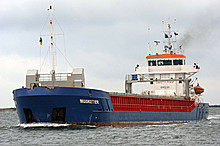
Back in 2011 a small cargo ship the Musketier ran aground on the coast of the Pas-de-Calais, thereafter managing to refloat itself. But the authorities directed it to anchor in the “Dick area” (no kidding) and it was then inspected by an assessment team. The ship was seen to have a crew of seven, and it was identified that the master had been asleep for 80 minutes before the grounding. He and the mate were on a four on four off, eight on eight off schedule. The company was recommended to “put in place a complement and bridge organisation consistent with the type of vessel and her activity”. The ship then continued to go about her business.
Now the Musketier is back in the news again, since it was observed crossing the traffic separation scheme in the channel and it was necessary for a helicopter to be sent out to land a man on the deck so that he could go and wake the captain.
Apparently the Gibraltar registry is going to carry out an investigation which, according to the report on the front page of the Nautilus Telegraph, will take several months.
The news report also says that there were now eight people on the ship. These were, three Filipinos, four Russians and one Ukrainian. It would have been good to have known what positions they held.