
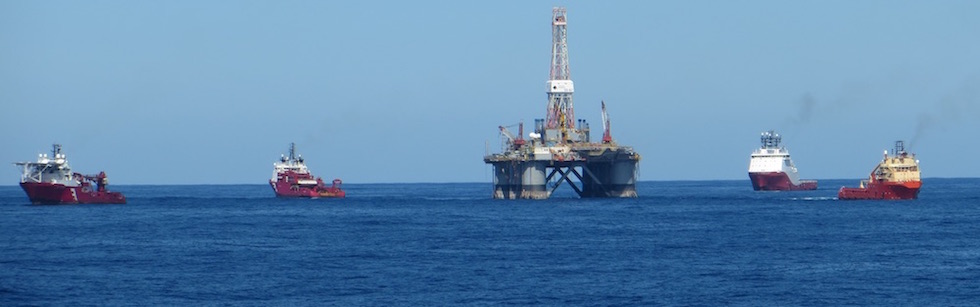

A CASUALTY OFFSHORE AUTRALIA
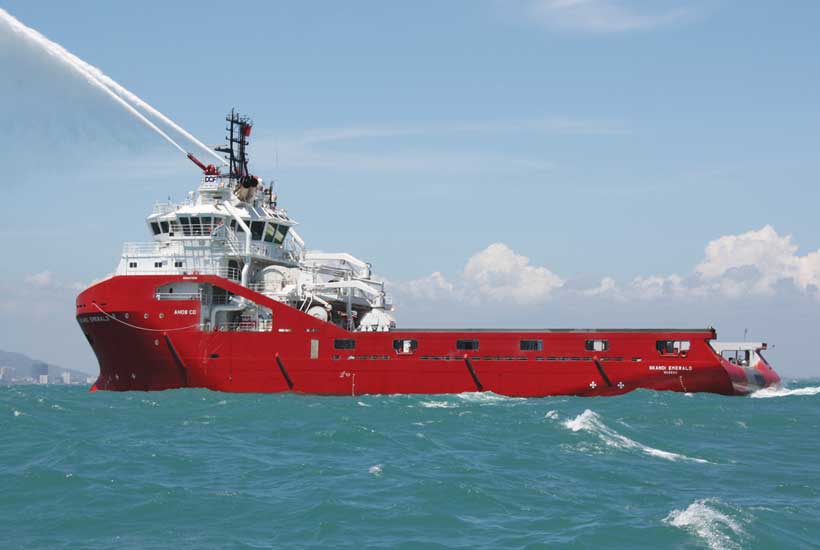
The Skandi Pacific. Photo Skipsrevyen
A number of Australian newspapers, and thereafter the marine press, reported that on 14th July a seafarer on board the DOF anchor-handler Skandi Pacific was crushed by a mini-container while attempting to re-secure cargo on the main deck of the vessel. As anyone who has been out there will tell you working on the deck in adverse weather can be dangerous, and really should be avoided if at all possible, particularly if there is cargo floating about.
The UK MCA have issued a variety of safety notices over the years to address this particular problem, one of them saying that there should be someone stationed at a level about the deck to advise those below when a big wave is coming. And actually there are ways of minimising the risk, but both the Captain and the deck crew need to be extremely experienced.
This leads me to a statement from the Australian Maritime Union saying that this unfortunate event should be a wake-up call for those in the government who advocate the deregulation of the crewing of ships in Australia, which currently requires all offshore vessels working there to be crewed by Australian nationals. There is to be an investigation by the Australian Transport Safety Board which no doubt will identify how the accident occurred, and what the experience of those on board the ship was. But back in 2007 after the capsize of the Bourbon Dolphin, those of us who were carrying out inspections of vessels about to undertake offshore work, were impressed by the experience of the Filipino deck crews. Many of them had spent 20 years in the business, some for the lifetime of the vessels on which they were serving. In fact no other deck crews had such depth of experience, so here-in is an opposite argument to that presented by the MUA. Perhaps allowing world wide recruiting would make things safer.
THE SUEZ CANAL EXPENSION
The operators of the Suez canal have tested their new super canal by sending two large ships South and one North, a couple of days ago. The enhanced canal will allow vessels to pass both ways over the whole of it length, as opposed to some ships being required to anchor for a time while those going the other way pass, and therefore requiring a convoy system. Obviously if ships can pass each other then no convoy system will be required and so maximum flexibility, beloved of all ship operators, will be possible. Apparently the official opening will take place in early August. So no more the wait in Port Said where the seafarer would be plagued by the riffraff from the sewers of the port, trying to sell doubtful or illegal products or invading the accommodation to steal what they could. Indeed it took a recent visit to Cairo for me to find that the Egyptians are really lovely people who I have now come to respect.
THE DAMEN 6711 YACHT SUPPORT VESSEL
We have become used to boggling at the vast size and reputed luxury of the yachts owned by the very rich people in the world.
There have always been some about, and back in the days when the glitterati mixed with the European Royal Families they would vie with each other as to who could have the most celebrated guest list. Queen Elizabeth, when Princess Elizabeth carried out a world cruise on board the Shaw-Saville passenger ship the Gothic, which might be taking things a bit far since she and her husband had it all to themselves. And it only takes a minimum of research to find pictures of the Duke of Windsor and Mrs Wallis-Simpson leaning over the rail of the Narcissus, now the Malahne, built in 1937 by Camper and Nicholson.
But by now things have changed. Gone are the days when owners and their guests were happy with a couple of games of deck quoits before retiring to the afterdeck for gin and tonic. Today they want to be able to race on jet skis, go scuba diving from a suitable support boat, and to get to and from the yacht by helicopter. But they don’t want the sleek lines of their craft to be marred by the stowage space this would require. So step forward the support vessel.
For a while supply ship owners offered their redundant craft for conversion into support vessels, and actually they seemed to fit the task pretty well, that is until the arrival of the Axe bow. I have always had a bit of a soft spot for this design, and now Damen have produced the ultimate version, the 6711 (don’t know what the numbers refer to) which is delightfully sleek and comes complete with helideck ,which apparently has a lift which allows the helicopter to be lowered into a hanger. Fantastic stuff if you have the money.
AN OIL RIG DISASTER IN 1957
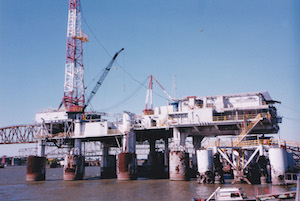
The Mr Charlie, probably similar the the Mr K
The drilling barge Mr K was “an uninspected mobile drilling platform”. The unit consisted of a hull on which were mounted a number of columns, which were topped by a deck which supported the drilling derrick, the accommodation, the helideck and a storage area for tubulars and chemicals, and within which was storage for mud, the pumping systems and the generators. It had been designed and built by the Bethlehem Steel Company, in 1956, for drilling in water depths not exceeding 14 feet (4.25 metres). The unit was 164 feet (50 metres) long and 54 feet (16.5 metres) wide. Ballast tanks in the lower hull allowed it to be floated, and sunk to rest on the seabed. There were also tanks in the hull for fuel, ballast and fresh water. The derrick was located at the stern and below it in the lower hull was a slot which allowed drilling to take place. It was owned and operated by Golden Meadow Well Service Company.
There were two tugs employed to move the rig from its location. The first, the Itco II was a 63 foot (19.2 metres) diesel tug built in 1956 and owned by the Independent Towing company the second, the Madeline was an almost identical vessel owned by Franklin Towing Company and chartered by Otto Candies. Neither of the tug masters were formally qualified and they had limited experience of towing drilling barges in the open sea.
On April 15th 1957 the barge was positioned on a prepared bed of sea shells in order to carry out drilling activities. The derrick was raised in its operational position and the barge was loaded with tubulars and equipment for its forthcoming drilling programme. The liquids in tanks were estimated at being between one foot and three feet (less than one metre), with the fuel tank being two thirds full. The fresh water tanks which contained about three feet (one metre) of water were interconnected by open valves. The estimates of the volumes in the tanks were based on the times when the pumps lost suction. Although the barge was provided with sounding pipes, no soundings were taken, or actually had ever been taken.
The report says that the barge was “continuously occupied in the accommodation there-on”, and that there were five people sleeping at the time of the casualty. This remark reflects the situation in the gulf at the time, when the drilling facilities were in general close inshore and that many were not actually provided with living accommodation. The, the report accepted that there were 20 lifejackets, three life floats and a number of lifebuoys on board. The rig was not provided with a general alarm system or a Station Bill.
On April 16th adverse weather caused deformation of the foundation and therefore the charterers, the Humble Oil Company, decided that the barge should be moved to Joseph’s Bayou while this was rebuilt.
On April 17th at 0900 the barge was afloat with a draught of six feet (two metres). The derrick was in the raised position, even though the facility is available for it to be lowered. And 40 minutes later the tugs and the tow were making way at about three knots when the barge started to list to port. Two minutes later it capsized. Of the crew of 15, nine of the crew lost their lives and three were injured.
The investigation into the accident did not have a problem in determining the cause, which was loss of stability. The combination of a greater than usual deck load, the fact that the derrick was in the operational rather than stowed position, and the slack tanks in the lower hull was sufficient, they thought, to cause the capsize.
Since the barge had been moved several times before successfully, it appeared that the problem had been operational, and as the report says, approvals and inspections during construction will not eliminate operational errors stemming from a lack of knowledge of stability. The investigators suggested that there were particular problems during the time when the unit was being ballasted up or down, and that the barge had been designed for inland waters rather than for the unprotected seas of the Gulf of Mexico. They also determined that possibly the tug masters were under-experienced, and unqualified particularly since they had displayed a lack of knowledge of “piloting” and the use of the nautical chart.
It also became apparently during the investigation that the supervisory personnel on board the Mr K were primarily experienced in drilling, and that none were aware of the dangers relating to ballasting, de-ballasting and the operation of the vessel in open waters.
By then the industry and the regulatory bodies involved in the offshore business were studying these particular difficulties, and they suggested that any procedures and systems under development should be considered to be experimental. In fact, as a result of the studies a special committee representing the industry drafted a document called “Manual for Safe Operating Practices for Offshore Mobile Drilling Platforms”. This was distributed in the industry for additional study and comment. This document when complete would contain guidance on stability, ballasting, de-ballasting, special hurricane procedures, manning, qualifications, supervision and responsibilities.
The investigators made a number of recommendations, initially in the short term pending improvements in the regulations and guidance, that none, or a very limited number of personnel should be on board these barges during tows, that the derrick should be lowered to the horizontal position at all times when under way and that a person with marine engineering experience and a practical knowledge of stability be required to be in charge of mobile platforms when preparing for and moving from one location to another.
More formally they recommended that mobile platforms at sea, but less than three miles from the coast should be subject to the same regulations as were in place for platforms on the Outer Continental Shelf, and that those regulations should be amended to include the approval of plans stability tests and inspections during construction.
AN ALLISION

Yes folks, this is an allision, which might be a sort of collision between a moving and a fixed object, in this case a cargo ship called the Majed and Randy, and this house on the Bosporus.
The picture takes me back to when I was a young Second Mate on a British tramp ship, visiting the Dutch island of Curacao to take bunkers towards the end of a round the world trip.
The captain was a very unpleasant man, who struck fear into all of us. He had the pale eyes of an Arctic sledge dog, and the temperament of a Pit Bull.
So there we were approaching Willemstad harbour late one evening which is accessed by means of a narrow channel. The captain was in charge on the bridge, there was a helmsman on the wheel, the apprentice was operating the telegraph and the mate and I were standing at the back of the wheelhouse with nothing to do.
As we approached the town it dawned on us that the captain’s eyesight was defective, and that rather than the channel he was heading straight for someone’s lounge. We said nothing but could see the people walking, about before he gave the order for a double ring astern. It seemed that we were only feet away before the ship took on stern way and pulled clear.
I still think about those people, and the shock they would have felt when they got the bow of a cargo vessel through their window.