

THE SCRAP HEAP

The Maersk Mariner working in Brazil in 2014. Photo Jan Plug
Trailing behind the list of oil rigs making their way to the breakers are numbers of offshore support vessels, some of them early Maersk anchor-handlers which in their day were state of the art, but even then complex and difficult to keep going.
Top of this list are probably the Maersk Master and Maersk Mariner, and it was reported the other day that the Maersk Mariner has gone to the breakers. These two vessels were a unique design, with a hatch forward of the accommodation and an open deck aft. Tucked in behind the accommodation was a winch with a vast wire capacity which made the ships very popular when it came to do deeper water rig moves before the turn of the century.
Offshore support vessels with cargo space forward are not unique, but they are very unusual. In the late 1970s OIL built the Oil Challenger which was a pipe carrier with the accommodation perched over the poop, but which turned out to be incompatible with the pipe layer for which it was constructed, the Viking Piper, and so was purchased by Heerema as a heavy lift carrier. More recently a few all aft platform ships the VS 493 Avants have been built, and apparently operated with some success.
These more recent constructions have been easier to operate because of the general availability of dynamic positioning to hold the vessels within range of offshore cranes. A DP1 system was used for a while on the Maersk M class in conjunction with some Shell platforms. This consisted of some sort of video recording system, which maintained the image in the same position. But apparently there was a tendency for the ship to change position when the crane lift passed through the picture. My own theory is that the design was intended to accommodate the stuff which oil rigs had to unload to get up on the pontoons for a shift, because in the 70s it all had to carted ashore, but by the time the ships entered service the rigs had mostly been modified to carry a bigger deck load.
THE CAPTAIN'S COLUMN
We seem to have an ongoing need to record what is happening to ship masters who have made errors resulting in loss of life on board their vessels, and this month the prosecution in the case of the Costa Concordia accident has asked that the Captain be sentenced to 26 years in prison. The admission by the Moldovan dancer who was on the Bridge at the time of the accident that she and the Captain were lovers, on the threat of being charged herself, might not have done him any good, but he will have to wait until after his defense lawyers final statement on 9th February to find out what his actual fate may be. The news articles which have made this information available on the internet have also stated that none of the other crew members who pleaded guilty and who were sentenced to periods in prison are actually serving time. For me this is slightly reassuring, they were essentially innocent bystanders when the Captain took charge.
THE SHANNON E SETTON

The Shannon E Setton in Fire. Photo US Coast Guard
Here’s a thing. You would hardly expect to be trucking along, pushing a barge and making way towards a crude oil storage facility when you hit something, and in no time at all you ship has exploded
This is another story from the inland waterways of North America, which it is quite difficult to believe. The tug and barge set was partially loaded and hence was in its way to a storage facility in Bayou Perot to complete the job. The Captain made for the facility which was three tanks mounted on a barge in the end of what was described as “North Canal”.
But as the tug was approaching the end of the channel the Captain saw some objects in the water and altered course. Immediately the tug hit an underwater obstruction, and there was a disturbance in the water. The tug had hit a gas pipeline. There was an explosion as the main engines took in the gas, followed by a fire which engulfed the tug. Two of the crew made it to the barge, another crew member and the Captain swam to the shore. The Captain was badly burned and died about a month later in hospital. The US NTSB report contains the following information:
Numerous active or abandoned oil and gas pipelines traverse this Louisiana region. When installed the pipelines are surveyed to ensure that they are buried at the appropriate depth. However, over time their coverage can decrease due to storms shoreline changes etc, which makes voyage planning challenging…Many pipelines in the region do not appear on standard navigation charts and mariners do not know their exact locations.!!! (My exclamation marks)
A EARLY OIL RIG DISASTER

The Mr Charlie Built in 1955. Probably Similar to Mr K. Photo Kenny Polson.
The drilling barge Mr K was according to the report “an uninspected mobile drilling platform”. The unit consisted of a hull on which were mounted a number of columns, which were topped by a deck on which was mounted the drilling derrick, the accommodation, the helideck and a storage area for tubulars and chemicals, and within which was storage for mud, the pumping systems and the generators. It had been designed and built by the Bethlehem Steel Company in 1956 for drilling in water depths not exceeding 14 feet. The unit was 164 feet long and 54 feet wide. Ballast tanks in the lower hull allowed it to be floated, and sunk to rest on the seabed. There were also tanks in the hull for fuel, ballast and fresh water. The derrick was located at the stern and below it in the lower hull was a slot which allowed drilling to take place. It was owned and operated by Golden Meadow Well Service Company.
There were two tugs employed to move the rig from its location. The first, the Itco II was a 63 foot diesel tug built in 1956 and owned by the Independent Towing company the second, the Madeline was an almost identical vessel owned by Franklin Towing Company and chartered by Otto Candies. Neither of the tug masters were formally qualified and they had limited experience of towing drilling barges in the open sea.
On April 15th the barge was positioned on a prepared bed of shells in order to carry out drilling activities. The derrick was raised in its operational position and the barge was loaded with tubulars and equipment for its forthcoming drilling programme. The liquids in tanks were estimated at being between one foot and three feet, with the fuel tank being two thirds full. The fresh water tanks which contained about three feet of water were interconnected by open valves. The estimates of the volumes in the tanks were based on the times when the pumps lost suction. Although the barge was provided with sounding pipes, no soundings were taken, or actually had ever been taken.
The report says that the barge was “continuously occupied in the accommodation there-on”, and that there were five people sleeping at the time of the casualty. This remark reflects the situation in the gulf at the time, when the drilling facilities were in general close inshore and that many were not actually provided with living accommodation. Although there was some disagreement amongst the survivors, the report accepted that there were 20 lifejackets, three lifefloats and a number of lifebuoys on board. The rig was not provided with a general alarm system or a Station Bill.
On April 16th 1957 adverse weather caused deformation of the foundation and therefore the charterers, the Humble Oil Company, decided that the barge should be moved to Joseph’s Bayou, while it was rebuilt. This resulted in a requirement to move the rig the following day and by 0900 it was afloat with a draught of six feet and two tugs attached, but to everyone’s surprise at 0940, it rapidly capsized and remained afloat upside down.
Subsequent to the capsize Coast Guard aircraft and vessels searched for survivors. These included one fixed wing aircraft, two helicopters and two patrol boats. Although the investigation does not precisely how those who survived were rescued, or how the bodies of those who died were recovered, some detail of the manner in which the upturned barge was returned to port is included, but is unimportant in this narrative.
The investigators did not have a problem in determining the cause of the accident, which was loss of stability. The combination of a greater than usual deck load, the fact that the derrick was in the operational rather than stowed position, and the slack tanks in the lower hull was sufficient, they thought, to cause the capsize.
Since the barge had been moved several times before successfully, it appeared that the problem had been operational, and as the report says, approvals and inspections during construction will not eliminate operational errors stemming from a lack of knowledge of stability. The investigators suggested that there were particular problems during the time when the unit was being ballasted up or down, and that the barge had been designed for inland waters rather than for the unprotected seas of the Gulf of Mexico. They also determined that possibly the tug masters were under-experienced, and unqualified particularly since they had displayed a lack of knowledge of “piloting” and the use of the nautical chart.
It also became apparently during the investigation that the supervisory personnel on board the Mr K were primarily experienced in drilling, and that none were aware of the dangers relating to ballasting, de-ballasting and the operation of the vessel in open waters.
By then the industry and the regulatory bodies involved in the offshore business were studying these particular difficulties, and they suggested that any procedures and systems under development should be considered to be experimental. In fact, as a result of the studies a special committee representing the industry drafted a document called “Manual for Safe Operating Practices for Offshore Mobile Drilling Platforms”. This was distributed in the industry for additional study and comment. This document when complete would contain guidance on stability, ballasting, de-ballasting, special hurricane procedures, manning, qualifications, supervision and responsibilities.
The investigators made a number of recommendations, initially in the short term pending improvements in the regulations and guidance, that none, or a very limited number of personnel should be on board these barges during tows, that the derrick should be lowered to the horizontal position at all times when under way and that a person with marine engineering experience and a practical knowledge of stability be required to be in charge of mobile platforms when preparing for and moving from one location to another.
More formally they recommended that mobile platforms at sea, but less than three miles from the coast should be subject to the same regulations as were in place for platforms on the Outer Continental Shelf, and that those regulations should be amended to include the approval of plans stability tests and inspections during construction.
THE PIETER SCHELTE
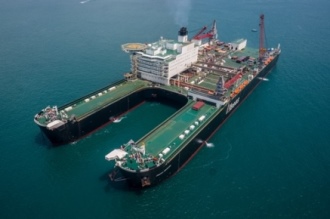
The Peter Schelte During its Departure from Singapore. Photo Allseas Publicity.
I have been saving the Pieter Schelte for a piece of good news since most of what I publish in this newsletter is anything but. The ship recently arrived in Rotterdam, and probably has done nothing yet. It is not all good news though. If you type the name into Google you get articles suggesting that the man after whom the ship is named was a Gestapo officer.
But lets just check out the dimensions of this craft , and be amazed. It is 382 metres long excluding the pipelay stinger and 124 metres wide and has 95,000 kW available which is about 129000 bhp. It has berths for 571 people.
Its lifting capability is awesome – yes it actually is awesome. It can lift a platform topsides weighing 48,000 tonnes and a jacket (the part of the platform in the sea) weighing 25,000 tonnes.
As a secondary activity the ship is capable of laying pipe with its 210 metre stinger fitted, and it can store 25,000 tons of pipe on the deck. This capability makes it the largest and most powerful pipelayer in the world, and far exceeding the capabilities of the Solitaire, also operated by Allseas which previously held this record.
From an operational view-point one assumes that everything it is supposed to do remains a theory, and that someone will have written an Operations Manual based on the probable activities and what the equipment is designed to do. It would be interesting to see whether the reality matches the theory when the ship enters service.